Paintings of Degaldoruwa Temple: An Amateur’s Views-by Avishka Mario Senewiratne
Source:Medium
A few days ago, I was in Kandy, a city I return to often. As is my habit, I carried a book with me and spent part of the commute reading Siri Gunasinghe’s 1978 work An Album of Buddhist Paintings from Sri Lanka, Kandy Period. In its pages, I came across a brief note on the Degaldoruwa Temple. A quick look at the map showed that it lay only fifteen minutes from the Radisson Hotel where I was staying. The urge to visit came at once.
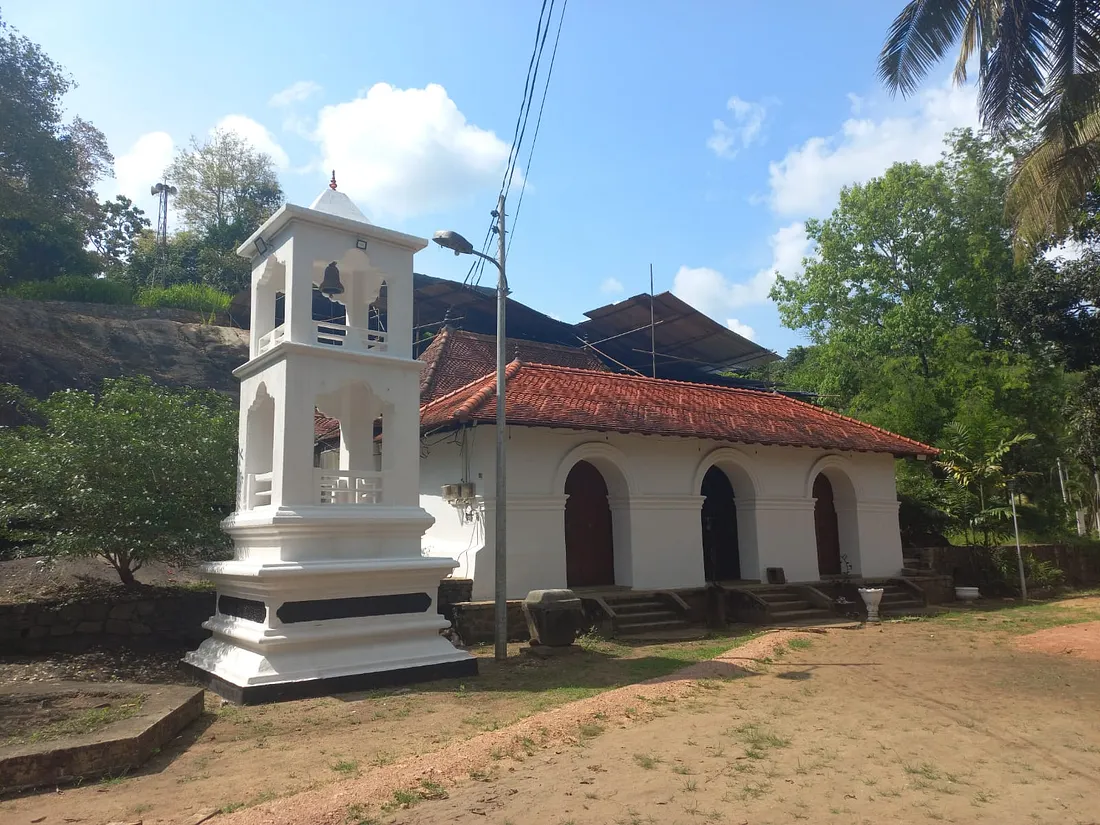
Entrance to the Degaldoruwa Temple
Though usually closed, I was fortunate to find the temple accessible that day. Degaldoruwa Podi Hamuduruwo kindly opened its doors and began to explain the history and meaning of what lay before me. Every nook and corner of the rock temple held something that drew the eye and demanded attention.
Through Gunasinghe’s work I learnt that the paintings of the temples at Degaldoruwa, Gangarama, Medawala, Lankatilaka, Ridivihara and Dambulla represent a few of the best examples of the central Kandyan style. (Gunasinghe, 1978) The royal patronage received by these temples was a contributory factor towards the artistic superiority of those paintings. The influence of this renaissance in painting during the Kandyan period centered around one man: King Kirthi Sri Rajasinha. A. C. Lawrie in his monumental work A Gazetteer of the Central Province of Ceylon translates Degaldoruwa Sannasa as follows:
“When His Great Majesty King Kirti Sri Rajasinha, descended from the ancient royal lineage of Mahasammata and belonging to the Suriyawansa, reigned with equity and justice in the city of Siriwardanapura, known as Senkadagala Nuwara, his fame spread throughout the land. Endowed with immense wealth and pure wisdom, and having won the affection of his subjects, His Majesty caused new temples, dagabas, and images to be constructed, while also restoring those that had fallen into disrepair. Through these acts, he actively fostered and strengthened the Buddhist religion.” (Lawrie, 1898, Volume 1, p. 139)
As John Holt notes, Kirti Sri deliberately used temple art as a means of articulating a “classical” Buddhist identity, reinforcing both religious devotion and royal legitimacy (Holt, 1996).
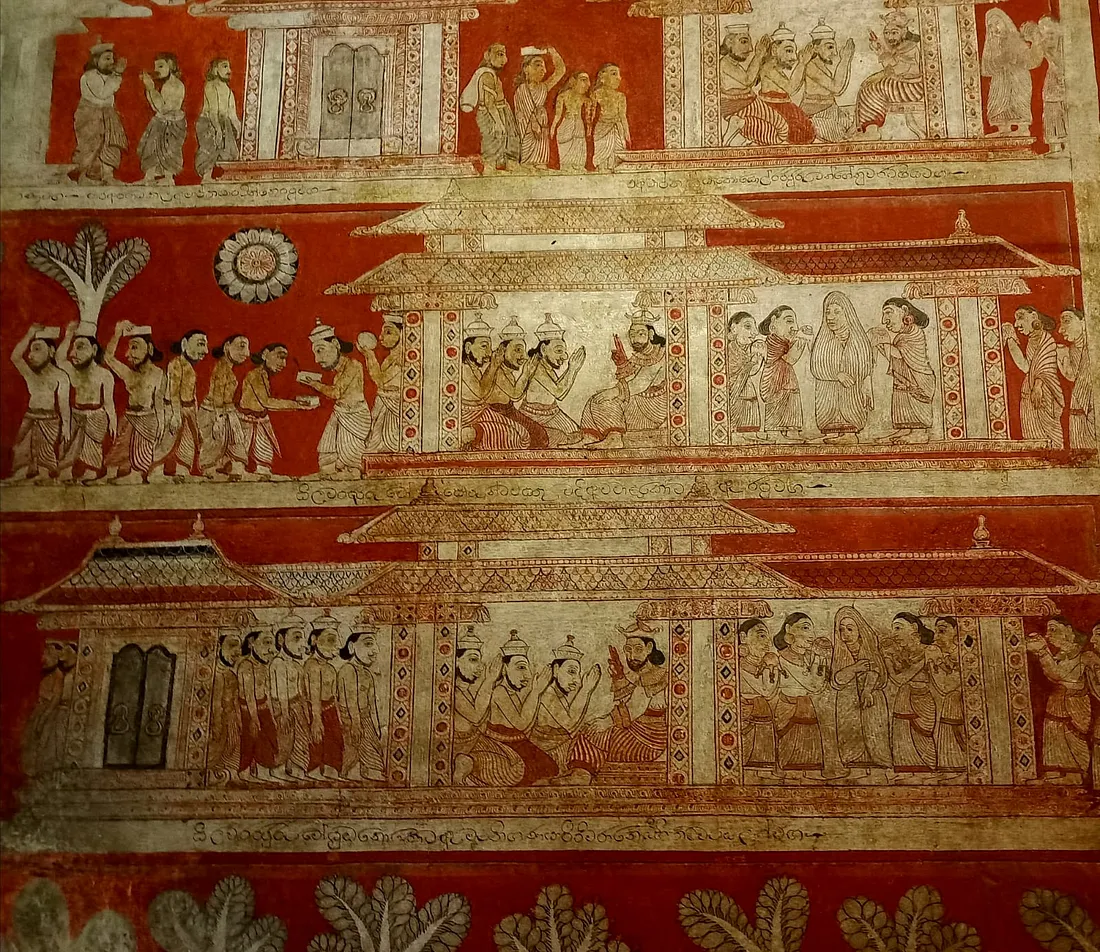
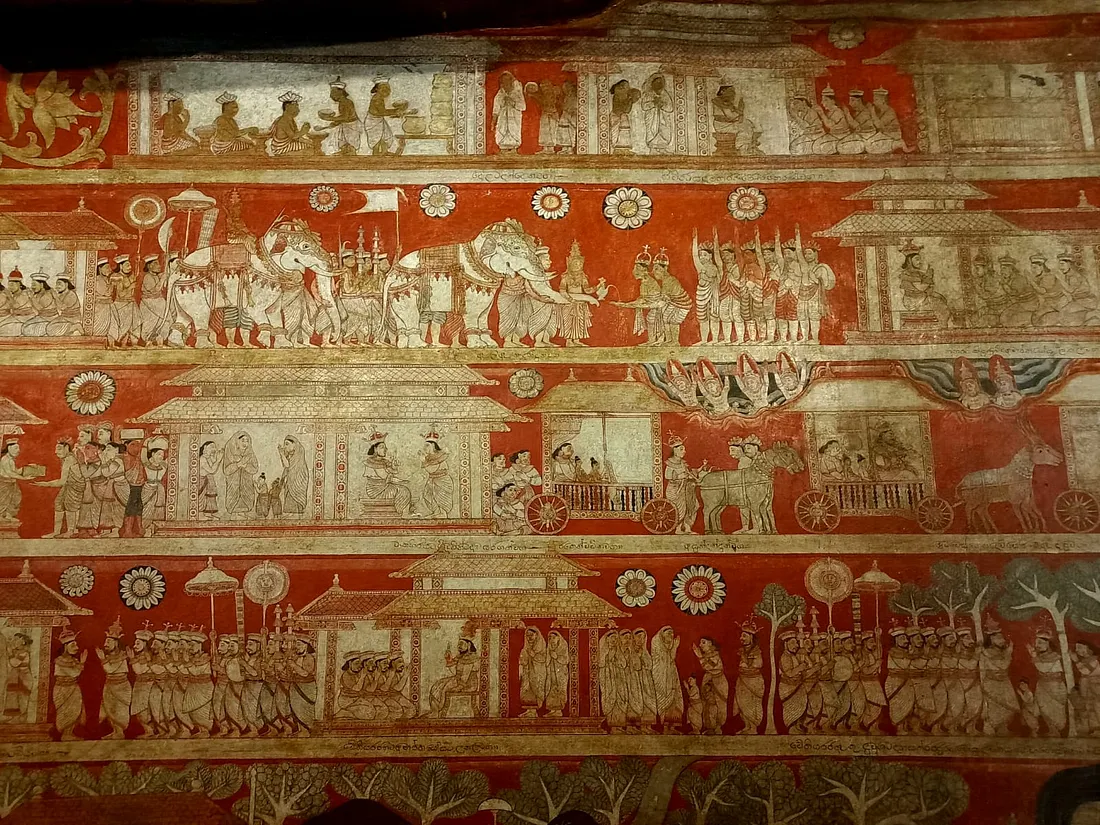
The compositions are marked by flat application of colour, a limited palette, and a strong sense of decorative rhythm, where figure and space are arranged with clarity and purpose. These paintings are not merely aesthetic works, but visual expressions of a structured religious world.
The murals depict key episodes from the life of the Buddha, most notably The Battle with Mara, alongside a series of jataka stories including Vessantara, Sutasoma, Silava, and Sattubhatta. In doing so, they function as a form of visual teaching, conveying moral and doctrinal themes to a largely non-literate audience. Holt’s reading of Kandyan temple art as a “visual liturgy” is particularly relevant here, as the paintings guide the viewer through a narrative of Buddhist truth and kingship (Holt, 1996).
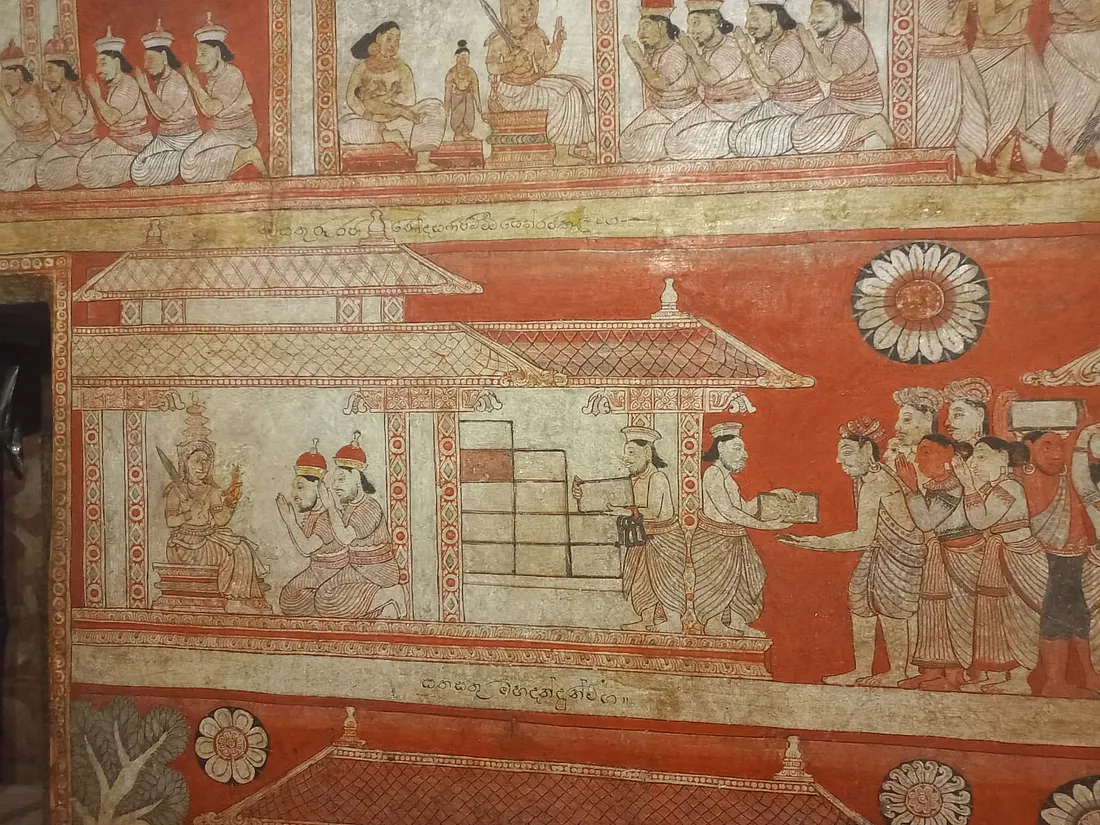
Thus, Degaldoruwa is not simply a painted shrine, but part of a larger cultural and religious statement. Through patronage of such temples, Kirti Sri Rajasinha aligned himself with the long tradition of Buddhist kingship, using art, ritual, and architecture to re-establish a classical order that would endure beyond his reign.
The leading art historian, Dr. Ananda Coomaraswamy was deeply intrigued by Kandyan period paintings, especially those at Degaldoruwa. In his magnum opus, Medieval Sinhalese Art, he states the Kandyan painters used a limited but carefully prepared range of pigments. White was derived from hydrous magnesite, while red, the dominant ground colour, was imported cinnabar. Yellow came from gamboge or orpiment. Black was made as lamp black using jak milk, oil, and resin. Blue, from indigo, was rare, and green was simply a mixture of blue and yellow. Gold was occasionally used, likely imported from Siam. Shades were sparingly applied, as the aim was flat, controlled decoration rather than depth or realism. (Coomaraswamy, 1979, p. 164)
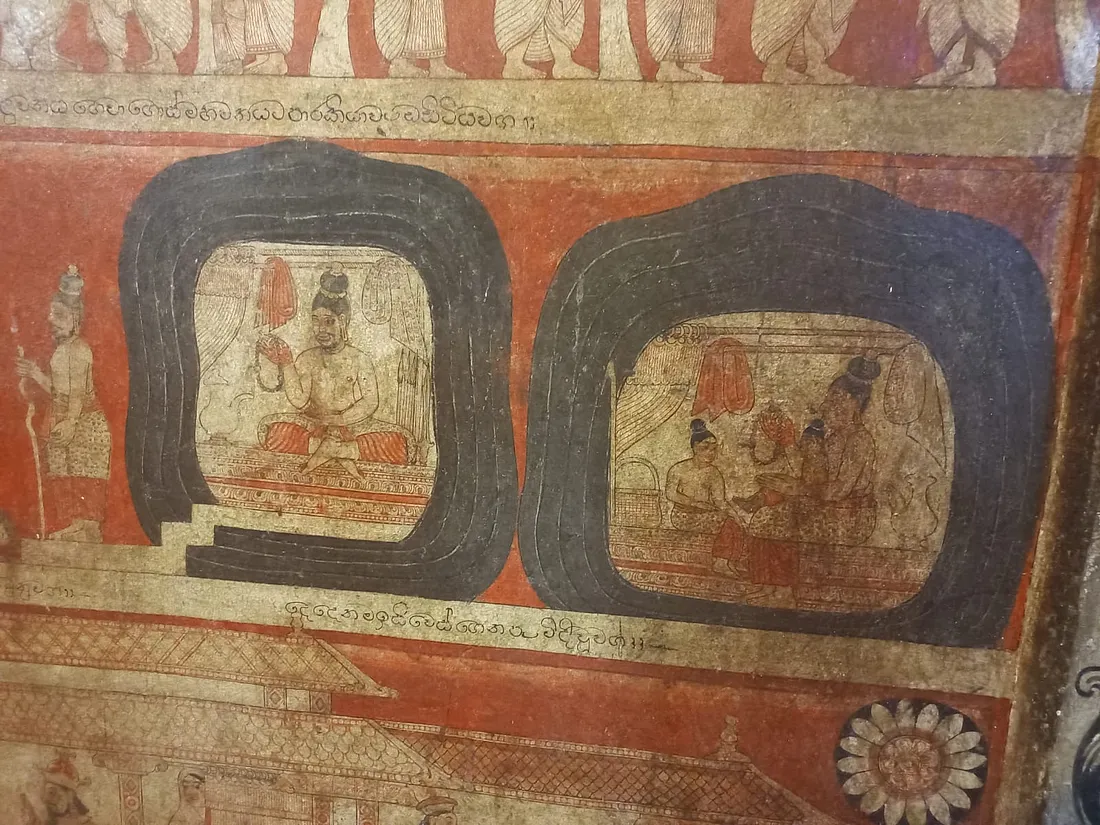
The cave temple paintings, started around 1771, represent one of the finest surviving examples of central Kandyan style. Unlike earlier periods, where individual artists are almost entirely unknown, the Degaldoruwa paintings preserve the names of several craftsmen. Four painters are recorded as having worked on the scheme: Nilagama Patabenda, who served as the chief foreman; Devaragampala Silvattenna, remembered as the most accomplished painter of his time; Koswatte Hitaranayide, to whom the Sutasoma Jataka is attributed; and another whose name has not survived. The work was carried out under the supervision of Moratota Maha Nayaka of Malwatte, indicating the close relationship between monastic authority and artistic production (Coomaraswamy, 1979, p. 168). This rare preservation of artistic attribution offers valuable insight into the organisation of temple workshops during the Kandyan period.
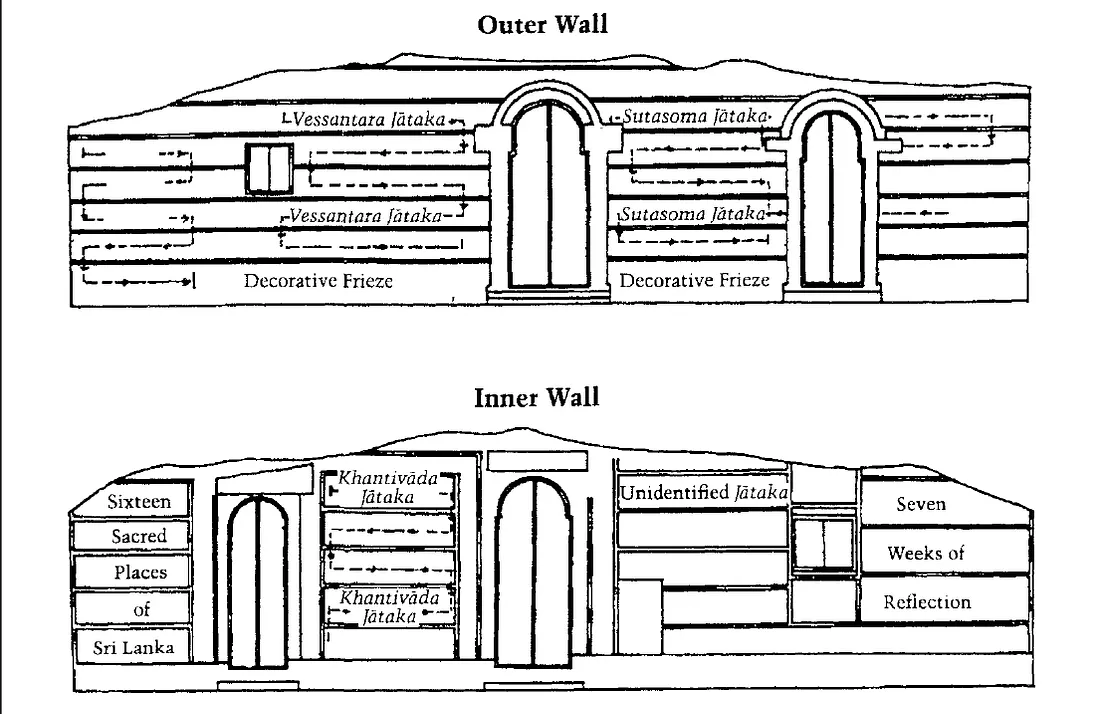
Image house in Degaldoruva; outer wall (top) and inner wall (bottom). [from John Holt’s The Religious World of Kīrti Śrī]
The paintings themselves are notable not only for their decorative appeal but for their documentary value. As has been observed, they are “priceless historical documents” that record with remarkable fidelity the material culture of the period, including royal attire, courtly insignia, domestic settings, and village life (Coomaraswamy, 1979, p. 168). Scenes such as the well in the Vessantara Jataka or the depiction of the king’s kitchen provide visual evidence of everyday practices that cannot be reconstructed from textual sources alone. In this sense, Degaldoruwa functions as a visual archive of eighteenth century Kandyan society.
In terms of subject matter, the murals are dominated by narrative cycles drawn from the Jataka stories and episodes from the life of the Buddha. Among the most prominent are the Vessantara, Sutasoma, Silava, and Sattubhatta Jatakas, each rendered in extended panels of continuous narration. This method, characteristic of Kandyan painting, presents successive moments of a story within a single visual field, with figures repeated in different contexts to indicate the progression of events (Coomaraswamy, 1979, p. 167). The effect is panoramic, requiring the viewer to follow the narrative actively across the surface. In addition, scenes such as the Buddha’s enlightenment and the Battle with Mara appear frequently, reinforcing core doctrinal themes of renunciation, temptation, and ultimate victory.
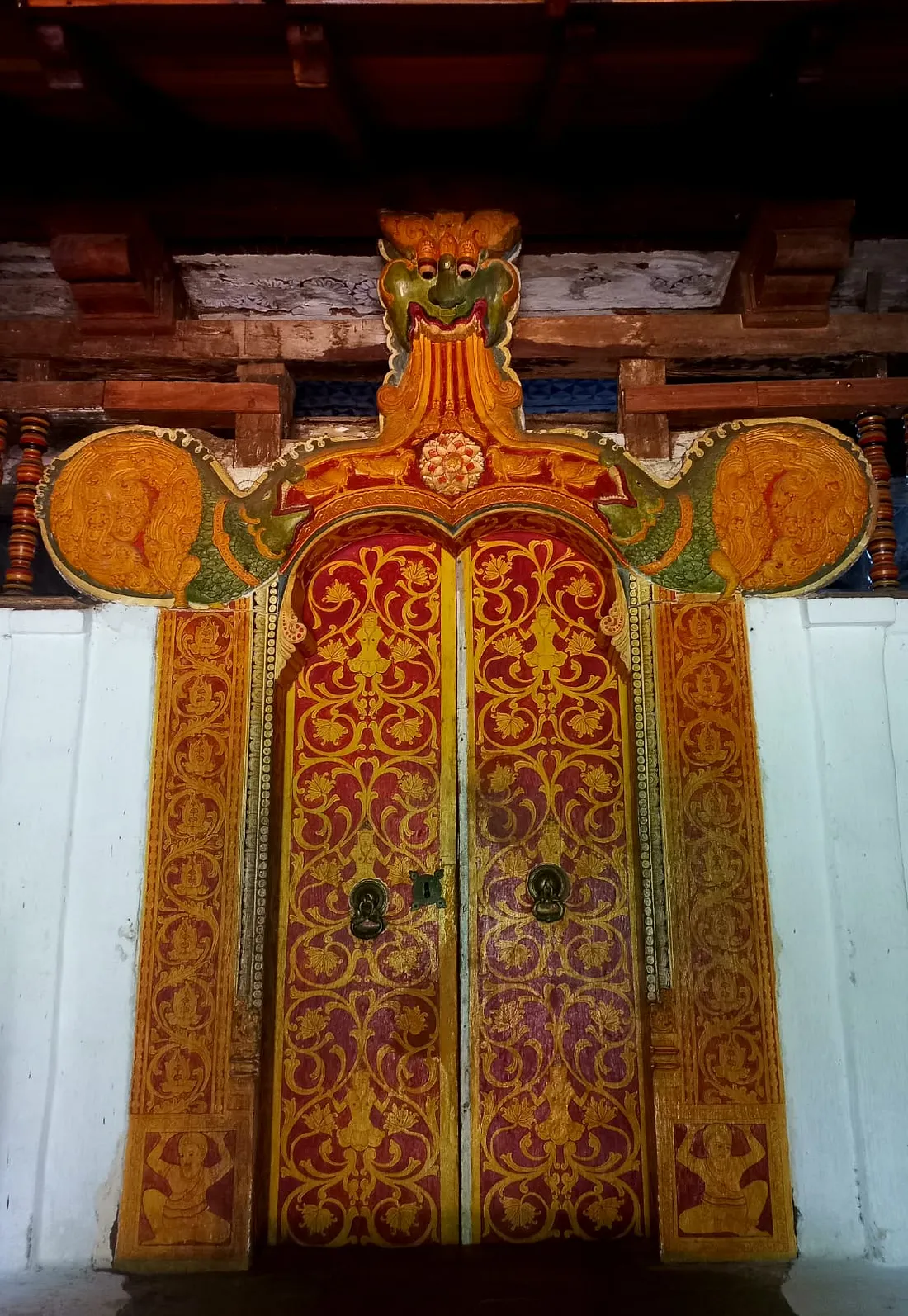
Stylistically, the Degaldoruwa paintings exemplify the essential features of Kandyan art. There is a deliberate absence of perspective and shading, with forms rendered in flat planes of colour and defined by strong black outlines. The palette is limited, typically employing red, yellow, white, and black, with blue and green used sparingly if at all. This restrained use of colour, combined with a clear emphasis on line and pattern, produces a decorative surface that prioritizes clarity over illusion. As the source notes, the primary aim of such painting is not naturalistic representation but the effective communication of an edifying story; the work is therefore “epic in character” rather than artistic in the modern sense (Coomaraswamy, 1979, 168).
Press enter or click to view image in full size
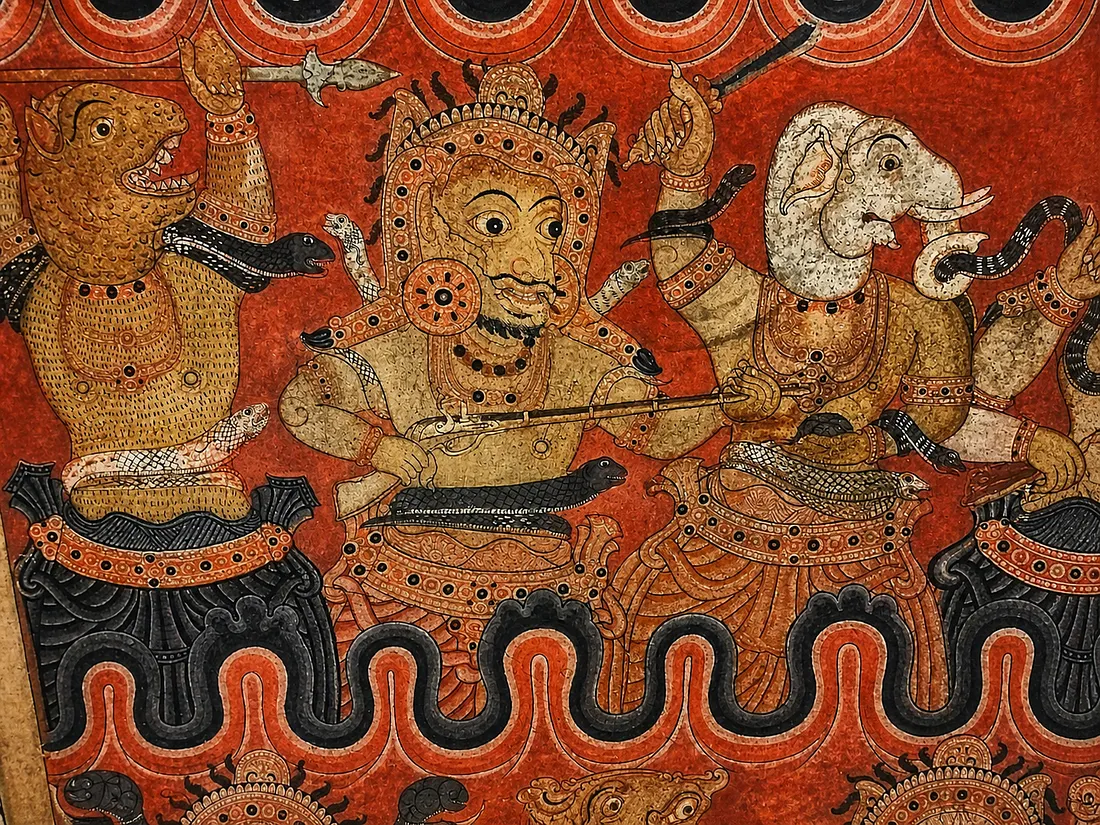
I have used AI here to enhance the colour tones as they may have been once for clarity
Above is one section in Degaldoruwa that attracted me. This remarkable mural reveals the richness of late Sinhala Buddhist art through its vivid colour, rhythmic design, and imaginative figures. Particularly striking is the inclusion of a firearm held by the central figure, reflecting the growing awareness and existence of European weaponry in Kandyan society. In essence, this is how tradition and foreign influence are blended into one dramatic sacred composition.
Conclusion
Thus, the Degaldoruwa Temple stands as more than a religious monument. It is a carefully conceived visual programme shaped by royal patronage, monastic oversight, and the skilled labour of hereditary painters. Degaldoruwa is not simply a series of paintings, but a disciplined way of seeing. Every figure, colour, and line is controlled to guide the eye and the mind. There is no attempt to imitate nature. Instead, the painter arranges a moral world where order prevails over confusion. The scenes do not just tell stories. They train the viewer to understand Buddhist truth through clarity, repetition, and restraint. Its murals embody a synthesis of devotion, narrative, and design, reflecting both the ideological aims of Kirti Sri Rajasinha and the enduring traditions of Kandyan artistic practice. In their combination of aesthetic discipline and narrative richness, these paintings remain among the most important expressions of Sri Lanka’s pre-modern artistic heritage.
References
Cave, H. W., (1907), The Book of Ceylon: Being a Guide to Its Railway System and an Account of Its Varied Attractions for the Visitor and Tourist
Coomaraswamy, Ananda K. (1979). Medieval Sinhalese Art. 3d ed. New York: Pantheon Books.
Cowell, E. B. (1895–1913). The Jataka; or, Stories of the Buddha’s Former Births, 6 vols. London: Luzac and Co., for Pali Text Society.
Gunasinghe, Siri (1978). An Album of Buddhist Paintings from Sri Lanka (Ceylon) (Kandy Period). Colombo: National Museum of Sri Lanka.
Holt, John, (1996), The Religious World of Kīrti Śrī: Buddhism, Art, and Politics in Late Medieval Sri Lanka Front Cover, Oxford University Press
Lawrie, Archibald C. (1898). A Gazetteer of the Central Province. 2 vols. Colombo: George J. A. Skeen, Government Printer.
Malalgoda, Kitsiri (1976). Buddhism and Sinhalese Society 1750–1900. Berkeley: University of California Press.
Manjusri, L. T. P. (1977). Design Elements from Sri Lankan Temple Paintings. Colombo: Sri Lanka Puravidya Sangamaya.
Seneviratna, Anuradha (1983). Golden Rock Temple of Dambulla. Central Cultural Fund Publication, no. 14. Colombo: Ministry of Cultural Affairs.
All photographs are by Avishka Mario Senewiratne