Places to visit when you holiday in Sri Lanka
Source:- Dæhæna
We have started this series as a regular feature in the newsletter. We hope it will benefit you when planning your next visit to Sri Lanka. We also welcome your personal experiences, especially those that may not be found on popular websites.
Buduruwagala (බුදුරුවගල රජමහා විහාරය)
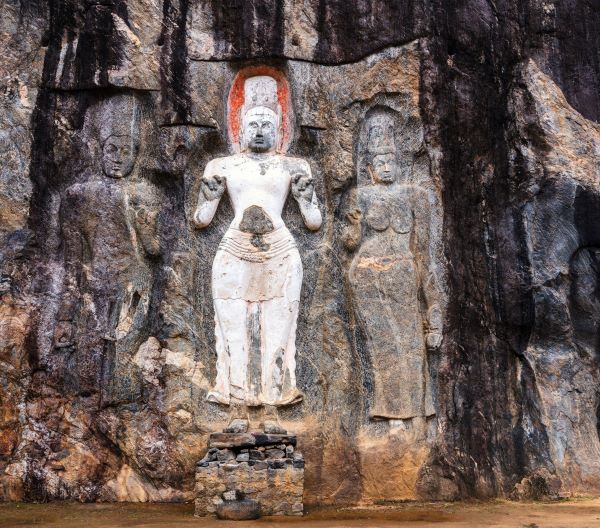
Buduruwagala is located approximately 5 km from Wellawaya along the Thanamalwila Road. The name Buduruwagala means “the rock with the statue of the Buddha.” True to its name, the site features seven rock-carved figures, dominated by a colossal 42-foot 8-inch (13-meter) standing Buddha statue in the Samabhanga gesture at the center. The rock itself resembles the shape of a kneeling elephant with its head lowered.
Origins of Buduruwagala
Although ancient texts make no mention of Buduruwagala, several scholars have proposed different dates for its origin. Dr. Paranavitana suggests the carvings date to the late 5th century, while Professor Dohanian places them in the latter half of the 7th century, and Professor Chandra Wickramagamage dates them to the 9th century.
The statues clearly belong to the Mahayana Buddhist tradition and reflect the Pallava–Sri Lankan art style, showing similarities to the carvings at Dowa Temple (Wickramagamage, 1990). Following the destruction of the Bamiyan Buddha statues in Afghanistan by the Taliban in 2001, the Buddha statue at Buduruwagala is now regarded as the tallest standing ancient Buddha statue in the world.
Interpretations of the Seven Sculptures
The central Buddha statue, standing in Samabhanga posture—a straight and balanced stance common during the Anuradhapura period—is surrounded by six other figures, three on each side. Above the statues, crevices in the rock indicate that a protective roof structure once existed.
On the left side, the central figure—24 feet (7.3 meters) tall—retains most of the ancient plaster and paint. This figure is believed to be Avalokiteshvara Bodhisattva, recognised by the small meditating Buddha image in his crown.
To his right is a 21-foot 8-inch (6.6-meter) tall bare-breasted female figure identified as Tara Devi, Avalokiteshvara’s spiritual consort. She is depicted in the graceful Thivanka pose (bent in three places) and wears an ornate tall headdress. Beside her is a 20-foot 3-inch (6.2-meter) figure believed to represent Prince Sudana, their son in Mahayana iconography.
However, H. C. P. Bell (1916) offered a different interpretation, suggesting that these three figures represent characters from the Vessantara Jataka—Brahmin Juthaka, King Vessantara, and Queen Madri.
On the right side of the central Buddha, three additional figures are found. The central figure here, 23 feet 6 inches (7.2 meters) in height, is thought to be the Maithri Bodhisattva, the future Buddha of this aeon. To the left is a 20-foot (6.1-meter) sculpture of Vajrapani Bodhisattva, an early Mahayana figure typically depicted holding a vajra (diamond club).
The final figure on the far right, standing 19 feet 7 inches (6 meters) tall, remains unidentified, though it is believed that it may represent either Vishnu or Sahampati Brahma, consistent with the Mahayana tradition. H. C. P. Bell (1916) believed these three figures to be depictions of the deities Kataragama, Maha Vishnu, and Saman.
Legends and Mysteries
A notable feature of the central Buddha statue is its broken nose, which local legend attributes to an English hunter. According to folklore, after shooting at the statue and damaging its nose, the hunter was attacked and killed by a wild elephant. It is said that his tombstone remained in the surrounding jungle until the mid-20th century, though its location is now lost to time.
The entire rock formation into which these figures are carved measures 305 feet in length and 70 feet in height. At the base of the Buddha statue lies a large, flame-shaped cavity in the rock that is mysteriously and perpetually wet with an oily substance said to resemble the scent of mustard oil.
Legend claims this cavity is connected to a sealed chamber inside the rock where a king’s treasure was hidden. Treasure hunters once attempted to reach this secret chamber using dynamite, resulting in a crack that now causes the healing oil from an inner rock-cut bath to seep to the surface. Today, pilgrims rub their hands on the oil emerging from the cavity and apply it to their foreheads, believing in its sacred and medicinal properties.
Courtesy: https://amazinglanka.com/wp/buduruwagala/