Spera Unveils South Asia’s First Homegrown Security Humanoid, Built by Sri Lankan Engineers
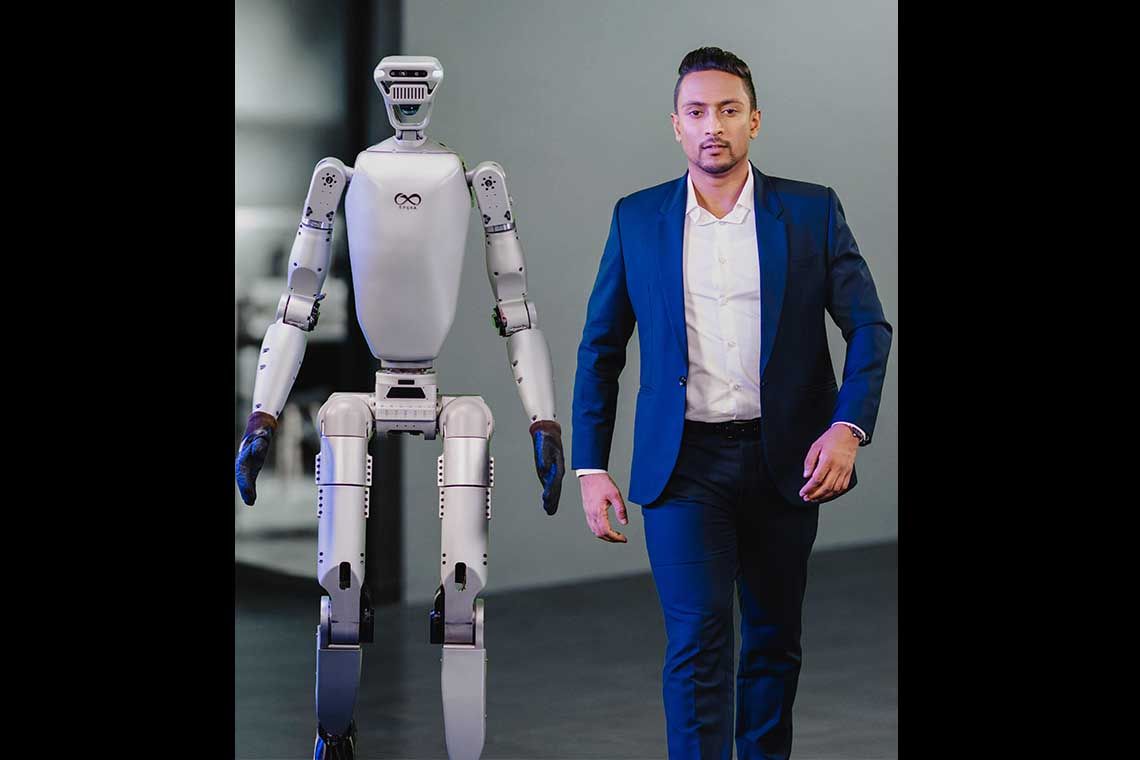
Original source image: Spera Humanoid – Prototype One. Credit: Businesscafe.
Sri Lankan technology company Spera has unveiled Spera Humanoid – Prototype One, described in reporting by Businesscafe, Gold FM News and LankaTalks as South Asia’s first homegrown full-scale bipedal humanoid developed specifically for security and defence applications.
The unveiling, reported between 3 and 9 September 2026, represents a significant development for Sri Lanka’s emerging deep-tech sector, since the platform is understood to have been designed and developed from the ground up by Sri Lankan engineers rather than imported as a completed system or assembled locally from a foreign-developed robotics platform.
Led by founder and Chief Executive Officer Sahan Yapa, Spera is presenting the prototype as an internationally oriented security platform, while also emphasising the longer-term objective of building a globally competitive humanoid robotics industry from Sri Lanka.

A locally engineered robotics milestone
The development of a full-scale humanoid requires the integration of mechanical engineering, electronics, software development, artificial intelligence, sensing systems and control technologies, all of which must operate in coordination if a robot is to move safely and interact with complex environments.
Spera’s unveiling is therefore notable not merely because a humanoid robot has been displayed, but because the company has asserted that the platform is the product of original Sri Lankan research, engineering and development. That distinction is important in a sector where many robotics systems are imported, adapted or assembled using externally developed components and intellectual property.
Sahan Yapa’s professional journey has reportedly been closely connected to the project. His early interest in machinery developed into self-directed learning in software development, electronics, mechanics and robotics, while the company’s earlier software activities helped generate experience and resources that could be reinvested into advanced robotics research.
The result is a prototype intended to demonstrate that Sri Lankan engineering teams can address technically demanding problems and develop systems with potential relevance beyond the domestic market.
Sri Lanka’s technology economy has traditionally been associated with software services, information technology outsourcing and digital entrepreneurship. Spera’s work points towards a broader opportunity in which software capability is combined with physical engineering, advanced manufacturing and artificial intelligence. This transition will require sustained investment in laboratories, specialised education, testing facilities and supply chains, but the prototype provides an important example of what local technical talent can pursue.

AI-generated contextual illustration based on the source image. Credit: eLanka.
Technical features designed for human environments
According to the published reports, Spera Humanoid – Prototype One incorporates several capabilities intended to support security-related operations in environments originally designed for people.
The platform uses bipedal locomotion, allowing it to move on two legs rather than relying on wheels, tracks or a fixed structure. A bipedal configuration may offer advantages when navigating spaces containing stairs, narrow passages, uneven surfaces and other features that are common in human-built facilities. It also presents substantial engineering challenges, because balance, foot placement, body movement and energy management must be controlled continuously.
The humanoid is also reported to feature high-torque actuation, referring to the powerful motors and mechanical systems used to move and stabilise the robot’s joints. Such actuation is central to the operation of a full-scale bipedal machine, where the legs, arms and torso must be coordinated with sufficient force and precision.
A further feature is five-finger manipulation. Human-shaped hands with articulated fingers can allow a humanoid platform to interact with objects, controls and equipment that were designed for human use. The reported capability does not, by itself, establish that the prototype can perform every task carried out by a person; rather, it indicates that Spera is developing a platform capable of more refined physical interaction than a robot limited to simple gripping or fixed tooling.
For environmental awareness, the prototype is reported to use 3D LiDAR perception. LiDAR systems measure surrounding surfaces and objects using reflected light, producing spatial information that can assist with mapping, obstacle detection and navigation. When combined with other sensors and control systems, three-dimensional perception may help a robot interpret the structure of a site and operate with greater awareness of its surroundings.
The platform also includes onboard artificial intelligence, which is intended to support perception, interpretation and operational decision-making. The available reporting does not suggest that the prototype should be regarded as entirely independent of human supervision. Instead, its artificial intelligence capabilities should be understood as part of a broader system that combines machine perception with human oversight.
Finally, Spera has reported long-range teleoperation, enabling a human operator to supervise or control the platform from a remote location. This feature is particularly relevant to security and defence applications, where a robot could potentially be assessed for work in hazardous or restricted environments while reducing the immediate physical exposure of personnel.

AI-generated contextual illustration based on the source image. Credit: eLanka.
Security and defence ambitions
Spera has positioned the humanoid as a platform for security and defence-related applications, particularly in high-risk operational environments. The company’s stated ambition is to develop systems capable of supporting human operators where mobility, situational awareness and remote intervention may be valuable.
Potential applications in this field could include observation, patrol support, inspection of hazardous areas, access to difficult locations and assistance with tasks that may expose personnel to unnecessary risk. However, the prototype’s unveiling should not be interpreted as evidence of confirmed defence procurement, operational deployment or signed commercial contracts.
The available reporting does not identify confirmed procurement agreements, investment figures or contracted deployments involving Spera Humanoid – Prototype One. At this stage, the platform should be regarded as a substantial prototype milestone and as an expression of the company’s future ambitions.
That distinction strengthens rather than diminishes the significance of the announcement. Deep-tech products normally progress through stages of validation, controlled testing, pilot activity and refinement before they are introduced into demanding operational environments. A prototype provides an opportunity to evaluate balance, reliability, safety, communications, maintenance requirements and the practical value of the system.

AI-generated contextual illustration based on the source image. Credit: eLanka.
Spera 2.0 and the emerging humanoid economy
Spera has reported that a second-generation model, Spera 2.0, is already in development, with plans to introduce the platform in several countries as the technology progresses. These plans remain ambitions rather than confirmed market outcomes, but they demonstrate the company’s intention to develop a product with international relevance.
The global humanoid robotics industry is attracting growing attention because such machines are being designed to function in workplaces, industrial facilities and public environments that have already been configured for human movement. The emerging sector brings together robotics, artificial intelligence, advanced materials, industrial automation, telecommunications and remote operations.
For Sri Lanka, participation in this field could generate benefits beyond the sale of a single product. It could encourage the development of specialised engineering careers, strengthen links between universities and industry, create opportunities for component manufacturing and help retain technical talent by connecting local expertise with international markets.
The most valuable outcome may therefore be the engineering capability developed during the process. Building a humanoid robot requires teams to solve difficult problems repeatedly, learn from failed prototypes and establish methods for testing systems under real-world conditions. Those capabilities can eventually contribute to other sectors, including industrial automation, medical devices, logistics, agriculture and disaster-response technology.
The wider importance of Spera’s announcement lies in this combination of ambition and local capability. A platform engineered in Sri Lanka for a global market challenges the assumption that advanced physical technology must always be imported into the country. It also adds a new dimension to the country’s established reputation for software and digital services.
A positive signal for Sri Lankan innovation
Spera Humanoid – Prototype One remains a developing technology, and its future success will depend on rigorous testing, reliable production, responsible use and the ability to translate a promising prototype into a safe and practical platform.
Nevertheless, the unveiling is a positive signal for Sri Lanka’s innovation landscape. It demonstrates that local engineers are engaging with one of the most technically demanding areas of modern technology and that Sri Lankan companies are prepared to pursue ambitious projects with international aspirations.
As Spera advances towards Spera 2.0 and evaluates opportunities in overseas markets, the company’s progress will be watched with interest by engineers, educators, investors and members of the global Sri Lankan community. The project’s central message is clear: with sustained effort, technical knowledge and a willingness to learn from failure, sophisticated robotics can be researched and developed from Sri Lanka for the wider world.
eLanka continues to share positive stories about Sri Lankan achievements in technology, business, education and innovation. Readers can explore the eLanka website and earlier coverage of robotics and automation developments in Sri Lanka.
This article was written based on the source https://businesscafe.lk/business-news/technology/21703-spera-unveils-south-asia-s-first-homegrown-security-humanoid, kindly email us at info@eLanka.com.au if any information needs to be corrected.
This article was written based on the source https://hirunews.lk/goldfmnews/487515/lankas-spera-unveils-south-asias-first-homegrown-security-humanoid, kindly email us at info@eLanka.com.au if any information needs to be corrected.
This article was written based on the source https://lankatalks.com/post/spera-unveils-south-asias-first-homegrown-security-humanoid, kindly email us at info@eLanka.com.au if any information needs to be corrected.
(adsbygoogle = window.adsbygoogle || []).push({});
At eLanka, we respect the rights of creators. If we have used an image you own and you’d like it removed, please email us at info@elanka.com.au and we’ll handle it promptly.