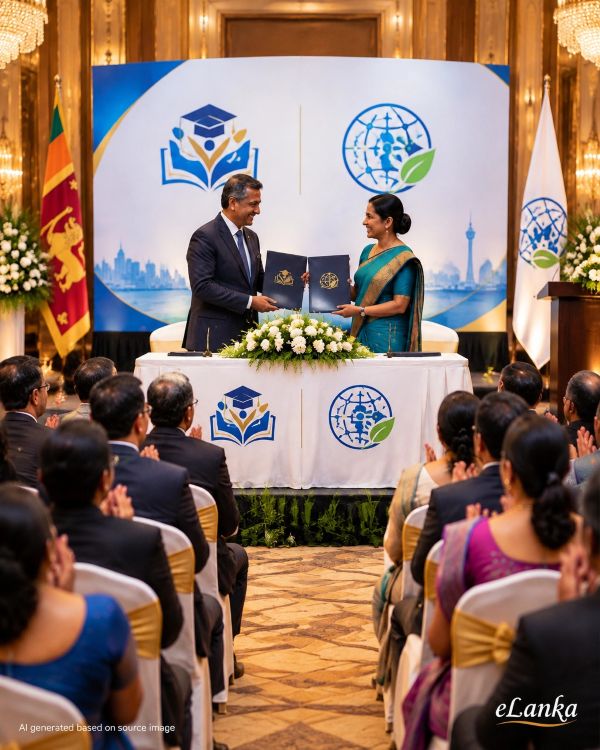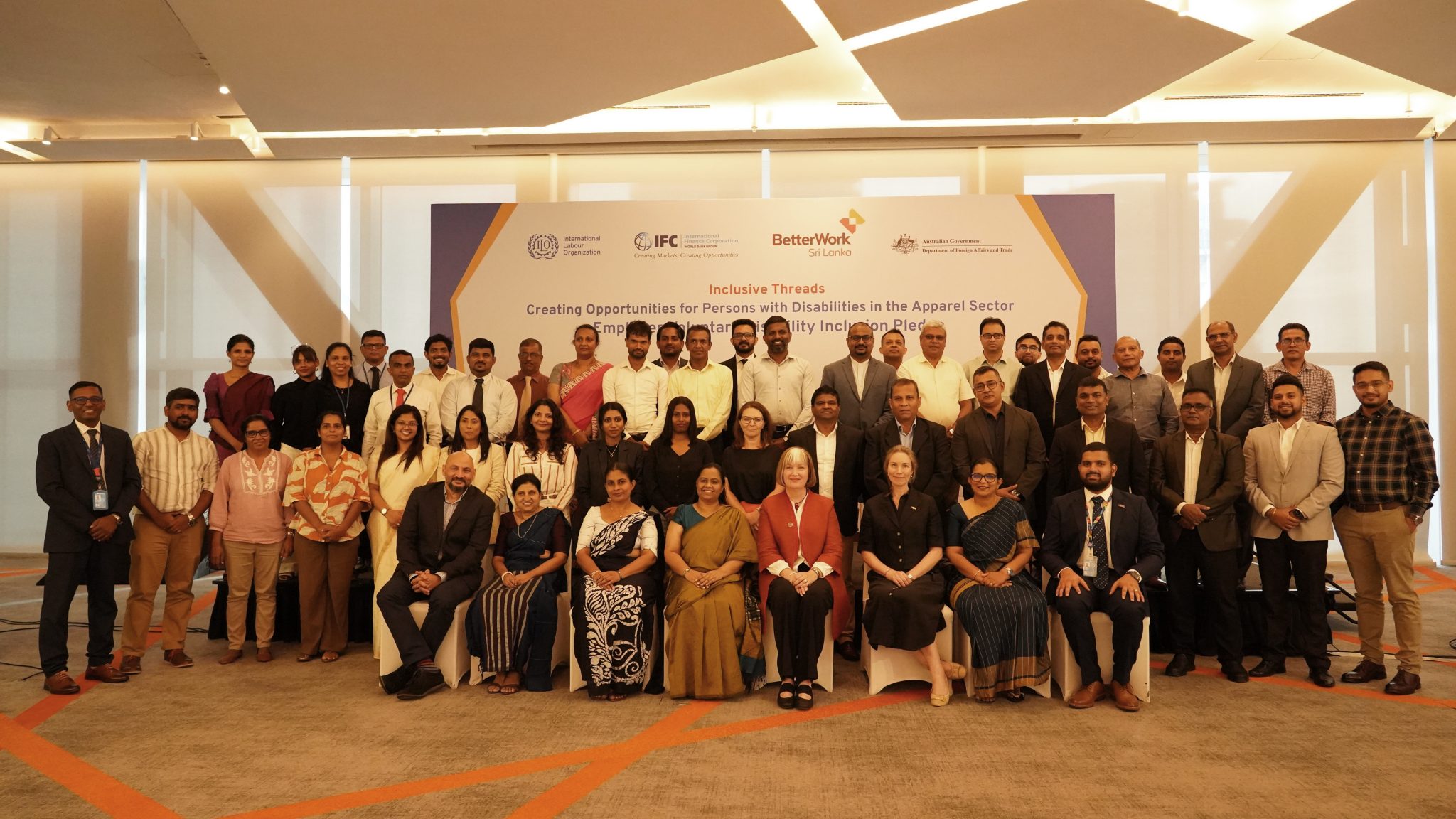
Sri Lanka’s apparel industry has taken a significant step towards creating a more inclusive labour market, after thirteen companies signed a voluntary Employer Disability Inclusion Pledge under the Inclusive Threads initiative of Better Work Sri Lanka.
The pledge, reported by Lanka Business Online on 21 August 2026, represents a coordinated commitment by employers, government institutions, industry bodies and development partners to improve access to decent employment for persons with disabilities. Rather than treating disability inclusion as a charitable undertaking, the initiative places employment, dignity, skills development and economic empowerment at the centre of its approach.
Inclusive Threads is being implemented through Better Work Sri Lanka, a joint programme of the International Labour Organization (ILO) and the International Finance Corporation (IFC), with support from the Australian Government’s Department of Foreign Affairs and Trade. The Joint Apparel Association Forum (JAAF), the Employers’ Federation of Ceylon (EFC), the Department of Social Services and other stakeholders have also contributed to the programme’s development.
A pledge based on eight practical principles
The voluntary pledge establishes eight interconnected principles intended to guide employers as they strengthen disability-inclusive practices across recruitment, training, workplace participation and career development.
The first principle is the promotion of the rights of persons with disabilities. This places persons with disabilities within a rights-based employment framework, recognising their entitlement to participate in working life on an equal basis, rather than viewing them primarily through a welfare or charitable lens.
The second principle is the prevention of discrimination. This applies to recruitment, selection, working conditions, training, promotion, remuneration and other aspects of employment. A person’s disability should not become an unjustified barrier to a position for which the individual possesses the necessary capacity, skills or potential.
The third principle concerns reasonable workplace accommodation. Such accommodation may involve adjustments to equipment, workstations, communication systems, schedules, facilities or procedures, allowing employees with disabilities to perform their responsibilities effectively and safely.
The fourth principle is the advancement of equal employment opportunity within the apparel and textile sector. This requires employers to identify suitable roles, establish accessible pathways into employment and ensure that persons with disabilities are considered as potential contributors to the industry’s future workforce.
The fifth principle focuses on inclusive recruitment practices. Employers are encouraged to examine job descriptions, selection procedures, interview arrangements and communication methods so that capable candidates are not excluded by avoidable or outdated processes.
The sixth principle is the removal of barriers. These barriers may be physical, such as inaccessible entrances or machinery; procedural, such as inflexible recruitment systems; or attitudinal, such as assumptions about a person’s ability to learn, work or progress.
The seventh principle is engagement with workers and persons with disabilities. Meaningful inclusion requires dialogue with employees, organisations of persons with disabilities, training providers and other relevant stakeholders, so that workplace solutions are informed by practical experience.
The eighth principle is collaboration with government and industry partners. The pledge recognises that sustainable change cannot be achieved by individual factories acting in isolation, and therefore encourages cooperation among employers, public institutions, vocational training centres, worker representatives and development organisations.
Together, these principles provide a structured basis for moving from broad support for inclusion towards measurable changes in employment practice.

Measurable progress through training and employment
The Inclusive Threads programme has already recorded several practical achievements. Since the formal collaboration with Better Work Sri Lanka began in November 2025, the programme has reached more than 17,000 households through community outreach and awareness activities.
It has also supported 12 formal job placements through district-level job fairs, creating direct pathways from skills development to paid employment. These placements are particularly important because they demonstrate that disability inclusion is most effective when training, recruitment and employer engagement are connected rather than handled as separate activities.
Training has been modernised at three vocational institutes operating under the Department of Social Services. The improvements are intended to make vocational education more relevant and accessible, while also aligning course content with the operational needs of the apparel industry.
The programme has further delivered sign-language training to more than 140 industry personnel, strengthening communication between employers, supervisors, trainers and workers. It has also facilitated factory-based internships for trainees across several apparel companies, providing participants with the opportunity to experience professional routines, production standards and workplace expectations in practical settings.
These measures are instrumental because successful employment depends on more than the availability of a vacancy. It requires appropriate preparation, accessible instruction, informed supervisors, supportive colleagues and a workplace designed to recognise ability rather than limitation.
Industry participation and shared responsibility
The thirteen companies that signed the pledge are:
- Brandix Apparel (Pvt) Ltd
- Filotex Lanka (Pvt) Ltd
- Hirdaramani International Exports (Pvt) Ltd
- Inqube Global (Pvt) Ltd
- Maliban Wovens (Pvt) Ltd
- Martex M F G (Pvt) Limited
- Miami Clothing (Pvt) Ltd
- Original Apparel (Pvt) Ltd
- Q Collection (Pvt) Ltd
- Sumithra Garments (Private) Limited
- Sun Queen Apparel (Pvt) Ltd
- Vogue Tex (Pvt) Ltd
- Winterquilts (Pvt) Ltd
Their participation signals that disability inclusion is increasingly being regarded as an industry-wide responsibility rather than an isolated corporate initiative. The apparel sector, which has long been an important source of employment and export revenue for Sri Lanka, is therefore well placed to demonstrate how inclusive employment can be incorporated into mainstream business operations.
Joni Simpson, ILO Country Director for Sri Lanka and the Maldives, stated that the pledge represents an ongoing commitment to review recruitment practices, remove barriers, engage with workers and create additional opportunities for persons with disabilities. The emphasis on continued progress is important, since the signing of a pledge is a starting point rather than evidence that every institutional challenge has already been resolved.
Darshani Karunarathne, Director of the Department of Social Services under the Ministry of Rural Development, Social Security and Community Empowerment, highlighted the employment focus of the programme, noting that the objective is to provide equal opportunities through work, with particular attention to the apparel sector.

Economic empowerment rather than charity
Yohan Lawrence, Secretary General of JAAF, described the employment of persons with disabilities as an investment in individuals who are willing to learn and who can excel in the workplace. This distinction is central to the Inclusive Threads approach.
Employment provides income, independence, professional identity and a stronger connection to the wider economy. It also allows individuals to develop skills, support their households and contribute to national production. When a capable person is excluded because of inaccessible systems or limited opportunity, the loss is experienced not only by the individual but also by the employer and the economy.
The pledge therefore presents a constructive antithesis to the assumption that disability inclusion is primarily a matter of benevolence. Its underlying proposition is that workplaces become stronger when recruitment is broadened, skills are recognised and working environments are designed to accommodate a wider range of employees.
For Sri Lankan apparel manufacturers competing in international markets, such measures may also support the sector’s reputation for responsible production, ethical employment and social sustainability. Global buyers increasingly examine labour practices throughout supply chains, making inclusive employment both a social obligation and a valuable component of long-term competitiveness.

A promising model for wider adoption
Inclusive Threads offers a model that could extend beyond the apparel sector. Its combination of community outreach, vocational training, employer commitments, factory internships and public–private collaboration provides a practical framework for addressing employment barriers in manufacturing, retail, hospitality, information technology and other industries.
Further progress will depend on sustained monitoring, transparent reporting and the continued participation of persons with disabilities in the design of workplace policies. Employers may also benefit from sharing successful accommodation practices, developing accessible career progression systems and training managers to identify ability without relying on preconceived assumptions.
The pledge signed in Colombo is consequently more than a ceremonial agreement. It is a public statement that Sri Lanka’s apparel sector is prepared to examine how opportunity is distributed and to strengthen the systems through which people enter, remain and progress in employment.
With thirteen companies already participating, more than 17,000 households reached, 12 formal placements supported, three vocational institutes modernised, over 140 industry personnel trained in sign language and factory internships established, Inclusive Threads has created a credible foundation for further advancement. Its greatest potential lies in ensuring that these early achievements become standard practice across the industry, enabling more persons with disabilities to secure dignified work and contribute fully to Sri Lanka’s economic future.
This article was written based on the source https://www.lankabusinessonline.com/2026/08/21/jaaf-and-ilo-better-work-programme-lead-apparel-sectors-push-for-disability-inclusion-with-inclusive-threads-pledge/, kindly email us at info@eLanka.com.au if any information needs to be corrected.
(adsbygoogle = window.adsbygoogle || []).push({});
At eLanka, we respect the rights of creators. If we have used an image you own and you’d like it removed, please email us at info@elanka.com.au and we’ll handle it promptly.