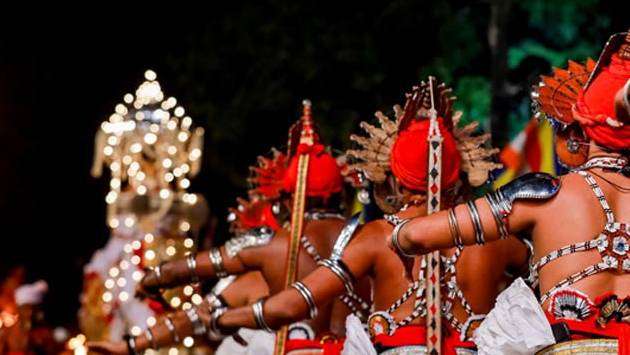
The final Kumbal Perahera of the historic Kandy Esala Perahera was scheduled to take to the streets of Kandy on Saturday, 22 August 2026, marking another important stage in one of Sri Lanka’s most significant religious and cultural celebrations.
According to a report published by the Daily Mirror, the procession was due to begin at the auspicious time of 6.28 p.m., facing north in accordance with established ceremonial customs. Its departure was to be signalled when the ceremonial elephant carrying the sacred Perahera casket stepped onto the sandalwood area near the entrance to the Sri Dalada Maligawa, the Temple of the Tooth in the hill capital.
The event once again placed Kandy at the centre of Sri Lanka’s living heritage, where religious observance, traditional performance, craftsmanship, music and public participation are woven together through a carefully preserved annual pageant.
A ceremonial journey through the heart of Kandy
The final Kumbal procession was set to begin from the Mahamaluwa within the Sri Dalada Maligawa premises before proceeding along several historic streets in central Kandy. The route included Dalada Veediya, Yatinuwara Veediya and Raja Veediya, after which the procession was to return to the Maligawa premises.
These streets form more than a practical route for a pageant. They constitute an important ceremonial landscape in which the architecture, public spaces and historic identity of Kandy are temporarily transformed by light, rhythm and movement. The passage of dancers, drummers, flag bearers and ceremonial elephants allows the city’s historic centre to function as a cultural stage, connecting its present-day community with traditions that have been maintained across generations.
The procession’s scheduled commencement at 6.28 p.m. also reflected the importance of timing within the ceremony. The movement of the Perahera is not treated as an ordinary public parade; rather, each stage is conducted according to customs that give structure and dignity to the observance.

The four Devales precede the Sri Dalada Maligawa Perahera
A distinctive feature of the Kandy Esala Perahera is the participation of the four principal Devales associated with Kandy. The Peraheras of Natha, Vishnu, Kataragama and Pattini were to precede the Sri Dalada Maligawa Perahera.
This order gives the procession a layered religious and cultural character. The four Devales represent long-established centres of devotion whose traditions have become inseparable from the annual pageant. Their processions move before the main Maligawa Perahera, creating a formal sequence in which each element contributes to the larger ceremonial narrative.
The presence of the four Devales also demonstrates the inclusive historical character of Sri Lanka’s ritual traditions. Their observances have developed through centuries of religious practice, local custom, artistic expression and royal-era ceremonial organisation. Within the modern Perahera, these traditions continue to be presented through drumming, dancing, decorated standards, illuminated ornaments and disciplined processional movement.
For Sri Lankans living around the world, the names of Natha, Vishnu, Kataragama and Pattini remain familiar cultural reference points, particularly among families seeking to preserve knowledge of Sri Lankan customs among younger generations. Images and recordings of the Kandy Perahera therefore carry significance well beyond the streets of Kandy, allowing cultural memory to be shared in homes, community centres and temples across Australia, the United Kingdom, the United States, Canada, New Zealand and other countries.
The sacred casket and Pulathisi Raja
The sacred Perahera casket occupies a central place in the ceremony, and its movement through the streets is treated with particular reverence. The Daily Mirror report noted that the sacred relic casket had been carried by the ceremonial elephant Pulathisi Raja during the previous procession on 21 August.
That earlier Kumbal Perahera commenced at the auspicious time of 6.40 p.m., proceeding along Sri Dalada Veediya and E. L. Senanayake Veediya, before continuing along Raja Veediya and returning to the Temple of the Tooth.
The role of a ceremonial elephant in the Perahera is not merely visual. The elephant forms part of a carefully organised ritual procession in which the sacred casket, traditional regalia and processional order are presented with solemnity. The decorated elephant, accompanied by drummers and dancers, represents the continuity of a pageant in which animal presence, human artistry and religious symbolism have historically been brought together.

A pageant sustained by traditional craftsmanship
The Kandy Esala Perahera depends upon a wide range of traditional skills, many of which are practised away from the public gaze. Costume preparation, drum making, ornament design, flag production, floral decoration and the maintenance of ceremonial objects all contribute to the visual and auditory identity of the event.
The costumes worn by Kandyan dancers are marked by elaborate silver-coloured ornaments, structured headpieces and carefully arranged decorative elements. The drummers provide the rhythmic foundation of the procession, while dancers translate that rhythm into highly disciplined movement. Together, these artistic forms give the pageant its distinctive character and distinguish it from a general civic celebration.
The illuminated streets of Kandy further intensify the visual effect. Against the evening sky, lamps and decorative lights highlight the procession’s movement, while the surrounding buildings and hills provide a setting that is both recognisable and historically charged. This combination of natural geography and ceremonial design has helped make the Kandy Esala Perahera one of Sri Lanka’s most widely recognised cultural events.
Sri Lanka’s heritage places, traditional celebrations and regional customs remain an important part of the country’s identity, as explored in eLanka’s article on the stories behind the names of places in Sri Lanka. The Kandy procession belongs to the same broader cultural inheritance, in which history is preserved not only in monuments and written records, but also through repeated public practice.

A shared cultural moment for Sri Lankans worldwide
The final Kumbal Perahera offered Sri Lankans at home and abroad an opportunity to engage with a tradition that remains active rather than merely historical. For those present in Kandy, the experience was shaped by the sound of drums, the movement of the processional groups and the illumination of the city streets. For Sri Lankans overseas, the event could be followed through news reports, photographs, video broadcasts and conversations within community networks.
Such occasions are instrumental in maintaining cultural connection. They provide younger Sri Lankans born or raised overseas with an accessible introduction to the country’s religious traditions, artistic forms and historical geography. They also enable older generations to share memories of Kandy, the Temple of the Tooth and the annual pageant with families separated by distance.
The enduring importance of the Kandy Esala Perahera lies in this continuity. Although the city and its surrounding society have changed considerably over time, the ceremonial route, the participating Devales, the music, the dancers and the sacred casket continue to form a recognisable cultural framework.
The final Kumbal procession of 2026 therefore represented more than an evening of pageantry. It demonstrated how Sri Lankan heritage can remain visible, carefully organised and publicly meaningful, while also serving as a bridge between the island’s historic traditions and the global Sri Lankan community.
Source: https://www.dailymirror.lk/breaking-news/Final-Kumbal-Perahera-to-take-to-Kandy-streets-today/108-348672
This article was written based on the source https://www.dailymirror.lk/breaking-news/Final-Kumbal-Perahera-to-take-to-Kandy-streets-today/108-348672, kindly email us at info@eLanka.com.au if any information needs to be corrected.
(adsbygoogle = window.adsbygoogle || []).push({});
At eLanka, we respect the rights of creators. If we have used an image you own and you’d like it removed, please email us at info@elanka.com.au and we’ll handle it promptly.