Sri Lankan Students Make Their Mark at the World Robot Olympiad Asia Pacific Open in Hyderabad
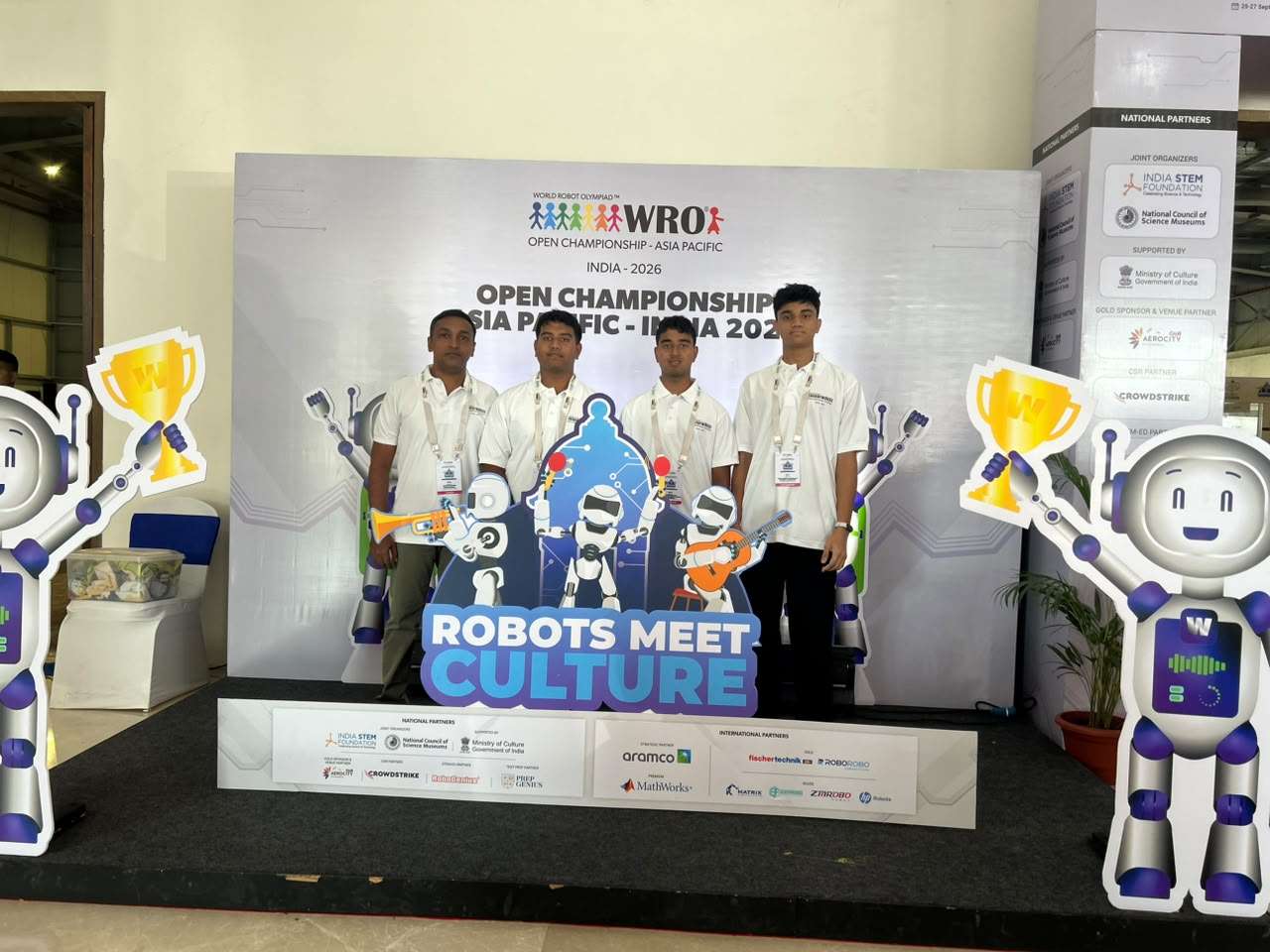
Sri Lankan students with their robots at the World Robot Olympiad Asia Pacific Open Championship. Photograph: Daily Mirror.
Four teams of Sri Lankan students have demonstrated how practical problem-solving can turn into thoughtful technological innovation, returning from the World Robot Olympiad (WRO) Asia Pacific Open Championship in Hyderabad with homemade robots designed to assist farmers, people with disabilities, older people and hospital patients.
The championship, hosted by WRO India, was held from 25 to 27 September at GMR Arena in Aerocity, Hyderabad. It brought together 149 teams from 25 countries, with more than 700 participants and supporters. Under the theme “Robots Meet Culture”, the event was inaugurated by Union Minister Gajendra Singh Shekhawat.
The Sri Lankan teams qualified through the national WRO competition, organised by the country’s WRO national organiser, Burhani Serendib School. They competed in the Future Innovators category, where students design and build an original robot to address a real problem in their communities.
Their results are notable, but so are the questions that guided their projects: How might a person move more safely around their home? How can a small gardener save water? How can a visitor with a disability experience a heritage site? And how can a patient be repositioned with greater ease?
The illustration below offers an AI-generated visual impression of a student robotics workshop. It is illustrative and does not depict the actual teams or their prototypes.

AI-generated illustration of students presenting a robotics project in a workshop.
Jaga: a robotic guide dog designed around everyday safety
Team MechRE from Gateway College Negombo secured eighth place in the Senior category with Jaga, a robotic guide dog designed to help blind and elderly people move around safely.
The project was prompted by the challenges associated with access to trained guide dogs. As reported by Daily Mirror, such a dog can cost more than 1.5 million rupees, involve years of waiting and may not be suitable for families unable to keep a dog indoors. The students sought to explore a technological alternative for people who need support moving around their homes and other spaces.
Team members Ometh, Nethika and Sineth designed Jaga to guide its user around obstacles and warn them when something is in the way. A mobile app allows family members to keep an eye on the device.
The team began by asking older people about their experiences rather than moving directly to construction. The students visited their own grandparents and friends, and found that 10 of the 13 elders they spoke to had difficulty finding their way around the house. That early research helped ground the project in a specific, observed need.
Building a useful device also required revision. The first version broke during regular use, so the students rebuilt it with stronger parts. That process (from listening to potential users, to testing and improving a prototype) reflects an important part of engineering: a promising idea must also withstand the conditions in which it is meant to work.
FUSION: gardening support shaped by local knowledge
Team F, comprising Bothalage Akindu Dilneth Ranuraka Fernando and Mohamed Rishad Aahil, secured 10th place in the Junior category with FUSION, a robot intended to assist small-scale farmers and home gardeners.
FUSION can move around a garden, recognise plants and water them when the soil is dry, helping avoid unnecessary use of water. The project also draws on Nakath, the Sri Lankan practice of choosing auspicious times for important farming work. Its design incorporates Nakath-inspired watering guidance and supports traditional crops and medicinal plants, including Gotukola. A mobile app provides farmers with brief advice rooted in local farming knowledge.
The project brings together several strands of learning: plant recognition, movement, soil conditions, water use and the cultural knowledge associated with cultivation. Its focus on small gardens also makes the challenge recognisable beyond commercial farming, connecting the technology with home growers and everyday food production.

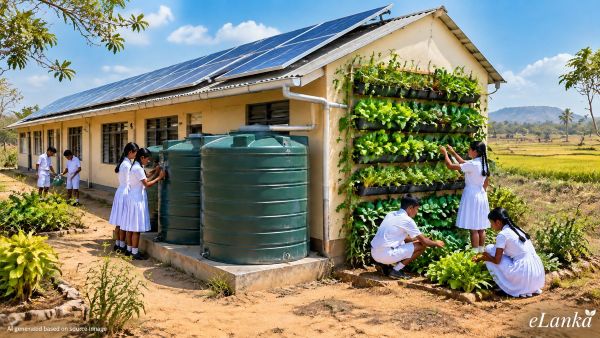
AI-generated illustration inspired by student projects connecting robotics, gardening and water-conscious design.
EchoLens: widening access to museums and heritage
Colombo students Taher Hussain, Ammaar Mustafa and Taher Iqbal Hussain, competing as Team R.E.A.C.H., placed 15th in the Senior category with EchoLens.
The small device clips onto ordinary glasses and is designed to make museums and heritage sites more accessible to visitors who are blind, hard of hearing or unable to speak. Its proposed functions include displaying live captions of a tour guide’s words, reading museum labels aloud, describing the wearer’s surroundings and turning sign language into speech.
The team identified Sigiriya as its main use case, linking a contemporary accessibility challenge with one of Sri Lanka’s most significant heritage settings. By considering how visitors with different communication and sensory needs might engage with a site, the students drew attention to the role that thoughtful design can play in making cultural experiences more inclusive.
EchoLens was the team’s second appearance at a WRO event, following its debut in Singapore last year. Continuing to develop a project across competitions can give students the opportunity to refine an idea and learn from presenting it to new audiences.
A hospital bed designed to reduce the need for lifting
The youngest Sri Lankan participants, Team Syncro-Rise, achieved 17th place in the Elementary category. Grade 6 and 7 students Sethika, Kithuja and Randiw presented the Smart Multifunctional Hospital Bed.
Built using a LEGO kit, the bed changes from a flat position into a sitting chair with one touch of a sensor. The intended benefit is that patients can change position without needing to be lifted. The students’ idea was inspired by seeing how hard nurses in Sri Lankan hospitals work to move patients.
The project shows how observation can help young learners identify a practical challenge and consider a device that might make a task easier. At the same time, it introduces foundational engineering concepts: a mechanism must respond reliably to a control, move safely between positions and be designed with the user in mind.
Ideas that begin with people
Taken together, the four projects span accessibility, gardening and patient care, but they share a common starting point: students paying attention to the needs of people around them. Their work illustrates how robotics education can extend beyond assembling components, encouraging young people to investigate a problem, plan a response, test a prototype and make improvements.
That approach offers encouragement to students considering STEM subjects, as well as to parents, teachers and schools supporting hands-on learning. A useful innovation does not always begin with an elaborate laboratory or a fully formed idea; it can begin with a conversation, a difficulty observed at home, or a question about how an everyday task might be made safer or easier.
The teams’ rankings are one measure of their achievement, while their research, persistence and community focus offer another. MechRE’s decision to rebuild a fragile prototype, Team F’s combination of garden technology and local farming knowledge, R.E.A.C.H.’s attention to accessible heritage and Syncro-Rise’s response to the work of hospital nurses each show young innovators learning to connect design with real-world use.
For more information about the next national competition, students, parents, teachers and schools can visit wro.lk. The next national competition is scheduled for March, offering more young people the opportunity to develop ideas, work in teams and explore how technology can serve their communities.
eLanka shares positive stories about Sri Lankans and community achievements around the world. Readers can find further news and updates through the eLanka website.
Source: Daily Mirror. The WRO national competition in Sri Lanka is organised by Burhani Serendib School.
This article was written based on the source https://www.dailymirror.lk/breaking-news/Sri-Lankan-Students-Make-Their-Mark-at-Asia-Pacific-Robot-Olympiad-in-Hyderabad/108-352095, kindly email us at info@eLanka.com.au if any information needs to be corrected.
At eLanka, we respect the rights of creators. If we have used an image you own and you’d like it removed, please email us at info@elanka.com.au and we’ll handle it promptly.
Thanks.
eLanka team
eLanka Disclaimer
Content published on eLanka may be created by the eLanka team, submitted by contributors or third parties, reproduced or adapted from other sources with appropriate source acknowledgement, or provided as promotional/advertising material by our clients. While eLanka takes reasonable care in preparing and publishing content, we do not warrant its completeness or accuracy. Views expressed are those of the respective authors or contributors and do not necessarily represent the views of eLanka. Third-party contributors, content providers and advertisers are responsible for the accuracy of material they supply and for ensuring they hold the necessary rights and permissions for its publication. Advertising and promotional content should not be regarded as an endorsement by eLanka of any product, service or claim.