News & Community eLanka

eLanka

Monday, 27 Apr 2026
  • Home
  • Read History
  • Articles
    • eLanka Journalists
  • Events
  • Useful links
    • Obituaries
    • Seeking to Contact
    • eLanka Newsletters
    • Weekly Events and Advertisements
    • eLanka Testimonials
    • Sri Lanka Newspapers
    • Sri Lanka TV LIVE
    • Sri Lanka Radio
    • eLanka Recepies
  • Gallery
  • Contact
Newsletter
Sri lankan news
  • eLanka Weddings
  • Property
  • eLanka Shop
  • Business Directory
eLankaeLanka
Font ResizerAa
Search
  • Home
  • Read History
  • Articles
    • eLanka Journalists
  • Events
  • Useful links
    • Obituaries
    • Seeking to Contact
    • eLanka Newsletters
    • Weekly Events and Advertisements
    • eLanka Testimonials
    • Sri Lanka Newspapers
    • Sri Lanka TV LIVE
    • Sri Lanka Radio
    • eLanka Recepies
  • Gallery
  • Contact
Follow US
© 2005 – 2026 eLanka Pty Ltd. All Rights Reserved.
Home » Goodnews Stories Srilankan Expats » Articles » The hidden and forgotten world of Kumana – by Mahil Wijesinghe
Articles

The hidden and forgotten world of Kumana – by Mahil Wijesinghe

eLanka admin
Last updated: December 21, 2021 8:08 am
By
eLanka admin
ByeLanka admin
Follow:
Share
8 Min Read
SHARE
Views: 12

The hidden and forgotten world of Kumana – by Mahil Wijesinghe

kumana

Source: Sunday Observer

Reminiscences of a journey to Bambaragasthalawa, where a 9th century Buddha statue was destroyed by human vultures Digital cameras have made my job easier – no more carrying lots of photographic equipment and hundreds of delicate rolls of films to remote locations. Now, hundreds of frames can be recorded to just one digital device and saved in my computer. The Covid-19 curfew enabled me to spend time in my home managing and sorting out folders of unpublished images of my past journeys.

For years, the Kumana bird sanctuary remained a no-man’s land, occupied by LTTE terrorists. It had become a safe haven for poachers, treasure hunters and LTTE activities. Thankfully, now no one needs to fear to travel there.

My routine trip to the Kumana bird sanctuary to enjoy not only the fauna and flora but also to visit the ancient ruins and artefacts led to a tragic discovery. I visited Kumana for the first time in 2013 with a few friends and this was followed by a second visit in 2016. We drove to Okanda from Colombo and trekked along jeep tracks on our way inside the park, stayed at the Galamuna Camp site near the Kumbukkan Oya for a night.

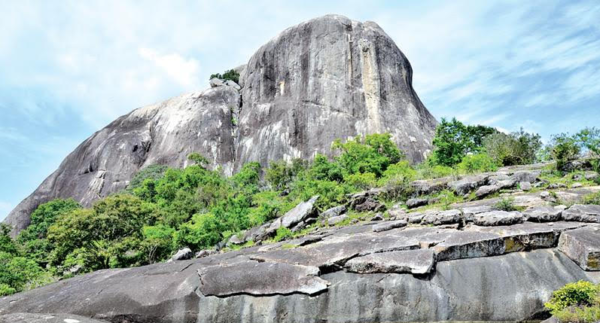
Nearly eight kilometres west of Okanda, the main entrance of the Yala East National Reserve, is the great rocky outcrop of Bambaragasthalawa which was my final destination. The main rock ends in an un-scalable peak, over hundreds of metres high. Spread out in all directions, are immense boulders with water pools, lying singly and in groups. Many of these boulders with drip-ledge caves provided natural shelter and several of them were occupied by generations of monastic bhikkus during the 2nd and 1st centuries BC before the thick jungle engulfed the once prosperous human settlement.

But, today, these rock caves are home to sloth bears and are considered to be one of the difficult rocky terrains to explore and see wildlife.


Historical records provide details about how from these early beginnings, Bambaragasthalawa prospered and grew into an important shrine.

It reached its peak many centuries later during the late Anuradhapura period, when a serene and beautiful recumbent statue of the Buddha was constructed in one of the larger caves.

I saw numerous rock caves with inscriptions and ruined structures in the rocky boulders in the vicinity of Bambaragasthalawa.

All these ancient structures had been damaged by treasure hunters and are in ruins today. Archaeologists believe that in ancient times, the place would have been called Naga Pabbatha Vihara.

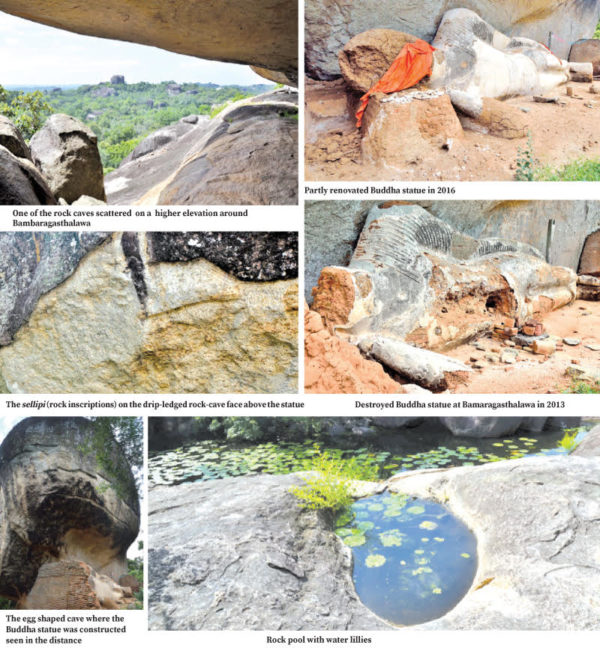
Today, it is known as Bambaragasthalawa because of the huge trees found around rocky boulders with Bambara (giant bee) hives, hanging on trees everywhere. From atop the rock, I could see a fascinating sight of a large number of rocky boulders standing out from the forest canopy of Kumana.It was vandalism of the worst kind on a rare and precious Buddha statue that I stumbled upon in one of the many rock caves scattered around Bambaragasthalawa in Kumana.

When I saw it on my first visit, the head lay smashed to bits and the stomach was dug out in this beautifully -sculptured 24-foot statue, probably dating back to the 9th century AD and crafted in the Anuradhapura tradition.

On my second visit, I saw it was partly renovated by the officers of the Department of Archaeology with the collaboration of the Department of Wildlife. The vicissitudes of time has left most of them in ruins. But it is a pity that humans are also destroying these priceless monuments of our bygone era.

It looked as if the vandals were searching for gems and couldn’t care less whether they were destroying a rare statue. There is a common belief that precious stones and things of value may have been embedded in statues. I found the statue in a pathetic state on my first visit.

Very few such statues made of bricks and sand and lime plaster exist. Usually, statues are cut out of crystalline, lime stone or granite. However, this statue is rare as the folds of the robe and the curls or waves of the hair can be picked out even in the destroyed head and are proof of this along with the size and texture of the bricks used.

The sellipi (rock inscriptions) are on the drip-ledged rock-cave face above the statue. These inscriptions fall into the category of those done in the 2nd or 1st century BC and detail that the rock-caves had been donated to monastic bhikkhus who inhabited them.


Even today, Kumana remains a lost civilisation in a hidden world. Its monuments lie scattered all over the jungle, overgrown and long forgotten. They are visible only in glimpses and fragments, a ruined chaithya atop rock boulders, a crumbling wall in the middle of the jungle.

Wander off the beaten track and you find statues buried in the scrub. It is all a part of a buried history which is still waiting to be unravelled. As I approached a ruined temple complex built on top of the rock, the sunlight at dusk turned the mountain of rocky boulders into a colour palette of beige and orange. When I stood among the ruins on a rocky ridge, I found that the sun had set aflame the trough formed by the flat rock. I tried capturing it on my camera but it was too grand a spectacle for a digital device to do justice to it.

However, the villagers at Panama say that during the conflict the LTTE fighters did not damage any of the artefacts. However, Sri Lankans should be made aware of their national heritage and the importance of preserving it for posterity. The mountainous landscape of shattered rocks in Kumana was spectacular, more so because it was so peaceful. And peace is always beautiful.

Kumana


TAGGED:BambaragasthalawaDepartment of WildlifeKumana bird
Share This Article
Facebook Whatsapp Whatsapp LinkedIn Email Copy Link Print
Previous Article Seeking to contact: Sonna Cassim (Wimalaratne)
Next Article Migrant communities The Crippling Impact Of Second Stage 3 Lockdown On Melbourne’s International Students-By Alicia Vrajlal
FacebookLike
YoutubeSubscribe
LinkedInFollow
Most Read
10 Pictures With Fascinating Stories Behind Them!

“A PICTURE SPEAKS A 1000 WORDS” – By Des Kelly

Look past your thoughts so you may drink the pure nectar of this moment

A Life Hack for when we’re Burnt Out & Broken Down – By Uma Panch

Narration of the History of our Proud Ancestral (Orang Jawa) Heritage. by Noor R. Rahim

eLanka Weddings

eLanka Marriage Proposals

Noel News

Noel News

Noel News

Noel News- By Noel Whittaker

Appreciation: Eileen Mary Sibelle De Silva

K.K.S. Cement Factory

Dr.Harold Gunatillake’s 90th Birthday party

Sri Lanka's women's cricket squad in Melbourne

Cricket: Sri Lanka’s women’s squad in Melbourne

- Advertisement -
Ad image
Related News
Articles Dr Harold Gunatillake

Enough magnesium in your body is really important and can truly help you prioritise your health. Magnesium plays a vital role in many bodily functions-by Harold Gunatillake

Lions Club Celebrates Avurudu with Music, Games, and Tradition-by Trevine Rodrigo
Articles Trevine Rodrigo

Lions Club Celebrates Avurudu with Music, Games, and Tradition-by Trevine Rodrigo

story of black dog
Articles

The Black Four-Legged Peace Walker: A Silent Guide on Day 4 in Sri Lanka

Ratnapura
Articles

“CITY OF GEMS” RATNAPURA Ratnapura, known as the “City of Gems” in Sri Lanka, derives its name from the Sanskrit words “ratna” (gemstone) and “pura” (town or city). As the hub of Sri Lanka’s gem mining industry. The name is derived from Sanskrit and Pali, languages that heavily influenced the region over 2000 years ago. The city earned this name because it has been the traditional center of Sri Lanka’s gem trade for over 2,000 years. It is the primary source of world-renowned precious stones, including blue sapphires, rubies, and cat’s eyes.Some historical accounts suggest a different origin linked to the Portuguese colonial era. There is a view that the name could be derived from the Portuguese word “Rapadura,” which refers to jaggery. Ratnapura is the heart of Sri Lanka’s gem industry, often called the “gem capital of the world” due to its incredible geological wealth and ancient trading history. The region is famous for producing over 40 of the 85 known gemstone varieties in the world. The most famous is the “Ceylon Sapphire,” prized for its vivid cornflower and royal blue hues. Other varieties include yellow, pink, and the rare orange-pink Padparadscha. Specialty Stones: Includes the rare Alexandrite (which changes color in different light), Cat’s Eye Chrysoberyl, Spinel, Tourmaline, Garnet, and Moonstone. The sapphire in Princess Diana’s Iconic engagement ring is a Ceylon sapphire from the Ratnapura area. Many world-renowned gems were unearthed in the Ratnapura district. One of the largest faceted blue sapphires ever found in Ratnapura, Blue Giant of the Orient is over 465 carats. The city features remains of a Portuguese-Dutch Fort, which now houses the National Gem and Jewellery Authority. Ratnapura is the starting point for the “classic” hard route (Gilimale route) to the sacred Sripada. Ratnapura district is home to a significant number of spectacular waterfalls, often described as having the highest concentration of waterfalls in Sri Lanka. – By Francis Paul Welangoda

Kirindi Ella Falls
Articles

Kirindi Ella Falls: Sri Lanka’s Majestic Multi-Tiered Wonder in Ratnapura – By Francis Paul Welangoda

  • Quick Links:
  • Articles
  • DESMOND KELLY
  • Dr Harold Gunatillake
  • English Videos
  • Sri Lanka
  • Sinhala Videos
  • eLanka Newsletters
  • Obituaries
  • Sunil Thenabadu
  • Dr. Harold Gunatillake
  • Tamil Videos
  • Sinhala Movies
  • Trevine Rodrigo
  • Photos
  • eLanka Newsletter

eLanka

Your Trusted Source for News & Community Stories: Stay connected with reliable updates, inspiring features, and breaking news. From politics and technology to culture, lifestyle, and events, eLanka brings you stories that matter — keeping you informed, engaged, and connected 24/7.
Kerrie road, Oatlands , NSW 2117 , Australia.
Email : info@eLanka.com.au / rasangivjes@gmail.com.
WhatsApp : +61402905275 / +94775882546
  • About eLanka
  • Terms & Conditions

Disclaimer:
eLanka is committed to sharing positive and community-focused stories. We do not publish or endorse political, religious, or ethnic viewpoints. The content published on eLanka, including articles and newsletters, reflects the opinions and views of the respective authors and not those of eLanka. eLanka accepts no responsibility or liability for the accuracy, completeness, or consequences of any content provided by contributors.

(c) 2005 – 2025 eLanka Pty Ltd. All Rights Reserved.