


The History of Volleyball in Sri Lanka: A Journey Since 1916 – By Malsha – eLanka
Volleyball holds a special place in the sporting culture of Sri Lanka, proudly recognized as the national sport. Its journey, spanning more than a century, reflects not only the evolution of a game but also the spirit, unity, and resilience of a nation. From humble beginnings in the early 20th century to international recognition, the story of volleyball in Sri Lanka is both inspiring and deeply rooted in community life.
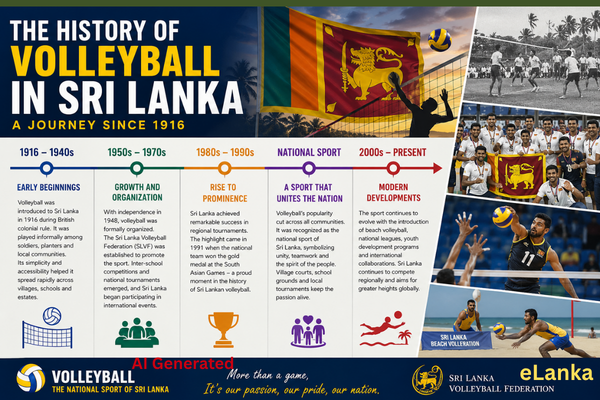
Early Beginnings (1916 – 1940s)
Volleyball was first introduced to Sri Lanka in 1916, during the period of British colonial rule. Initially, the game was played informally among soldiers, planters, and local communities. Its simplicity—requiring minimal equipment and space—made it accessible to people across villages and towns.
Unlike sports such as cricket, which were often confined to elite institutions, volleyball quickly spread among the rural population. It became a favorite pastime in schools, estates, and village gatherings. The game’s adaptability to different environments allowed it to flourish organically, especially in regions where other organized sports were less accessible.
Growth and Organization (1950s – 1970s)
The mid-20th century marked a turning point for volleyball in Sri Lanka. With the country gaining independence in 1948, there was a renewed focus on developing national identity through sports. Volleyball, already popular at grassroots level, was formally organized with the establishment of governing bodies.
The Sri Lanka Volleyball Federation (SLVF) was formed to regulate and promote the sport nationwide. Structured tournaments, coaching programs, and inter-school competitions began to take shape. During this period, volleyball became deeply embedded in school sports culture, producing talented players who would later represent the nation.
By the 1960s and 1970s, Sri Lanka had begun participating in international competitions, gaining exposure and experience. The sport’s popularity surged, particularly in rural areas, where village tournaments became major social events, drawing large crowds and fostering community pride.
Rise to Prominence (1980s – 1990s)
The 1980s and 1990s are often considered the golden era of Sri Lankan volleyball. The national team made significant strides in regional competitions, particularly in South Asia.
One of the most notable achievements came in 1991, when Sri Lanka won the gold medal at the South Asian Games. This victory marked a historic moment, showcasing the country’s potential on the international stage. The team’s performance inspired a new generation of players and elevated the status of volleyball across the island.
During this period, the government and sports authorities increased their support for volleyball development. Training facilities improved, and more structured coaching programs were introduced. Schools continued to serve as the primary talent pipeline, ensuring a steady flow of skilled athletes.
Volleyball as the National Sport
Volleyball’s deep connection with Sri Lankan society led to its official recognition as the national sport. This designation reflects not only its popularity but also its accessibility and cultural significance.
In villages across Sri Lanka, volleyball courts are a common sight. The sport transcends age, gender, and social boundaries, bringing people together in a shared passion. Evening matches, often played under makeshift lights, are a familiar scene, highlighting the game’s enduring appeal.
Modern Developments (2000s – Present)
In the 21st century, Sri Lankan volleyball has continued to evolve, adapting to modern trends while preserving its traditional roots. The introduction of beach volleyball has added a new dimension to the sport, with Sri Lanka participating in international beach volleyball tournaments.
Efforts have been made to professionalize the sport further. National leagues, youth development programs, and international collaborations have helped raise standards. Organizations such as the Sri Lanka Volleyball Federation continue to play a crucial role in promoting the game and nurturing talent.
Despite facing challenges such as limited funding and competition from more commercial sports, volleyball remains a cornerstone of Sri Lanka’s sporting identity. The passion for the game at grassroots level continues to drive its growth.
Cultural and Social Impact
Volleyball in Sri Lanka is more than just a sport—it is a cultural phenomenon. It plays a vital role in community bonding, youth development, and social cohesion. Village tournaments often coincide with religious festivals and local celebrations, making volleyball an integral part of cultural life.
The sport has also provided opportunities for young people to pursue athletic careers and represent their country. Many players from humble backgrounds have risen to national prominence, embodying the values of dedication and perseverance.
Challenges and the Road Ahead
While volleyball enjoys widespread popularity, it faces several challenges in the modern sporting landscape. Limited infrastructure, lack of sponsorship, and the growing dominance of sports like cricket pose obstacles to its advancement.
However, there is significant potential for growth. With increased investment in training, facilities, and international exposure, Sri Lanka can strengthen its position in regional and global volleyball.
Promoting volleyball in urban areas, enhancing media coverage, and encouraging private sector support are key steps toward ensuring the sport’s future. Additionally, focusing on women’s volleyball and youth programs can further expand its reach and impact.
Conclusion
From its introduction in 1916 to its status as the national sport, volleyball has woven itself into the fabric of Sri Lankan life. Its journey is a testament to the power of simplicity, accessibility, and community spirit.
As Sri Lanka looks to the future, volleyball remains a symbol of unity and resilience. With continued dedication and support, the sport can achieve even greater heights, inspiring generations to come.
The story of volleyball in Sri Lanka is far from over—it is a living legacy, still being written on courts across the island every day.
At eLanka, we respect the rights of creators. If we have used an image you own and you’d like it removed, please email us at info@elanka.com.au and we’ll handle it promptly.
Thanks.
eLanka team