Wishma Sandamali: Death of Lankan in Japan sparks grief, debate-by Ben Dooley and Hisako Ueno
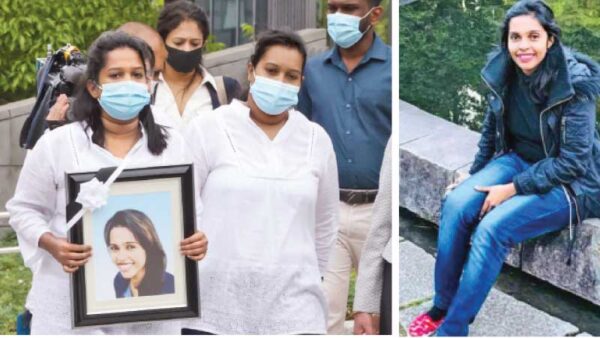
Sandamali’s sisters carry her photograph
Source:Dailynews
First came a high fever. Then her face and limbs turned numb. Soon, she could keep down little more than water, sugar and bites of bread as she wasted away in her cell in a Japanese detention centre.
By early March, Wishma Sandamali Rathnayake — a migrant from Sri Lanka who was being held for overstaying her visa — could barely make a fist and was having trouble speaking, according to Government records detailing her care.
Yet week after week, as she begged to be released to a hospital for treatment, her jailers refused. She and her supporters believed they knew why: The authorities, even as her health deteriorated, suspected that she was faking her illness to avoid deportation.
 On March 6, at the age of 33, Rathnayake died alone in her cell.
Her case has become a source of outrage for critics of Japan’s immigration system, who say that Rathnayake was the victim of an opaque and capricious bureaucracy that has nearly unchecked power over foreigners who run afoul of it.
The tragedy has spurred a national reckoning in Japan, a country with a long history of hostility toward immigration. It is now grappling with its at-times inhumane treatment of foreigners, especially people of colour, and many are calling for change.
They point to a system in which most immigration decisions are made in secret, offering migrants little recourse to the courts. Those who overstay their visas or who have entered the country illegally can be held indefinitely, sometimes for years. And migrants who file asylum claims, as Rathnayake once did, are particularly unwelcome.
Japan, the world’s third-largest economy, settles less than one percent of applicants seeking asylum, including just 47 last year — a point of contention among other countries that have called on Tokyo to do more.
Immigration officials are “police, prosecutors, judges and jailers,” said Yoichi Kinoshita, who left the Government’s immigration bureau over its lack of clear standards to guide its sometimes life-or-death decisions. He now runs an advocacy group focused on fixing the system. On Tuesday, the Japanese Government, facing growing pressure over Rathnayake’s death, made two major concessions.
The governing Liberal Democratic Party abandoned an effort to revise Japan’s immigration law, as opposition lawmakers said they would not start a debate over the changes unless the Government released video footage of Rathnayake taken in the detention centre just before she died.
The Government had argued that the revisions would improve the treatment of detainees, in part by stopping lengthy detentions, which have drawn sharp criticism from human rights groups for decades. But critics took particular issue with changes that would have allowed Japan to forcefully repatriate asylum seekers, potentially returning them to dangerous situations in their home countries.
Also on Tuesday, Justice Minister Yoko Kamikawa agreed to meet with Rathnayake’s two sisters in order to “express my condolence.” Kamikawa has repeatedly declined to address the specifics of Rathnayake’s death, whose cause has yet to be officially determined. She has said she will withhold comment until the immigration bureau has completed an inquiry into the case. The bureau, in a statement, reiterated her remarks.
After the meeting, the sisters said that Kamikawa had told them that the Government would not release the footage. They said they would not return home until they viewed the video.
 Kamikawa held the meeting as her ministry, which administers the immigration bureau, has come under regular attack in the news media for its role in Rathnayake’s death and its evasiveness about the causes. Protesters have gathered nearly every day in front of Parliament, and objections lodged by opposition lawmakers have been unusually fierce.
These lawmakers want to overhaul an immigration system in which the outcomes for those caught inside can be bleak. At least 24 detainees have died since 1997, according to the Japan Lawyers Network for Refugees. Activists have alleged Government negligence in some cases, most recently the deaths in 2020 of an Indonesian man and in 2019 of a Nigerian man on a hunger strike. Official inquiries have not supported the accusations.
None of those cases has inspired the public anger engendered by the death of Rathnayake, a hopeful young woman who had come to Japan with dreams of teaching English.
In the summer of 2017, she began studying Japanese at a school in the Tokyo suburbs. On her Facebook page, she shared photos of trips to Buddhist temples and to the mountains, where she delighted in snow. Around six months into her programme, she began skipping class, said Yuhi Yokota, the school’s vice principal. Before long, she moved into an apartment with her boyfriend, another Sri Lankan student she met in Japan. The couple then disappeared, a development that school officials reported to immigration authorities, Yokota said.
Hoping to stay in Japan, Rathnayake applied for asylum status, but the Government denied a request to renew her residence permit, and she withdrew her application. Officials soon lost track of her.
Then, last August, she appeared at a police station in Shizuoka, on the Pacific coast of central Japan, asking for protection from her boyfriend, who she said had abused her. She said she wanted to go home, but had less than US$20 to her name. The authorities were more interested in another problem: Her residence permit had expired and she was in Japan illegally. They sent her to a detention centre in Nagoya, a few hours southwest of Tokyo, to await deportation.
Several months later, she received a letter from her ex-boyfriend. He knew that she had reported him to the police, he wrote, adding that he would seek revenge if she returned to Sri Lanka.
Rathnayake decided she would be safer in Japan. With the encouragement of a local nonprofit organisation, START, she decided to try to stay.
The move irritated officials at the detention centre, said Yasunori Matsui, the group’s adviser. They demanded that she change her mind, she told him during one of his frequent visits.
In late December, Rathnayake fell ill with a fever, and within weeks she was having trouble eating, according to the nonprofit.
She tried to pass the time by watching television, but the commercials for food made her unbearably hungry.
Rathnayake was suffering from extreme anxiety, doctors found. A nurse suggested dealing with it by writing a diary with all of the things she was thankful for. In late January, a doctor prescribed her vitamins and painkillers. After they made her vomit, she resisted taking more.
Care was limited at the detention centre’s medical facility, which was more like an infirmary than a clinic.
Officials said her problems were caused by “stress,” she wrote in a letter to Akemi Mano, a local activist, adding that “they don’t take me to the hospital.”
The authorities took Rathnayake to a gastroenterologist in early February. The exam was inconclusive, but if she could not keep down her medicine, she should be hospitalised, the doctor wrote in a medical report reviewed by The New York Times. The comment conflicts with the official Government account of the visit, which says no recommendation for hospitalisation was made.
Rathnayake was returned to the detention centre. Soon, she could no longer walk. When she met with her representatives of START, she was rolled out in a wheelchair with a bucket in her lap. She had filed for a provisional release in January, citing anxiety. Detention centres had already released hundreds of healthy detainees because of concerns about the coronavirus, but in mid-February, her application was denied without explanation. Soon after, she submitted a second one on medical grounds. She was so weak she could barely sign the form, Matsui said.
Despite the severity of her symptoms, officials waited until March 4 to take Rathnayake to a hospital. A psychiatrist who examined her wrote that her sponsors had told her that being sick would improve her chances of being released, according to a medical record reviewed by The Times and first reported by TBS, a Japanese broadcaster. START denies the allegation. The cause of Rathnayake’s illness was unclear, the doctor noted. While it was possible that she was faking, he wrote, there would be no harm in granting her request for medical release, adding that “if you think about the patient’s benefit, that’s probably best.”
Two days later, Rathnayake was dead.
At the end of April, a group of opposition lawmakers held a video meeting with Rathnayake’s mother and sisters. One after another, they conveyed their deepest apologies and asked what they could do to help assuage the family’s grief.
“I want to know why they let her suffer,” her mother said. “Why didn’t they take her to the hospital as soon as possible?”
For now, the family can only speculate. An interim report on Rathnayake’s death, released by immigration officials last month, is filled with minute detail, like blood pressure and oxygen saturation readings during each checkup, the exact time she was administered medicine for her headaches or chest pain, every bite of food she ate or rejected.
But it omits the most important information: an answer for Rathnayake’s mother. (New York Times)

Sandamaili’s sisters and their lawyer walk to the Immigration Centre