eLanka

Thursday, 11 Dec 2025
  • Home
  • Read History
  • Articles
    • eLanka Journalists
  • Events
  • Useful links
    • Obituaries
    • Seeking to Contact
    • eLanka Newsletters
    • Weekly Events and Advertisements
    • eLanka Testimonials
    • Sri Lanka Newspapers
    • Sri Lanka TV LIVE
    • Sri Lanka Radio
    • eLanka Recepies
  • Gallery
  • Contact
Newsletter
  • eLanka Weddings
  • Property
  • eLanka Shop
  • Business Directory
eLankaeLanka
Font ResizerAa
Search
  • Home
  • Read History
  • Articles
    • eLanka Journalists
  • Events
  • Useful links
    • Obituaries
    • Seeking to Contact
    • eLanka Newsletters
    • Weekly Events and Advertisements
    • eLanka Testimonials
    • Sri Lanka Newspapers
    • Sri Lanka TV LIVE
    • Sri Lanka Radio
    • eLanka Recepies
  • Gallery
  • Contact
Follow US
© 2005 – 2025 eLanka Pty Ltd. All Rights Reserved.
Home » Goodnews Stories Srilankan Expats » Articles » 48,000-year-old arrowheads reveal early human innovation in the Sri Lankan rainforest: BY Michelle Langley, Oshan Wedage, Patrick Roberts
Articles

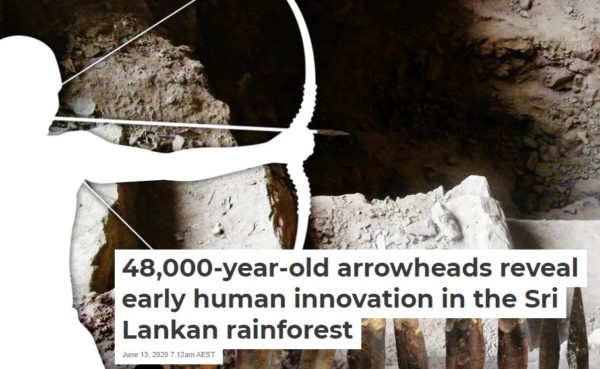
48,000-year-old arrowheads reveal early human innovation in the Sri Lankan rainforest: BY Michelle Langley, Oshan Wedage, Patrick Roberts

eLanka admin
Last updated: December 20, 2021 5:30 am
By
eLanka admin
ByeLanka admin
Follow:
Share
5 Min Read
SHARE

48,000-year-old arrowheads reveal early human innovation in the Sri Lankan rainforest: BY Michelle Langley,  Oshan Wedage, Patrick Roberts

the Sri Lankan rainforest

Contents
  • When was the bow and arrow invented?
  • Complex tools, complex minds

Source:Conversion

Archaeological excavations deep within the rainforests of Sri Lanka have unearthed the earliest evidence for hunting with bows and arrows outside Africa.

At Fa-Hien Lena, a cave in the heart of Sri Lanka’s wet zone forests, we discovered numerous tools made of stone, bone, and tooth – including a number of small arrow points carved from bone which are about 48,000 years old.

When was the bow and arrow invented?

The invention of the bow and arrow allowed people to hunt prey at a much greater distance. People no longer had to get within “a stone’s throw” of prey which could suddenly bolt and escape. This innovation greatly increased the chances of a successful hunt.

Bows and arrows also made it much safer to hunt dangerous prey. If you don’t have to get too close, you’re less likely to be trampled or mauled by a hurt and angry animal.

The origin of the bow and arrow is one of the great mysteries of human technological innovation. How did it come about? When? Where? And why?


Read more: What a bone arrowhead from South Africa reveals about ancient human cognition
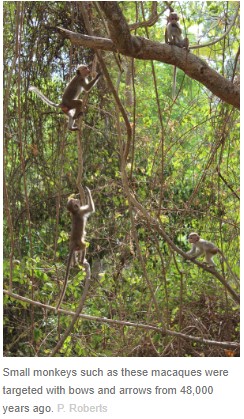
Small monkeys

Currently, the oldest evidence for the use of the bow and arrow are small stone points found in Sibudu cave in South Africa, which are some 64,000 years old.

Outside Africa, the oldest finds were previously pieces of bows found in Germany dating back no more than 18,000 years.

Because bows and arrows are mainly made from highly perishable stuff like wood, sinew, and fibres, they don’t leave a lot of evidence behind for archaeologists to find. So the small bone points recovered from Fa-Hien Lena are an important discovery.

The bone points show evidence for having been fixed to a small shaft and shot at high speed into prey – which were apparently mostly small monkeys and giant squirrels, judging by the butchered bones thrown away at the site after meals.

Complex tools, complex minds
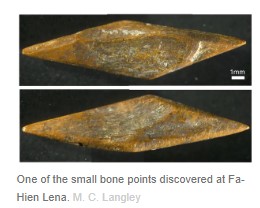
One of the small bone points discovered at Fa-Hien Lena.

The discovery of such ancient bone arrow points is startling in itself. However, we also found other tools which give equally rare insights into the lives of the earliest members of our species currently documented in Sri Lanka.

Particularly interesting are well-preserved knives, scrapers, and awls made from the bones and teeth of monkeys and deer, which were used to work skins or plant materials.

These tools are our only way to learn about the other, more fragile items that may originally have been at the site, because anything made from leather or plant fibre (such as clothing, bags, baskets, mats, or nets) stood no chance of surviving 48,000 years in the humid tropical environment.
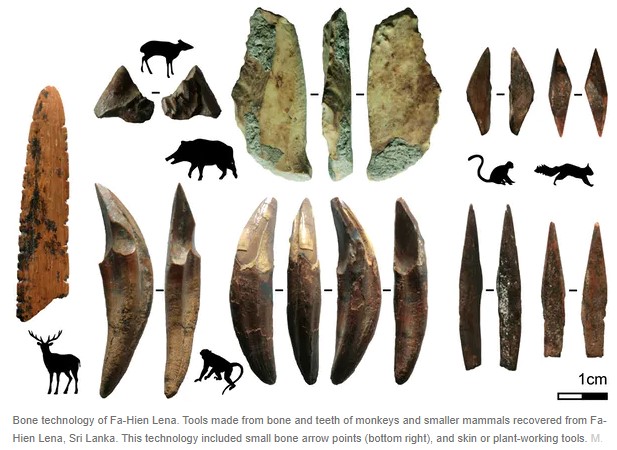
Bone technology of Fa-Hien Lena.

More Read

New publication-The Story of Furniture in Sri Lanka
Your Support Made a Difference – Flood Relief Donation Distribution Report Week 1
Two Sri Lankan origin players named in Australia Mens for ICC U19 World Cup

One of these artefacts is an unusual implement with carefully spaced notches down each side. It appears to be a shuttle for creating nets of woven fibres. No doubt nets would have been incredibly useful for catching the tree-dwelling prey the people of Fa-Hien Lena hunted, as well as bringing the fish up from the rivers.
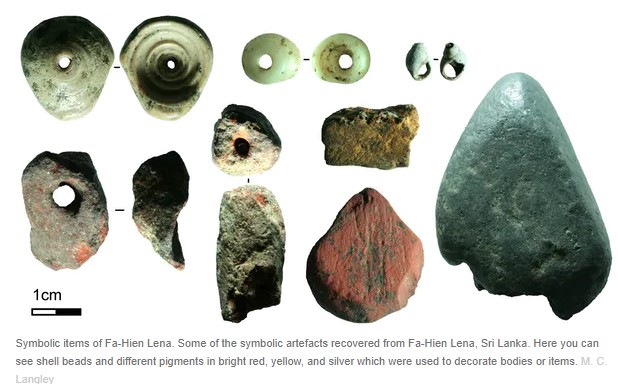
Symbolic items of Fa-Hien Lena

These rainforest pioneers also left behind evidence about their social lives in the form of white shell beads and small blocks of mineral pigments in bright colours: red, yellow, and silver.

Each of the pigment nodules show signs they were used to create paints for the body, and three of the bright red nodules were drilled to be strung as beads – something we have not found anywhere else in the world.

The white shell beads, on the other hand, are similar to those found in Africa and Eurasia, but were collected or traded from the coast some 20–30 kilometres away. Apparently, small, shiny, white shell beads never get old.

With these finds, it is becoming more and more clear that we have only just begun to scratch the surface when it comes to understanding the earliest modern human communities.
Michelle Langley
Michelle Langley

Senior Research Fellow, Griffith University

Oshan Wedage

Oshan Wedage

Researcher, Max Planck Institute for the Science of Human History

Patrick Roberts

Patrick Roberts

Research Group Leader, Max Planck Institute for the Science of Human History

 

TAGGED:Fa-Hien Lenahe Sri Lankan rainforestMichelle LangleyOshan WedagePatrick Roberts
Share This Article
Email Copy Link Print
Previous Article St JOSEPHS COLLEGE COLOMBO St JOSEPHS COLLEGE COLOMBO: Past Cricket Captains – 1898 to 2020
Next Article Sinharaja Forest Sinharaja Forest: A natural, national treasure: by RAJA WAIDYASEKERA
FacebookLike
YoutubeSubscribe
LinkedInFollow
Most Read
10 Pictures With Fascinating Stories Behind Them!

“A PICTURE SPEAKS A 1000 WORDS” – By Des Kelly

Look past your thoughts so you may drink the pure nectar of this moment

A Life Hack for when we’re Burnt Out & Broken Down – By Uma Panch

Narration of the History of our Proud Ancestral (Orang Jawa) Heritage. by Noor R. Rahim

eLanka Weddings

eLanka Marriage Proposals

Noel News

Noel News

Noel News

Noel News- By Noel Whittaker

EILEEN MARY SIBELLE DE SILVA (nee DISSANAYAKE) – 29 September 1922 – 6 April 2018 – A Woman of Value an Appreciation written by Mohini Gunasekera

K.K.S. Cement Factory

Dr.Harold Gunatillake’s 90th Birthday party

Sri Lanka's women's cricket squad in Melbourne

Cricket: Sri Lanka’s women’s squad in Melbourne

- Advertisement -
Ad image
Related News
cricket Australia
Articles

Sri Lankan Tamil youth wins Player of the Series at Australian U19 Cricket Nationals.

SUGUMAR-SELLATHURAI STEP UP TO THE PLATE
Articles

SUGUMAR-SELLATHURAI STEP UP TO THE PLATE

The Other Side of the World – by Kala V. Pillai
Articles

The Other Side of the World – by Kala V. Pillai

Nifraz Rifaz, Christkindlesmarkt, Markets, Renewable Energy & More on Kaleidoscope 292
Articles Savithri Rodrigo

Nifraz Rifaz, Christkindlesmarkt, Markets, Renewable Energy & More on Kaleidoscope 292

Articles

Two Sri Lankan origin players named in Australia Mens for ICC U19 World Cup

  • Quick Links:
  • Articles
  • DESMOND KELLY
  • Dr Harold Gunatillake
  • English Videos
  • Sri Lanka
  • Sinhala Videos
  • eLanka Newsletters
  • Obituaries
  • Sunil Thenabadu
  • Dr. Harold Gunatillake
  • Tamil Videos
  • Sinhala Movies
  • Trevine Rodrigo
  • Photos
  • Tamil Movies

eLanka

Your Trusted Source for News & Community Stories: Stay connected with reliable updates, inspiring features, and breaking news. From politics and technology to culture, lifestyle, and events, eLanka brings you stories that matter — keeping you informed, engaged, and connected 24/7.
Kerrie road, Oatlands , NSW 2117 , Australia.
Email : info@eLanka.com.au / rasangivjes@gmail.com.
WhatsApp : +61402905275 / +94775882546

(c) 2005 – 2025 eLanka Pty Ltd. All Rights Reserved.