In Appreciative Memory of Karen Roberts, 1965-2018-by Michael Roberts
Source:Thuppahis
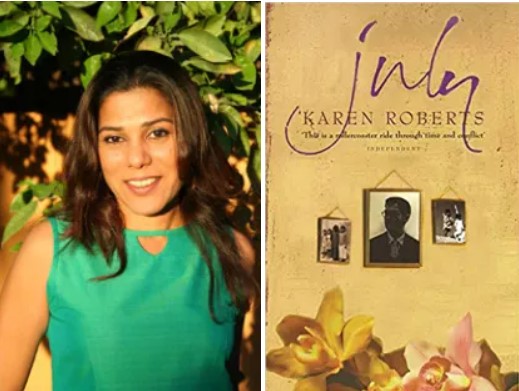
It has been something of a shock for me to discover that the Sri Lankan authoress Karen Roberts[1] had passed away in USA in 2018 while only in her middle-aged fifties (about the same age as my daughters). What a tragedy!
My links with Karen are three-fold. Firstly, her novel July is centred on the cataclysmic set of events in Sri Lanka in late July 1983 when Tamils residing in the south-central regions of the island were assailed in shocking ways. The imprint of this awful event on my reflections is embodied in an ethnographic essay of my own which was written up in 1991 and is as much a heartfelt literary essay[2] as a documentary-political account: namely “The Agony and Ecstasy of a Pogrom: Southern Lanka, July 1983.”

Secondly, I was familiar with her lineage links because I had banged into one of her aunts(?), Karel Roberts, on a train journey to Kandy way back in the 1980s or so.[3] Karel was a journalist and I discovered that she was a direct descendant (granddaughter?) of Dr Emmanuel Roberts[4] and that her mother was still alive. I immediately took steps to make an appointment at their home in Bambalapitiya because I was working on a socio-political history of Colombo (work that generated People Inbetween).[5]
I was therefore aware that Karel’s father was not a Burgher, but of Sinhala Navandanna stock, with Roberts being an adaptation by some males of the Ratnajinendra, Rabel and Ratnaweera lineages – presumably in order to secure greater acceptance in British colonial and Ceylonese middle-class circles.
My third connection was as fortuitous as momentous. Via the Sansonis of Barefoot I received an invitation to serve on a panel devoted to cricket-writing at the Galle Literary Festival in January 2008. As it happened, Karen Roberts was one of the writers who received high-profile billing at this event. The GLF also sponsored luncheon gatherings for writers of this calibre and that for Karen was located (and sponsored) by Dr. Hilali Noordeen,[6] an eminent doctor in London who has a home in Galle Fort. I entered my name (and monies) for this event with alacrity.
 Karen is facing the camera on the right while the host Hilali is the one seated on extreme right

Karen – pictured in two of my snaps – was accompanied by her younger sister at this little gathering. She was stunned when I indicated knowledge of her Navandanna background; but immediately stressed that there was a Goyigama mix as well in her ancestral roots.
All this was serendipity: we gelled. After all, both of us were niyama thuppahi …. yes, deeply and truly achcharu, and thus nica in the standard upper caste/class perceptions. That is, we were of promiscuous degenerate stock if the traditional Sinhala caste-based upper-echelon yardsticks were treated as the guideline.
Such affinities were bonding in their affect. Further links were noted when the two sisters indicated that their initial education had been at St Lawrence School in Wellawatte – precisely where my two daughters had one year of schooling in 1970/71.
Karen also provided me with some ethnographic tales from her first-hand experiences in July 1983. As I recall, her employers had closed shop that fateful Monday 25th July morning and rushed away leaving the employees to cope on their own. There was no public transport plying that day, so Karen had walked back from Kollupitiya to Dehiwala along Galle Road – usually using the middle of the road. She witnessed several Tamil boutiques and shops being assailed and the goods burnt or destroyed.
We did maintain contact for a while thereafter … and if my memory is on the mark, she was working in the Middle East then but moved soon to USA. Alas, we lost touch.
In this my belated Vale and Appreciation, I present photographs of the book covers of the novels she produced (many now out of stock as well as a review of her novels that does not pull its punches. But the best epitaphs are the two snaps taken at Hilali Noordeen’s luncheon gathering where Karen stood forth as a conversationalist and a lover of Sri Lanka.


A Review of Karen Roberts’ Novels in ………. https://srilankanwriters.wordpress.com/2018/02/24/karen-roberts/
Karen Roberts (b. 1965–2018) was a US-resident Sri Lankan born-writer who authored Flower Boy (1999), July (2001) and The Lament of the Dhobi Woman (2010). She was resident in California at the time of her untimely passing over, in February 2018.
Roberts’ three novels present revisitations of familiar Sri Lankan themes, and often draw on class, caste and ethnicity in search of creative purchase. Flower Boy opens in a tea estate in colonial Ceylon where a young boy born to the servant class is denied by the British mistress of befriending her new born daughter. The motif of embittered female cum negligent mother, which Roberts returns to in The Lament of the Dhobi Woman (2010) is powerfully felt in the character of Elsie who, subsequently, returns to England.
In 2001, Roberts publishes July, which is not original in either theme or representation of character. The theme of love divided by ethnic pressures ruptures the potential relationship between Priyanthi and Neranjan, as the country is pushed towards the Civil War, which spills over in the aftermath of the July rioting of 1983. To the narrative of July Roberts also introduces a toddy tapper – a person of a working class, marginalized caste background – who plays a crucial role in the particular outing where Niranjan and Priyanthi understand their feelings for each other. Though marginal to the main plot, the toddy tapper is a recurrence in Roberts’ writing in as much as he represents the working marginal space. In Flower Boy, the servant class is portrayed and Chandi – the boy – is carefully built up with three-dimensionality, giving character to his aspirations, feelings and beliefs alike.
In Lament of the Dhobi Woman (2010), Roberts centers the story on Catrina — a Colombo-born artiste — and her childhood ayah, Seelawathi: who was brought to Colombo as a young girl and inducted as a servant in Catrina’s parents’ home, and was sexually preyed on by Catrina’s uncle, Rick. The motif of the demonic mother figure makes a comeback into Roberts’ fiction through Catrina’s mother, Sarla; while, the story – alike Flower Boy – hints at trans-continental and trans-spatial moorings.
Roberts’ attempts at characterizing underprivileged and marginalized domains are often flawed by her inability to ‘enter the skin’ — or to learn into — the class/culture she thus strives to give representation. Her own class and social privilege (and the dislocation therein) as an urbane and cosmopolitan writer often hinder her efforts of excavations into the minds and emotions of the fictional characters she proposes to build.
**** ****