New wildlife underpass at Galgamuwa – solution for Human-Elephant Conflict – By Arundathie Abeysinghe

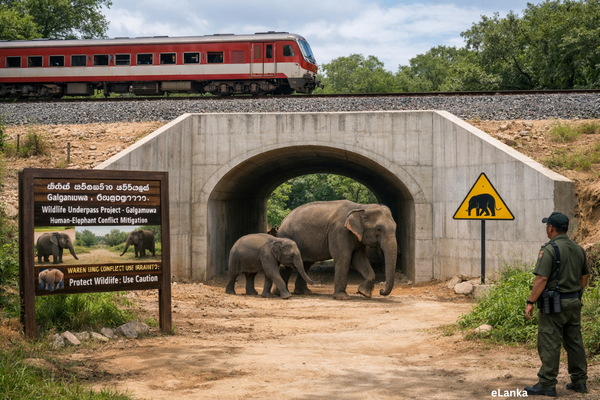
According to scholars, the new wildlife underpass at Galgamuwa in North Western Province which will be completed this month, will be a solution for the Human-Elephant Conflict (HEC). Galgamuwa is part of the Mahaweli Development Programme, the largest multipurpose national development programme in the country. Currently, construction of the elephant underpass is being completed beneath the railway line at Kasikote, between Galgamuwa and Ambanpola, an area well-known for frequent elephant crossings. A tunnel is constructed beneath the railway track to allow wild elephants to move safely from one side to the other, reducing the risk of train collisions as well as HEC.
In 1977, when the Accelerated Mahaweli Development Scheme was launched, vast extents of forest lands were logged to facilitate new settlements. This led to elephants losing their habitats.
According to senior engineers working on the project site, “construction work is expected to be completed in March 2026. The project would have been completed in early March, yet, the design phase of the project could not be finalised as there were challenges in controlling the movements of elephants towards the villages. During the rainy season, the slope that had already been cut was filled with water. Hence, those issues had to be addressed prior to its completion.”
Galgamuwa residents are of the view that “this is a key project that should have been completed several decades ago as over 300 people have died in the area due to HEC, while over 50 people are handicapped as a large number of houses were damaged by elephants in search of food. For many years, we have spent sleepless nights due to fear of elephants roaming villages at night. One or two officers of the Department of Wildlife Conservation (DWC) cannot handle several elephants at once.”
According to environmentalists “due to new settlements, there is lack of food in existing elephant migratory routes. To prevent elephant encounters, majority of villagers have set up electric fences which are useless as elephants cross the fences by felling large trees over them.”
“Kahalla-Pallekele sanctuary was declared in 1989 with the objective of declaring the area up to Kala Wewa and Balalu Wewa as a national park. Yet, after this declaration, illegal land grabbing and human activities have disturbed migratory routes that elephants have been using for many years. Subsequent governments dug trenches, thinking that it would discourage elephants from coming towards villages. But that too was unsuccessful. Elephants now destroy electric fences because there’s lack of maintenance. It is difficult for just one or two wildlife officers to manage these elephant fences. When there’s lack of fodder, they go to people’s backyards in search of vegetables and fruits grown in home gardens.”
In certain areas of Galagamuwa, community-based seasonal paddy field fences are constructed to avoid HEC. These are very successful as there is a direct incentive for the farmers to maintain and monitor the fence as their crops may be raided by elephants. In 2024, there were around 300 seasonal paddy field fences erected by Farmer Organisations supported by the Department of Agrarian Development. These seasonal paddy field fences contributed significantly to the number of elephant deaths decreasing from 488 in 2023 to 386 in 2024 as people kill elephants mainly when they raid their paddy or vegetable crops.
Scholars are of the view that “although, the project would be completed this month, it is necessary to monitor, at least for a period of one year, if elephants may get used to using the underpass, even though they may not use it immediately.”