Sunn hemp – solution for Sri Lanka’s fertiliser crisis – By Arundathie Abeysinghe

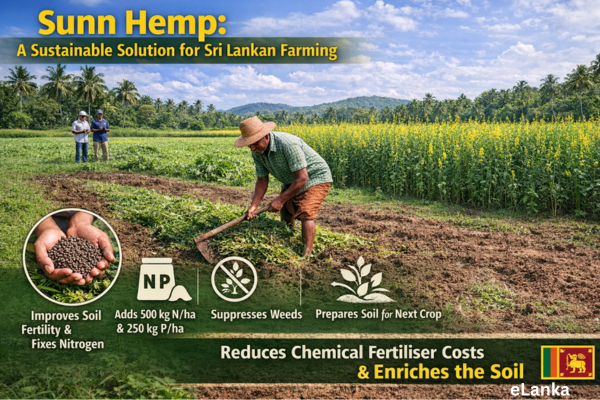
During the past several years, research studies have been conducted at the Faculty of Agriculture, University of Peradeniya to evaluate the suitability of Sunn hemp (Crotalaria juncea L.) for Sri Lankan farming systems, with special focus on the Dry Zone. According to research, Sunn hemp, being a legume, fixes atmospheric nitrogen into its biomass, which is later added to the soil during green manure incorporation. This significantly reduces the need for synthetic nitrogen fertiliser, saving farmers money while protecting the environment.
Senior officials of the Department of Agriculture recommend adding about 10 t/ha of organic matter, especially for their annual crops to improve soil conditions and crop performance. Generally, farmers use compost or cattle manure for this purpose. Some farmers add an organic input known as “green manure”.
According to Crop Scientists “there is another important category of organic inputs (green manure) consisting of fresh plant material, mainly green leaves. Sri Lankan farmers have used green manure for generations. The most popular green manure plant in Sri Lanka is Gliricidia Tithonia, which is known for adding nutrients and greater biomass to the soil.”
“Despite their benefits, Gliricidia plants are perennial in nature as they require separate space to grow and take several months to produce sufficient biomass. It is necessary to cut them and transport before incorporating into the soil. These limitations make their use less practical, especially for farmers managing annual crops. Hence, it is necessary to use an alternative short-duration crop that can be grown directly in the field for a few weeks and easily incorporated into the soil while it is still green. Sunn hemp is an annual leguminous crop with multiple benefits grown in many parts of the world. Brazil is the largest producer, using it mainly as forage and green manure. India, the second-largest producer, grows it for fiber production and green manuring. Developed countries such as the USA and Australia use Sunn hemp for ecological purposes including soil erosion control, weed suppression, nematode management, and soil improvement as it can grow well in low-fertility and harsh soils. It requires only minimal water for germination and grows vigorously with little care.”
“Sun hemp 50 percent flowering stage is the most suitable time for incorporating it into the soil. Under the Dry Zone conditions, this stage is usually reached around 50 days after planting. Sunn hemp also supplies around 500 kg N/ha and 250 kg P/ha, while significantly suppressing weeds. Sunn hemp biomass decomposes rapidly once incorporated into the soil. Within two weeks, farmers can establish their next cash crop. The enriched soil environment supports beneficial microorganisms and gradually releases nutrients, acting as a slow-release fertilizer,”
Scholars are of the view that “although, Sunn hemp is not yet a major cash or export crop in Sri Lanka, it has great potential as a farmer-friendly solution for improving soil health. One of the main challenges is the availability and cost of seeds, which is currently around Rs. 530 per kg. Cultivating one hectare requires an investment of approximately Rs. 53,000. Yet, the savings from reduced fertiliser use can exceed this cost several times and the long-term ecological benefits are even greater. Instead of admiring its yellow blooms, it is necessary to incorporate it into the soil while it is green and allow it to nourish Sri Lanka’s farming systems. As scientific research has already revealed its benefits, it is time for farmers and stakeholders to use this knowledge to enrich the soil, strengthen food production, and secure sustainable yields for the country.”