Assessing a U.S.-China State Visit: Visual Impact, Results, and the Constraints of Summit Diplomacy-by Harold Gunatillake

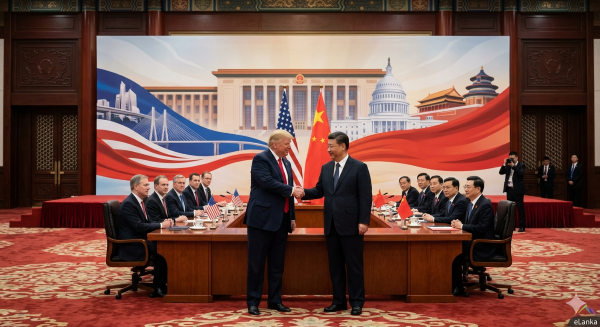
The characterisation of Donald Trump’s visit to China as a “success story” largely hinges upon the evaluative
perspective, given that the visit achieved notable symbolic and strategic diplomatic accomplishments; however, it did not result in considerable structural advancements in trade.
Constructive Tone: President Donald Trump and Chinese President Xi Jinping engaged in a notably positive and cordial dialogue, aiming to foster stability in U.S.-China relations. President Xi emphasised that “the great
rejuvenation of the Chinese nation and making America great again can go hand in hand.”
Geopolitical Discussions: The leaders participated in direct diplomatic talks concerning global hotspots, with President Trump asserting a shared commitment to ending the war in Iran and preventing nuclear proliferation.
Entourage Power: President Trump was accompanied by a prominent U.S. business delegation of leading CEOs from
firms including Apple, Tesla, Nvidia, and Boeing. This delegation aimed to project an image of robust economic negotiations, with Boeing reportedly securing a deal for 200 aircraft.
A neutral analysis of whether the visit could be deemed successful and whether the discussions regarding Iran
yielded any tangible results.
A diplomatic visit between the United States and China can be evaluated through at least two perspectives. One considers the ceremony, tone, and the public messages conveyed to both domestic and international audiences by each party. The other assesses measurable policy outcomes, such as signed agreements, narrowed disputes, or the establishment of new mechanisms to address future disagreements. Based on this criterion, the visit may be regarded as a qualified success.
It appeared to enhance the overall atmosphere of the relationship and yielded public assertions of progress; however, the available evidence does not demonstrate significant breakthroughs on the most challenging strategic issues. Official statements from the United States during the 2017 visit highlighted in-depth discussions, expanded cooperation, and the continuation of high-level dialogue mechanisms, particularly concerning trade and North Korea.
The Case for Declaring the Visit a Success
From a diplomatic perspective, the visit accomplished several significant objectives pertinent to great-power relations.
Firstly, both governments characterised the meetings as constructive, thereby signalling stability within a relationship frequently characterised by mistrust.
Secondly, the visit strengthened established communication channels initiated earlier in 2017, encompassing a broader dialogue framework that includes security, economics, law enforcement, cybersecurity, and social issues.
Thirdly, the trip resulted in highly visible commercial announcements, providing both parties with evidence of mutually beneficial cooperation. Even analysts who questioned the visit’s depth acknowledged that the optics were compelling and that the political atmosphere was markedly more amicable than many observers had anticipated.
The Limits of That Assessment
A more cautious interpretation suggests that the visit was more successful in its presentation than in its policy substance. The prominent commercial figures announced at the time attracted attention; however, external analyses observed that many of these deals were memoranda of understanding rather than legally binding agreements, thereby limiting their immediate significance.
More critically, the most challenging issues within the relationship remained unresolved.
Trade imbalances, strategic mistrust, and disagreements regarding regional security persisted despite cordial language and ceremonial hospitality. Expert commentary following the visit reflected this nuanced perspective: the trip may have fostered goodwill and short-term stability, but it did not evidently alter the fundamental structure of U.S.-China competition.
What Can Be Said About Private Discussions
It is challenging to verify claims that both leaders reached a consensus on most issues in private. Public addresses, official statements, and press engagements are crafted to convey selected messages rather than to reveal the full scope of confidential diplomacy. Consequently, a neutral analysis should refrain from implying widespread private agreement unless corroborated by documentary evidence. The more substantiated conclusion is that both parties publicly emphasised respect, cooperation, and ongoing dialogue, although significant disagreements persisted within the policy agenda.
This distinction is vital in analytical discourse, as summit diplomacy often leads to a disparity between optimistic rhetoric and actual implementation.
Has a decision been made regarding Iran?
Regarding Iran, the evidence supports a cautious conclusion. The official documentation from the 2017 visit does not specify Iran as a primary objective, instead emphasising the bilateral relationship, economic cooperation, and the North Korea issue.
Consequently, there is no definitive public basis to assert that a concrete decision was made during that visit to resolve the conflict in Iran. More recent reports on a subsequent summit similarly indicate discussions rather than resolutions: news coverage indicated that the leaders discussed Iran and the Strait of Hormuz, but no comprehensive agreement or formal decision was disclosed.
For an impartial account, the most precise formulation is that Iran may have participated in the discussions, but no publicly documented settlement resulted from the negotiations.
Xi Jinping issued unequivocal warnings concerning Taiwan, establishing explicit strategic boundaries. Conversely, Trump declared that he did not make any commitments to Xi regarding the Taiwan issue.
Different perspectives reveal that Western analysis and media have observed that, although Trump attained tactical stability and favourable optics, Xi Jinping effectively utilised the summit to establish a more enduring and assertive framework for managing the U.S.-China rivalry.
Conclusion
In neutral terms, the visit may be characterised as a diplomatic success in atmosphere, symbolism, and relationship management; however, it represents only a partial achievement on substantive policy matters.
It enhanced the presentation of cooperation and provided both parties with political material that could be positively showcased. Conversely, it did not conclusively resolve the fundamental disputes that define the relationship, nor did it result in publicly documented decisions regarding Iran.
This equilibrium is crucial for any fair assessment: summit meetings can help stabilise relations and shape perceptions without necessarily producing decisive policy breakthroughs.
For a detailed overview and diverse viewpoints on the summit, feel free to check out the BBC News Trump-Xi Summit Coverage. You can also explore insightful analysis from Firstpost Vantage to gain a broader understanding.
How successful was Donald Trump’s trip to China – BBC News –
President Donald Trump concluded his visit to Beijing following a two-day summit with Chinese President Xi Jinping, asserting that the discussions were ‘very successful.’ He stated that he had negotiated “fantastic trade deals, great for both countries,” although limited details have been disclosed regarding the specific agreements reached between the two superpowers.
Trade remained a high priority on the agenda despite recent tensions regarding the conflict in Iran. Business representatives anticipated securing significant agreements and extending the current tariff truce, which is scheduled to expire in November.
Xi calls for China and the US to be ‘partners not rivals’.
China Hosts Lavish Welcome Ceremony For Trump at the Great Hall, Beijing
Chinese President Xi Jinping hosted an elaborate state banquet for President Donald Trump in Beijing during the U.S. president’s official visit to China. Senior officials from the Trump administration and prominent business leaders, including Elon Musk and Jensen Huang, attended the dinner. President Xi expressed the view that China’s concept of “national rejuvenation” could align with President Trump’s “Make America Great Again” initiative.
Additionally, Trump extended an invitation to Xi to visit the White House on September 24th.
End