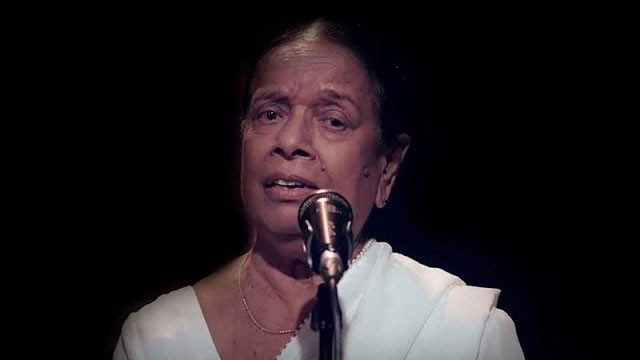
Veteran Sri Lankan singer Nanda Malini. (Source: Ada Derana)
Sri Lanka is remembering Visharad Dr Nanda Malini, one of the country’s most influential and beloved vocalists, whose voice and artistic principles helped shape the character of Sinhala music across several generations. She passed away at her home in Nawala on 20 August 2026, aged 82, bringing to a close a remarkable musical journey that had extended across nearly seven decades.
Although her passing has been received with deep sadness, Nanda Malini’s contribution is best understood through the enduring cultural presence she established. Her recordings, interpretations and disciplined approach to music remain woven into the memories of families in Sri Lanka and among Sri Lankan communities throughout Australia, the United Kingdom, Canada, New Zealand, the United States and other parts of the world.
A musical journey founded on discipline
Born on 23 August 1943 in Lewanduwa, Aluthgama, Nanda Malini displayed an aptitude for singing from a young age. According to biographical details reported by Ada Derana, her early musical development was encouraged by T. N. Margaret Perera, under whose guidance she was introduced to a wider public after winning a poetry competition.
That achievement led to an opportunity to sing on Radio Ceylon, where she performed on Karunaratne Abeysekera’s popular programme Lama Mandapaya. The early broadcast exposure became an important milestone, as radio remained one of the most powerful cultural institutions in Sri Lanka during that period, carrying music, poetry and performance into homes across the island.
Her development was not permitted to rest solely on early recognition. Training was continued under B. Victor Perera, followed by study at the Heywood Institute, while further musical education was undertaken at the Bhatkhande Music Institute in Lucknow, India, in 1963. She later obtained a Visharada degree in 1984, reflecting a lifelong commitment to technical excellence and continued learning.
The progression from a young singer on radio to a nationally respected artist was therefore built through a combination of natural ability, formal study and sustained artistic discipline. In an entertainment environment often influenced by changing fashions, Nanda Malini’s work was distinguished by its seriousness of purpose and by the care with which musical expression was approached.
A voice that gave Sinhala music depth
Nanda Malini’s importance extended well beyond vocal performance. Her voice possessed clarity, control and emotional range, while her interpretations were frequently marked by restraint rather than theatrical excess. Meaning was allowed to emerge through phrasing, tone and feeling, enabling the music to communicate with listeners in a manner that was intimate yet broadly accessible.
Her artistic repertoire addressed a wide range of human experiences, including love, memory, relationships, social realities and the emotional complexity of ordinary life. The words selected for her recordings were treated as an essential part of the musical experience, rather than as a secondary element placed beneath melody. That relationship between language and voice helped establish a distinctive standard within Sinhala popular music.
Her early association with leading figures in Sri Lankan music, including the celebrated composer and vocalist W. D. Amaradeva, further placed her within a significant chapter of the country’s modern musical history. Ada Derana reported that, after her return to Sri Lanka, she appeared on Amaradeva’s Madhuvanthi programme, where she performed songs including Sannaliyane and Ran Dahadiya Bindu Bindu. Such collaborations demonstrated her ability to work within sophisticated musical arrangements while retaining a recognisable personal identity.
The achievements accumulated during her career were reflected in the honours she received. Accessible reports confirmed that she won 11 Sarasaviya Awards and eight Presidential Awards for Best Singer, placing her among the most decorated vocalists in Sri Lankan cultural life.
These awards represent only the formal record of her achievement. The more substantial measure of her influence can be found in the continuing familiarity of her voice, the respect accorded to her artistic standards and the manner in which her work has remained relevant to listeners who encountered it at different stages of their lives.
A cultural legacy carried across generations
For many Sri Lankan families, music has served as an important vessel of memory. Songs heard in childhood, during family gatherings, religious occasions, journeys or quiet evenings at home often become connected with particular places and periods of life. Nanda Malini’s recordings occupy a significant place within that tradition, offering a bridge between personal recollection and the wider cultural experience of Sri Lanka.
For Sri Lankans living abroad, that connection has carried an additional significance. In Melbourne, Sydney, Perth, London, Toronto, Auckland and other cities where Sri Lankan communities have established new homes, Sinhala music continues to provide a means of maintaining linguistic and cultural continuity. Nanda Malini’s voice has formed part of that inheritance, enabling younger generations to encounter the sound, vocabulary and emotional textures of the heritage shared by their parents and grandparents.
Her contribution was particularly important because it demonstrated that popular music could be both accessible and intellectually substantial. Sinhala songs could engage with intricate emotions, meaningful poetry and the realities of human relationships without sacrificing melodic appeal. That balance remains one of the most valuable aspects of her artistic legacy.
Nanda Malini also helped affirm the role of the vocalist as an interpreter and cultural participant. Her work was not confined to the delivery of melodies; it involved an active engagement with language, composition and the social atmosphere in which songs were created. Through that commitment, music became a means of reflection, education and cultural expression, as well as entertainment.
The breadth of her legacy is evident in the continuing interest shown by musicians, researchers, broadcasters and listeners. Her career provides a significant reference point for understanding the development of Sinhala music during the second half of the twentieth century and into the modern era, while her recordings continue to offer younger artists an example of how technical skill and artistic integrity can be combined.
A nation pays tribute
Sri Lanka declared three days of national mourning from 21 to 23 August 2026 in recognition of Nanda Malini’s immense contribution to the country’s music and culture, according to Newswire.
Arrangements reported by Ada Derana stated that members of the public could pay their respects at the Nanda Malini Music Ashram, No. 30, Vijayaba Mawatha, Nawala Road, Nugegoda, from 10.00 a.m. on Friday, 21 August, until 3.30 p.m. on Saturday, 22 August.
Her final rites were scheduled for 5.00 p.m. on Saturday, 22 August, at the General Cemetery in Borella. The arrangements reflected the exceptional place she held in the national consciousness, while also providing an opportunity for listeners and admirers to acknowledge a lifetime devoted to Sri Lankan music.
A voice that remains part of Sri Lanka
The passing of Nanda Malini marks the end of an era, but it does not signal the disappearance of her music. A recording preserves more than a performance; it retains the sound of a language, the artistic values of a period and the emotional atmosphere through which listeners came to understand themselves and their society.
Her voice will continue to be heard in homes, classrooms, cultural programmes and community gatherings, including those organised by Sri Lankans living beyond the island. It will continue to accompany recollections of home and to introduce younger listeners to the depth and versatility of Sinhala musical expression.
Sri Lanka’s cultural identity has been shaped by artists who transformed personal talent into a shared national inheritance. Nanda Malini was instrumental among them. Through a career defined by musical knowledge, interpretive strength and an unwavering respect for meaningful Sinhala music, she gave generations of listeners a body of work that remains dignified, resonant and enduring.
Her golden voice may have fallen silent, but the musical legacy of Visharad Dr Nanda Malini remains firmly embedded in Sri Lanka’s cultural memory and in the hearts of the global Sri Lankan community.
Sources and additional references
Source: https://island.lk/veteran-singer-nanda-malini-perera-passes-away-at-the-age-of-82/
This article was written based on the source https://island.lk/veteran-singer-nanda-malini-perera-passes-away-at-the-age-of-82/, kindly email us at info@eLanka.com.au if any information needs to be corrected.
Additional references:
Feature Image : youtube.com