


Two Sri Lankan workers who helped rescue South Korean Air Force pilots from the Yellow Sea in 2022 have been granted long-term residency status, in a decision that formally recognises an act of courage carried out far from their homeland and highlights the constructive contribution made by Sri Lankan workers to communities overseas.
South Korea’s Ministry of Justice granted the two men Skilled Worker Visa status, known as E-7-4, on Friday, 21 August 2026. The decision was made in recognition of their exceptional contribution to the national interest after they assisted in saving two pilots whose fighter jet had crashed into the sea near Hwaseong, in Gyeonggi Province.
The identities of the two men were not disclosed in the reports issued by South Korean authorities. Their anonymity has therefore been retained in this article, while the verified details of their rescue and official recognition have been carefully preserved.
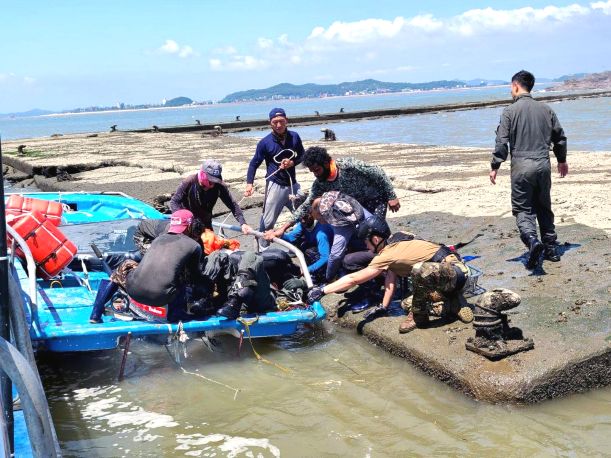
A rescue carried out at sea
The incident occurred on 12 August 2022, approximately 45 kilometres south of Seoul, when the Sri Lankan workers were employed aboard a fishing boat operating off the coast of Hwaseong. A South Korean Air Force fighter jet suffered an engine fire before crashing into the Yellow Sea, forcing its two pilots to eject over the water.
The workers noticed the emergency and, together with the vessel’s South Korean captain, moved towards the area where the pilots had fallen. The men were brought out of the water and taken to safety, an intervention that proved instrumental during a critical period in which every minute carried considerable importance.
The rescue was undertaken by civilian maritime workers who were engaged in ordinary duties, rather than by a specialised military rescue unit. The circumstances demonstrated how local knowledge, alertness and immediate cooperation can become decisive when an emergency develops in a difficult marine environment.
The two Sri Lankan workers had entered South Korea under the Employment Permit System and were holding E-9 visas, which are generally issued to foreign workers employed in sectors experiencing labour shortages. At the time, the men were contributing to the country’s coastal fishing industry, a demanding area of work in which stamina, practical knowledge and close coordination are required.

Recognition from the South Korean Air Force
The men’s actions were subsequently recognised by the South Korean Air Force. In May 2026, they received a letter of appreciation from the Air Force chief of staff for their role in helping to save the two pilots.
That acknowledgement established that the rescue had not been regarded as an incidental act, but as a significant contribution to public safety. It also provided an official record of the assistance given by the Sri Lankan workers, whose response had been carried out under demanding conditions at sea.
The recognition carries particular significance because the men were working under temporary employment arrangements at the time of the incident. Their original E-9 status allowed a maximum stay of four years and 10 months, meaning that their ability to remain in South Korea was governed by a defined employment and immigration framework.
The award of E-7-4 status has therefore provided more than ceremonial recognition. It has created a more secure legal foundation for their continued employment and residence, allowing their future in South Korea to be shaped by long-term stability rather than by the limitations associated with their original temporary-worker visas.
What the E-7-4 status provides
The E-7-4 Skilled Worker Visa is a residency status intended for foreign workers whose skills and contributions are considered valuable to South Korean society and industry. Under the arrangement announced by the Ministry of Justice, the two men may initially remain in South Korea for up to two years.
Their status may then be renewed in two-year increments without a limit on the number of extensions, provided the relevant requirements continue to be met. The arrangement offers considerably greater continuity than the E-9 system, under which employment and residence are more closely connected to temporary labour arrangements.
The status does not represent automatic Korean citizenship or an unconditional grant of permanent residency. It does, however, establish a recognised long-term pathway and gives the two workers greater opportunity to continue their lives and employment in South Korea.
The third Sri Lankan worker who participated in the rescue had already obtained long-term residency status, according to the Ministry of Justice. Consequently, the latest decision completed the process of granting more secure residency arrangements to the other two men involved in the rescue.

A positive example of contribution overseas
The decision has significance beyond the individual circumstances of the two workers. It demonstrates how the actions of Sri Lankan expatriates can strengthen relationships within the communities where they live and work.
Sri Lankans employed overseas contribute in many different ways, including through professional expertise, skilled trades, hospitality, healthcare, agriculture, transport and maritime industries. While many contributions occur quietly through regular employment and community participation, moments of crisis can reveal the depth of responsibility and solidarity that individuals are prepared to demonstrate.
In this case, the workers’ response was direct and practical. They recognised that people were in danger, altered the course of the fishing vessel and assisted the South Korean captain in bringing the pilots to safety. The subsequent commendation from the Air Force and the decision by the Ministry of Justice have placed that action within an official framework of public service.
The decision also reinforces the value of fair recognition for foreign workers who make exceptional contributions. Stable residency arrangements enable such workers to continue contributing to the communities in which they have established their working lives, while also providing greater security for their families and personal futures.
Justice Minister Jung Sung-ho said the Ministry of Justice would continue supporting foreign nationals who had made special contributions to South Korean society so that they could live stably in the country. That statement reflects an important principle: social belonging can be strengthened when courage, responsibility and service are acknowledged irrespective of nationality.
A story of courage and community
The rescue near Hwaseong took place four years before the residency decision was announced, yet its importance has remained clear because the men’s actions were followed by sustained official recognition. The letter from the Air Force chief of staff and the E-7-4 status granted by the Ministry of Justice together provide a comprehensive acknowledgement of both their immediate bravery and their continuing value as workers in South Korea.
For Sri Lankans living in Australia, the United Kingdom, the United States, Canada, New Zealand, South Korea and other countries, the story offers a positive reminder that individual conduct can influence how communities are understood. It presents Sri Lankan workers not merely as participants in overseas labour markets, but as active members of the societies in which they live, capable of responding with courage when fellow human beings face danger.
eLanka, which has connected Sri Lankans in Australia and around the world since 2005, continues to share constructive stories about Sri Lankan achievements, service and community contribution through its online platform. The Hwaseong rescue is precisely the kind of positive international story that illustrates the strength, compassion and practical ability found within the global Sri Lankan community.
The two workers’ journey from temporary employment status to long-term residency has consequently become a story not only about a rescue at sea, but also about recognition, responsibility and the enduring value of service.
This article was written based on the source https://www.newswire.lk/2026/08/21/four-years-after-saving-korean-pilots-sri-lankan-workers-gain-long-term-visas/, kindly email us at info@eLanka.com.au if any information needs to be corrected.
(adsbygoogle = window.adsbygoogle || []).push({});
At eLanka, we respect the rights of creators. If we have used an image you own and you’d like it removed, please email us at info@elanka.com.au and we’ll handle it promptly.