Port City Colombo and the Business of Staying Longer: A New Hub for Global Digital Industries

Where a company establishes its next regional operation has become a far more strategic decision than it once was. The question is no longer limited to identifying a location with competitive operating costs or an available pool of skilled workers; instead, globally mobile businesses are assessing how a jurisdiction can support long-term resilience, market access, regulatory confidence and the gradual development of higher-value capabilities.
This changing approach is placing greater attention on Port City Colombo, Sri Lanka’s first multi-service Special Economic Zone (SEZ), which is positioning itself as a complementary operating location for digital industries extending across the Middle East–South Asia corridor.
The strategic opportunity has been examined in the Daily FT article Port City Colombo and the Business of Staying Longer, published on 14 September 2026, and in the related CXO Insight Middle East feature, The expansion equation: Port City Colombo and the changing geography of growth, published on 10 September 2026. Together, the reports present Port City Colombo as part of a broader shift from short-term, opportunistic expansion towards strategic anchoring, in which companies establish platforms capable of supporting multiple markets and functions.
From expansion to strategic anchoring

Thulci Aluwihare, Deputy Managing Director, CHEC Port City Colombo, described the changing logic behind international expansion in the CXO Insight Middle East interview.
“We are seeing a shift from opportunistic expansion to strategic anchoring. Companies are no longer simply expanding into established hubs. Increasingly, they are evaluating jurisdictions based on long-term outcomes such as regulatory predictability, capital mobility, digital infrastructure, talent depth, cost efficiency, and proximity to multiple markets.”
This assessment reflects a wider transformation in the way technology companies, professional services firms and digitally enabled enterprises organise their international operations. A regional office is increasingly expected to perform more than a sales or administrative function; it may also support research, software engineering, customer experience, data operations, finance, product development, business continuity and regional leadership.
Aluwihare further observed that “there is a noticeable move toward regional platforms rather than single-country operations”, with risk diversification and operational continuity being considered alongside growth potential. For companies serving clients across several time zones, a strategically located platform can therefore provide a more flexible foundation than a single-market branch.
Port City Colombo is seeking to respond to this requirement by offering an internationally oriented regulatory and commercial environment within Sri Lanka, while also drawing on the country’s existing services and technology capabilities.
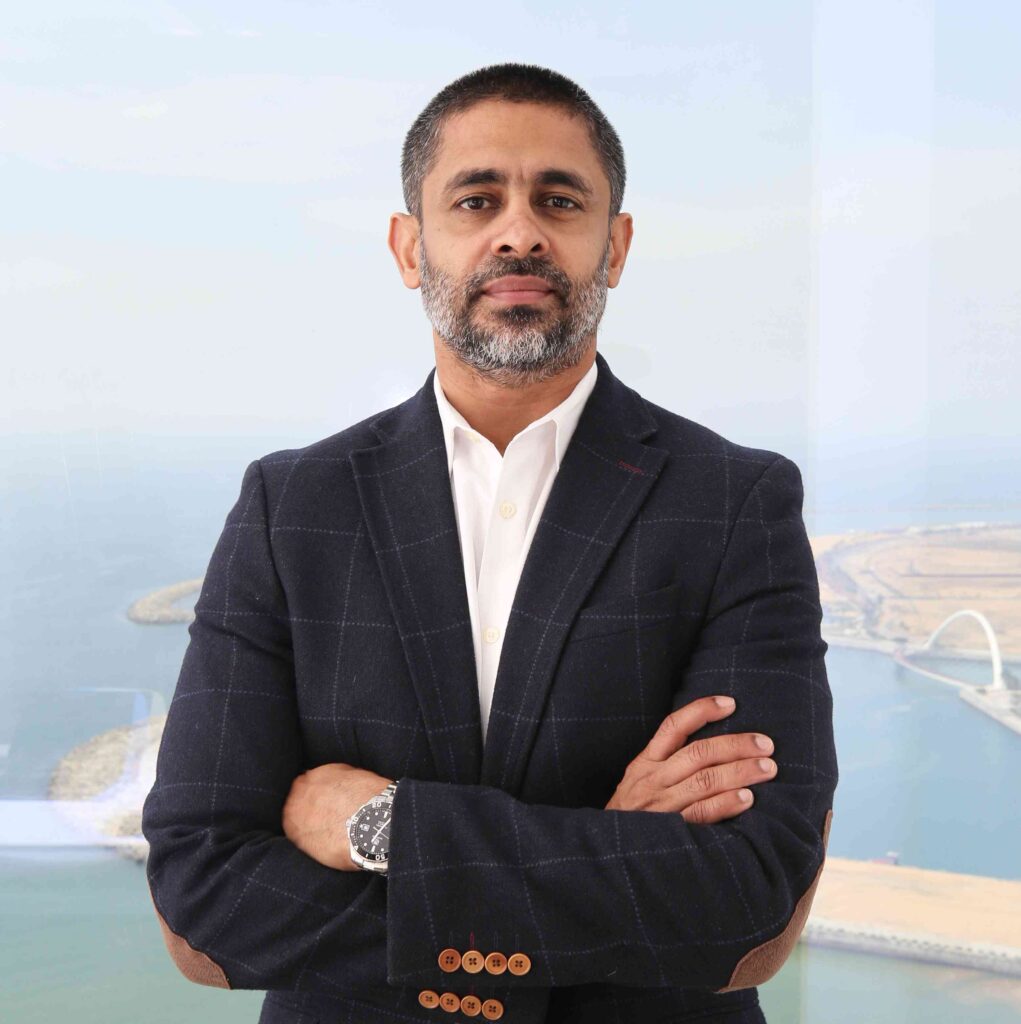
Thulci Aluwihare, Deputy Managing Director, CHEC Port City Colombo. Image credit: CXO Insight Middle East.
A structured framework for international businesses
Port City Colombo operates under the Colombo Port City Economic Commission Act of 2021, which established a distinct framework administered through a single-window authority. The Commission is empowered to licence, regulate and facilitate businesses operating within the zone, with the intention of reducing administrative friction and providing a more coordinated pathway for international enterprises.
The SEZ framework includes several features designed to support globally oriented companies:
- 100 percent foreign ownership;
- no cap on foreign employment;
- transactions in 16 designated foreign currencies;
- enhanced capital mobility;
- concessionary corporate income tax rates for eligible businesses;
- customs and border tariff waivers during the business set-up phase;
- investment protection mechanisms embedded in law and contract;
- a dedicated International Commercial Dispute Resolution Centre;
- provisions supportive of Sharia-compliant finance and Islamic banking; and
- no minimum investment threshold for access to fiscal and non-fiscal benefits.
The absence of a minimum investment threshold is particularly relevant to technology businesses, because digital expansion does not always begin with large physical assets or substantial capital expenditure. A specialist software team, an artificial intelligence research unit or a small regional management office may initially require a modest footprint before its operations expand in response to customer demand.
This staged model can allow a company to establish a presence, assess regional requirements and increase its commitment over time, while retaining access to a framework intended for larger and more complex operations.
The wider objective is to create a rules-based environment aligned with international governance expectations, while providing commercial flexibility for enterprises that operate across borders. The dedicated dispute resolution mechanism and the provisions relating to international finance are intended to strengthen confidence among businesses that require clarity when entering a new jurisdiction.
Sri Lanka’s technology base provides a foundation
Port City Colombo’s proposition is supported by Sri Lanka’s existing information and communications technology sector. According to the CXO Insight Middle East feature, the country’s ICT industry generates approximately US$1.2 billion in exports, employs more than 140,000 professionals and includes more than 500 ICT companies.
Sri Lanka’s national Digital Economy Strategy has set a target of US$5 billion in ICT exports by 2030, reflecting an ambition to expand beyond conventional outsourcing and establish a stronger presence in software, engineering, digital services, innovation and technology-enabled business.
Sri Lanka also produces approximately 30,000 graduates annually, while its universities and vocational institutions continue to contribute to the professional pipeline. For international firms, the value of this workforce lies not only in numerical capacity, but also in its experience of serving overseas clients across software development, enterprise solutions, business process management and information technology-enabled services.
English-language proficiency, geographic proximity to markets across the Indian Ocean and the country’s established services history can offer a useful base for companies seeking a complementary location rather than a complete replacement for existing offices in the Gulf, South Asia or Southeast Asia.
The early composition of Port City Colombo’s registrants offers an indication of this potential. IT and ITES companies account for nearly 50 percent of early registrants, suggesting that service-led enterprises are among the first to recognise the advantages of a digitally connected SEZ.
From BPM and BPO to global capability centres
Business Process Management and Business Process Outsourcing operations may provide an accessible entry point for companies establishing a regional presence. These operations can often be launched more quickly than capital-intensive industrial projects, while creating an initial platform for customer support, finance, administration, data processing and other business services.
The longer-term opportunity is for such operations to evolve into Global Capability Centres, or GCCs, which undertake more sophisticated functions for multinational organisations. These may include software development, cybersecurity, analytics, finance, research, engineering and product support.
Port City Colombo is also seeking to attract nano-GCCs: small, highly specialised teams working in artificial intelligence, research and development or product engineering. Such teams compete primarily through expertise and innovation rather than headcount, making them particularly relevant to a market that is building its position in the international technology economy.
Other opportunities identified in the source material include:
- regional headquarters;
- global delivery centres;
- innovation laboratories;
- data infrastructure;
- business continuity facilities;
- artificial intelligence operations;
- product engineering teams; and
- specialised research and development units.

The IT Park at Port City Colombo. Image credit: CXO Insight Middle East.
These functions can contribute to a deeper technology ecosystem because they connect companies with universities, service providers, professional advisers, infrastructure partners and local talent. The resulting network may be more valuable than the presence of individual firms considered in isolation.
Supporting higher-value digital services
The Hon. Eng. Eranga Weeraratne, Deputy Minister of Digital Economy, Sri Lanka, linked Port City Colombo with the country’s wider technology ambitions.
“Port City Colombo complements this vision by providing a structured, internationally aligned platform that enables IT and BPM enterprises to establish regional operations with regulatory clarity and operational efficiency.”
He further stated:
“As the sector accelerates, platforms such as Port City Colombo can play a pivotal role, not only in attracting new investment, but in anchoring higher-value digital services, fostering innovation, and positioning Sri Lanka as a trusted regional technology hub.”
This emphasis on higher-value activity is important because the next stage of Sri Lanka’s technology development will depend on moving steadily up the value chain. The country’s established services sector provides a useful starting point, but sustained progress will require investment in research, advanced computing, secure data environments, specialised skills and collaboration between businesses and educational institutions.
Artificial intelligence is likely to intensify these requirements. AI-led enterprises need reliable connectivity, protected data infrastructure, computing capacity and access to professionals who can develop, manage and commercialise new technologies. Port City Colombo’s planned infrastructure and integrated urban framework are intended to accommodate these requirements as the technology ecosystem develops.
A convergence point across three regions
Port City Colombo’s geographical position gives the project a distinctive regional context. Sri Lanka sits at the intersection of South Asia and the Indian Ocean, with established connections to the Middle East, Southeast Asia and East Africa.
For Gulf-based companies, a Sri Lankan operating location may provide access to South Asian talent and delivery capacity while remaining connected to Middle Eastern markets. For South Asian enterprises, the SEZ may offer a platform for international expansion, foreign-currency transactions and regional coordination. For global companies, it may function as one component of a distributed operating model designed to balance talent, costs, continuity and market proximity.
Aluwihare described the broader vision as positioning Port City Colombo “as a regional convergence point for globally mobile digital industries, bridging South Asia, the Middle East, and Southeast Asia”.
That ambition will require consistent implementation, continued infrastructure development, strong talent retention and sustained confidence in the regulatory framework. Nevertheless, the convergence of policy, location, digital capability and international demand presents a constructive opportunity for Sri Lanka.
For Sri Lankan businesses and professionals living in Australia and other parts of the global Sri Lankan community, this development may also create new avenues for collaboration, technology partnerships and cross-border enterprise. eLanka’s Business Directory provides a platform through which businesses can promote their services, while its news and articles section continues to share developments relevant to Sri Lankans worldwide.
The business of “staying longer” is therefore not limited to extending a visitor’s time in Colombo. In the context of digital industries, it represents the deeper objective of encouraging companies to establish enduring operations, develop local capability and use Sri Lanka as a dependable platform for regional growth.
Source: https://www.ft.lk/business/Port-City-Colombo-and-business-of-staying-longer/34-797191
This article was written based on the source https://www.ft.lk/business/Port-City-Colombo-and-business-of-staying-longer/34-797191, kindly email us at info@eLanka.com.au if any information needs to be corrected.
This article was written based on the source https://www.cxoinsightme.com/feature/the-expansion-equation-port-city-colombo-and-the-changing-geography-of-growth/, kindly email us at info@eLanka.com.au if any information needs to be corrected.
(adsbygoogle = window.adsbygoogle || []).push({});
At eLanka, we respect the rights of creators. If we have used an image you own and you’d like it removed, please email us at info@elanka.com.au and we’ll handle it promptly.