Sri Lankan Scientist Themiya Nanayakkara Helps Uncover the Oldest Fast Radio Burst From 10 Billion Years Ago

AI-generated illustration based on the source material. A clearly usable authentic portrait of Themiya Nanayakkara was not available from the source, so no source photograph of him is embedded.
A Sri Lankan scientist has contributed to an international discovery that offers astronomers a rare glimpse into the early universe. Themiya Nanayakkara was a co-author on research identifying the most distant fast radio burst yet precisely traced to its host galaxy: a brief signal from a galaxy that existed when the universe was about three billion years old.
The findings were published in the scientific journal Science. They could help researchers investigate how galaxies and matter changed over cosmic time, as well as the immense, largely unseen structures known as the cosmic web.
The research was led by University of Sydney astrophysicist Dr Manisha Caleb and involved an international team. Nanayakkara, also of the University of Sydney, was identified as a co-author. The achievement places a Sri Lankan scientist among researchers working at the frontier of astrophysics, using some of the world’s most powerful radio and space telescopes to study events from the distant past.
A signal from the early universe
The burst, designated FRB 20240304B, was detected on 4 March 2024 by the MeerTRAP project using the MeerKAT radio telescope in South Africa. MeerKAT’s radio observations located the signal with precision and indicated that it was exceptionally distant. To establish its distance, however, the team needed to identify the galaxy from which it originated.
That proved challenging: the host galaxy was too faint to be seen by the ground-based telescopes initially used to examine the area. The researchers subsequently turned to NASA’s James Webb Space Telescope, whose infrared instruments detected the faint galaxy and measured its redshift at 2.148. That measurement places the burst at a time when the universe was about three billion years old.
The signal had travelled for more than 10 billion years before reaching Earth. In that sense, it provides a view of a cosmic event from an era long before the Sun and the solar system existed. The galaxy itself should not be described as having existed 10 billion years after the Big Bang: rather, it existed when the universe was roughly three billion years old, and its radio signal crossed the intervening space over billions of years.

AI-generated illustration of a distant fast radio burst and a radio telescope array. It is a visual representation, not an image of the recorded signal.
What are fast radio bursts?
Fast radio bursts, commonly known as FRBs, are extremely powerful flashes of radio waves that last only a few milliseconds. Although brief, a burst can release as much energy as the Sun produces over several days. Their short duration and strength allow astronomers to detect them across vast cosmic distances.
Their precise origins remain uncertain. Researchers have proposed that some FRBs may be produced by magnetars: highly magnetised neutron stars, the compact remnants left behind after certain massive stars collapse. The source of each burst cannot simply be assumed, however, and scientists continue to investigate how these signals are generated.
The properties of FRB 20240304B’s host galaxy provide clues, but not a final answer. Webb revealed a small, actively star-forming dwarf galaxy, substantially less massive than the types of galaxies commonly associated with previously studied FRBs. Its stars appear to have formed rapidly during a period when star formation across the universe was near its peak.
That setting is relevant to the competing explanations for FRBs. A merger between two neutron stars may take a long time to occur, while a young magnetar could form following the collapse of a massive star and produce an energetic event sooner. The team’s observations make a young magnetar a plausible explanation for this burst, but the origin of FRBs as a broader class remains unresolved.
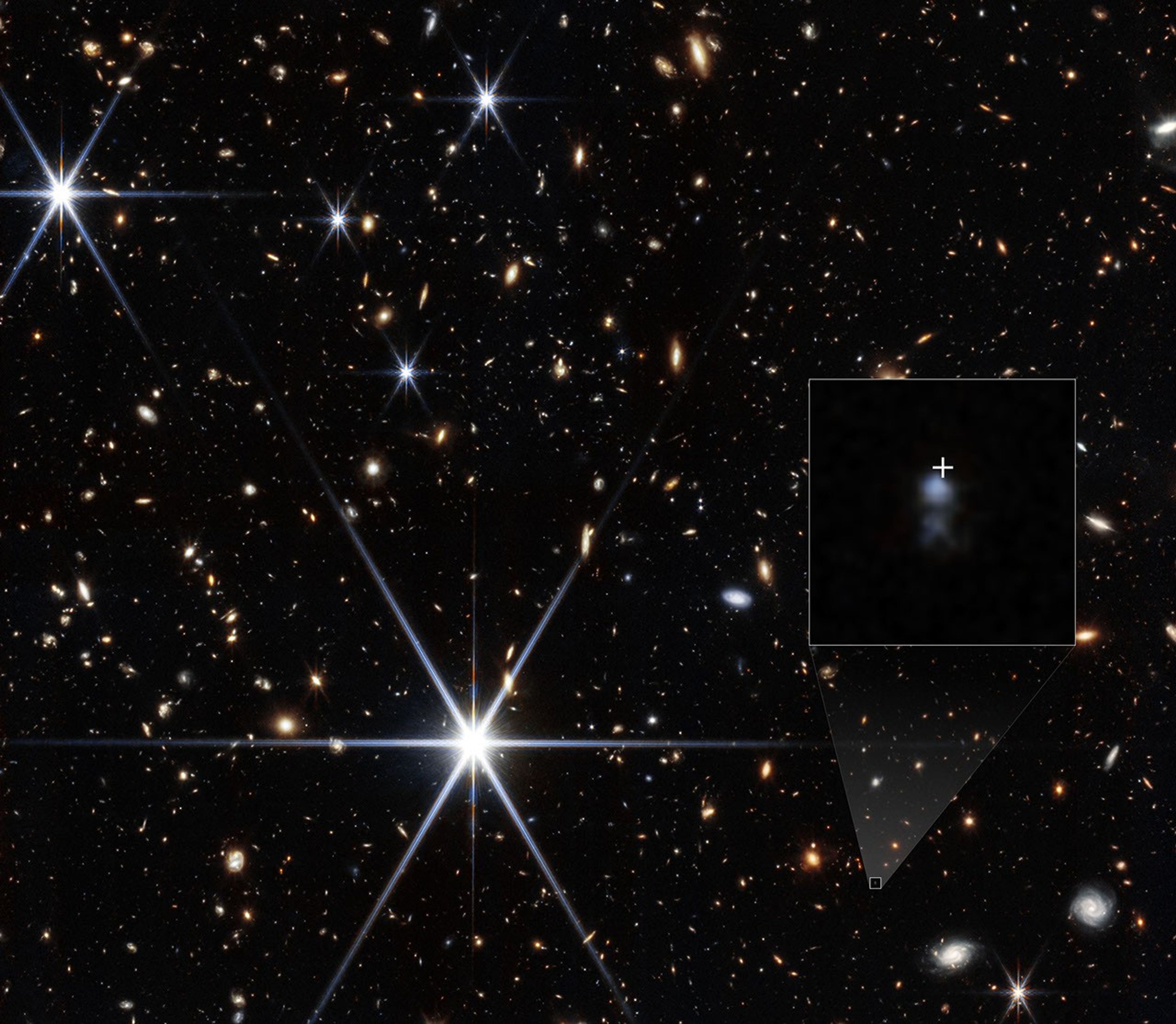
NASA’s James Webb Space Telescope image of the field containing FRB 20240304B’s host galaxy; the burst’s location is indicated by a white cross. The small host galaxy is actively forming stars. Image credit: NASA, ESA, CSA, STScI and Themiya Nanayakkara (University of Sydney); image processing by Joseph DePasquale (STScI).
A potential tool for mapping the cosmic web
The significance of the discovery extends beyond setting a distance record. As an FRB travels through space, its signal is affected by matter along the route. Astronomers can study these changes to learn about material that may be difficult to observe directly.
That possibility is important because ordinary matter is spread across a vast network of filaments and structures known as the cosmic web. Distant FRBs may act as probes of this network, helping researchers trace matter between galaxies and build a more detailed picture of how it is distributed. The team also reported evidence of intervening structures along the signal’s path, illustrating how a burst can carry information about more than its place of origin.

AI-generated illustration of the cosmic web and a signal passing through matter between galaxies. The visual is illustrative and does not represent a direct observation.
In comments reported by Australia’s ABC News, Dr Caleb described the discovery as extraordinary, noting that the signal began its journey billions of years before the Sun and solar system existed. Her observation captures the remarkable timescale involved, while the research itself provides the measurements that make the finding scientifically significant.
As reported by Newswire, the finding from the team led by Dr Caleb, with Nanayakkara as a co-author, has been widely covered as the oldest fast radio burst ever recorded, and it continues to draw international attention to the role Sri Lankan researchers are playing in contemporary astrophysics.
The study also demonstrates how different instruments can contribute complementary evidence. MeerKAT detected and localised the radio burst, while Webb’s infrared observations enabled the team to identify and measure the distant host galaxy. Neither observation alone provided the full picture: the radio signal led researchers to a precise position, and the space telescope helped establish where in cosmic history the event occurred.

AI-generated illustration of a space telescope studying a faint early-universe galaxy. It is not a photograph of Webb or the FRB 20240304B host.
A contribution with an inspiring reach
Nanayakkara’s co-authorship is a point of pride for Sri Lankans at home and abroad, and a reminder that research teams addressing fundamental questions about the universe draw on expertise from across the world. The reported result is not only a milestone in astronomy; it also shows how advanced observations, international collaboration and careful analysis can extend the boundaries of what researchers are able to study.
For young Sri Lankans considering science, the work offers a meaningful example of participation in a field where questions cross national borders and span billions of years. Nanayakkara’s contribution forms part of a collaborative effort involving radio astronomy in South Africa, observations from NASA’s Webb telescope and researchers working across international institutions.
The team hopes that further discoveries of distant FRBs will give astronomers additional opportunities to investigate how galaxies and matter evolved over time. For now, FRB 20240304B stands as a striking example of how a signal lasting only milliseconds can carry information across the universe, and how Sri Lankan scientific talent is contributing to the effort to interpret it.
Sources: Newswire; NASA; South African Radio Astronomy Observatory; Science research paper; ABC News.
This article was written based on the source https://www.newswire.lk/2026/10/09/sri-lankan-scientist-helps-uncover-oldest-fast-radio-burst-from-10-billion-years-ago/, kindly email us at info@eLanka.com.au if any information needs to be corrected.
At eLanka, we respect the rights of creators. If we have used an image you own and you’d like it removed, please email us at info@elanka.com.au and we’ll handle it promptly.
Thanks.
eLanka team
eLanka Disclaimer
Content published on eLanka may be created by the eLanka team, submitted by contributors or third parties, reproduced or adapted from other sources with appropriate source acknowledgement, or provided as promotional/advertising material by our clients. While eLanka takes reasonable care in preparing and publishing content, we do not warrant its completeness or accuracy. Views expressed are those of the respective authors or contributors and do not necessarily represent the views of eLanka. Third-party contributors, content providers and advertisers are responsible for the accuracy of material they supply and for ensuring they hold the necessary rights and permissions for its publication. Advertising and promotional content should not be regarded as an endorsement by eLanka of any product, service or claim.