


Looted from Kandy in 1765, Two Maha Thuwakku Wall Guns Are Coming Home from the Netherlands
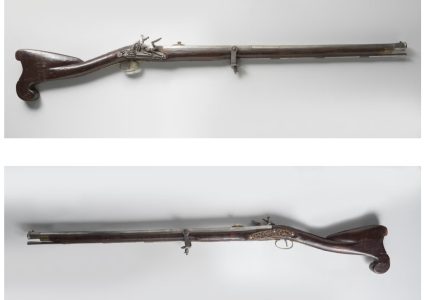
Photograph: Newswire.
Two centuries-old Sri Lankan wall guns held at Amsterdam’s Rijksmuseum are to be returned to Sri Lanka, following a decision announced by the Netherlands on 26 November 2026. The weapons have been identified as traditional Maha Thuwakku, and their return will be the second restitution of this kind to Sri Lanka, following the return of two other wall guns in 2023.
The announcement brings renewed attention to an object whose purpose was bound to the defences of the Kingdom of Kandy. A wall gun was designed to be supported or mounted on a rampart, where it could be used from a fortified position; it was not simply a firearm intended to be carried and used like a smaller hand-held weapon. In that sense, a Maha Thuwakku is not merely an object from a museum collection, but a material connection to the kingdom’s military history.
The two guns are currently held at the Rijksmuseum in Amsterdam. According to the Newswire report, one bears inscriptions linking it to the King of Kandy, a detail that gives the object particular historical significance.
An inscription, and the work of establishing provenance
The inscription is a striking clue, but the return decision rests on more than a single mark. The independent Colonial Collections Committee recommended the restitution following provenance research conducted by the Rijksmuseum in close collaboration with Sri Lankan experts. Rianne Letschert, the Netherlands’ Minister of Education, Culture and Science, approved the return after considering the committee’s recommendation.
That collaboration deserves particular recognition. Provenance research traces an object’s history of ownership and movement, drawing on records and evidence to understand how it came to be held in a collection. In this case, working with Sri Lankan experts helped bring knowledge of the weapons’ cultural and historical context together with research into their past. The result was an assessment that supports their identification as Maha Thuwakku and connects them to events in Kandy.
The inscriptions on one gun, linking it to the King of Kandy, are among the meaningful details in that story. They help establish a connection between an individual object and the history of the kingdom from which it was taken. Yet such clues become most useful when they are considered alongside documentary research, institutional records and expertise from the country of origin.
The Dutch government’s announcement describes the committee’s recommendation as based on research carried out by the Rijksmuseum in close collaboration with Sri Lankan experts. It also notes that the guns share a provenance with two other weapons returned to Sri Lanka in 2023.

AI-generated illustration based on the source image; it is illustrative and does not depict the historic guns as an authenticated museum photograph.
The history behind their removal
The Dutch government states that Dutch troops attacked and destroyed Kandy and its royal palace in 1765, and that weapons and ammunition were among the items looted. The two wall guns are believed to have been taken during that attack.
Kandy was then an independent kingdom in the island now known as Sri Lanka. The return announcement does not provide a date for the formal transfer, and one has yet to be determined. For now, the announcement marks an important step: the decision has been made, while practical arrangements for the handover remain to follow.
The Dutch government has described the restitution of cultural objects involuntarily lost during the colonial period as contributing to the redressing of historical injustice. That is the government’s stated framing of the decision. The announcement also reflects the role of a formal process: a committee reviews provenance research and makes an independent recommendation, after which the responsible minister decides whether to approve a return.
For Sri Lankan readers, including those living far from the island, the story carries a quieter significance as well. Objects separated from their place of origin can remain part of a community’s historical memory, even when they are kept in collections overseas. A return offers an opportunity for renewed access and connection, and for the object to be understood within the history and cultural setting from which it came.
A second return, following 2023
The forthcoming transfer follows the return of two other guns to Sri Lanka in 2023, with which these two share a provenance. The new announcement therefore continues a process already under way, rather than standing alone.
That earlier return provides a useful point of reference. It showed how an object’s movement into a foreign collection can be examined through research, and how its return can support public understanding of the history it represents.
The Rijksmuseum describes its role in restitution as that of a custodian of objects owned by the Dutch State; decisions on restitution are made by the responsible minister. The museum’s work on provenance research is therefore central to establishing the history of an object, while the committee and government carry distinct responsibilities in reviewing recommendations and deciding on returns.
The formal handover will provide the next milestone. No date has been set, but the announcement gives Sri Lanka, the Netherlands and the public an opportunity to look forward to the guns’ return and to the further research and interpretation that may accompany it.
Bringing a distant object into closer view
The story of the Maha Thuwakku wall guns is, in part, a story about how historical knowledge is assembled. The inscription connecting one gun to the King of Kandy offers an unusually direct link to the kingdom. The provenance research, conducted in collaboration with Sri Lankan experts, places that clue within a fuller historical account. Together, they help explain why the weapons are not simply anonymous museum objects.
Their return will not erase the events of 1765, nor does the announcement suggest that it should. Rather, the decision creates a practical means for these objects to be brought back into a Sri Lankan context and for their history to be shared with a wider public. The next chapter will be the formal transfer, when arrangements between the relevant parties have been completed.
For those interested in Sri Lankan heritage across the world, the announcement is a reminder that important pieces of the island’s past can be held far from home, and that careful, cooperative research can help clarify their stories.
Sources: Newswire, 26 November 2026 and Government of the Netherlands, “The Netherlands returns two guns from the Rijksmuseum to Sri Lanka”, 26 November 2026.
This article was written based on the sources https://www.newswire.lk/2026/11/26/stolen-over-260-years-ago-two-historic-sri-lankan-guns-set-to-return-home/ and https://www.government.nl/latest/news/2026/11/26/the-netherlands-returns-two-guns-from-the-rijksmuseum-to-sri-lanka, kindly email us at info@eLanka.com.au if any information needs to be corrected.
At eLanka, we respect the rights of creators. If we have used an image you own and you’d like it removed, please email us at info@elanka.com.au and we’ll handle it promptly.
Thanks.
eLanka team
eLanka Disclaimer
Content published on eLanka may be created by the eLanka team, submitted by contributors or third parties, reproduced or adapted from other sources with appropriate source acknowledgement, or provided as promotional/advertising material by our clients. While eLanka takes reasonable care in preparing and publishing content, we do not warrant its completeness or accuracy. Views expressed are those of the respective authors or contributors and do not necessarily represent the views of eLanka. Third-party contributors, content providers and advertisers are responsible for the accuracy of material they supply and for ensuring they hold the necessary rights and permissions for its publication. Advertising and promotional content should not be regarded as an endorsement by eLanka of any product, service or claim.