Dutch Hospital – aura of Colonial Era Architecture
By Arundathie Abeysinghe
 Nestled among skyscrapers and situated within the hustle and bustle of Colombo Fort, Old Colombo Dutch Hospital, popularly known as “Dutch Hospital” dates to Dutch Colonial Era of *Ceylon. The Dutch Hospital had been constructed in 1600s as a hospital to treat Dutch Soldiers, Dutch Sailors as well as officers of the Dutch East India Company due to the close proximity of the Building to Colombo Harbor.
Dutch Hospital is considered as one of the oldest buildings in Colombo. Considered as a heritage building, the Building is a well-maintained shopping and dining precinct at present.
The Building, although constructed during the Dutch Colonial Era has been influenced by tropical requirements as well as local building style of Ceylon during that period, and is different from Colonial Era Structures in Ceylon. With red clay roof tiles, boxy pillars, a wooden staircase (to reach the second floor of the Building), large central courtyards, long open *verandahs, about half-a-meter thick walls, large doors and windows, massive teak rafters as well as beams, the Building is reminiscent of marvelous Colonial Era Architecture. The upper floor the Building has a wooden floor and the wooden staircase in the front wing of the Building is used to reach it. There are long open verandahs which run along the length of each wing of the Building. The wide eaves of the Building had been designed to be shady, cool, airy as well as spacious to provide maximum comfort to in-house patients.
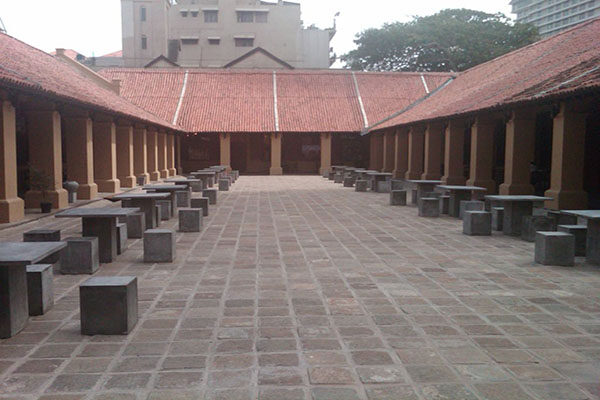
During the Dutch Colonial Era, there had been five wings in the Building with four wings connecting to form a square with a large courtyard in the center. The Chief Surgeon’s Residence, pharmacy and apothecary’s residence had been housed in the fifth wing of the Building, a simple layout with a small first floor. The fifth wing had connected to the other four wings with a smaller courtyard.
*Paul Herman, German-born physician as well as botanist had served as Medical Officer to Dutch East India Company in Sri Lanka between 1672 – 1679 and had worked as a Medical Officer at the Dutch Hospital.
As there were no proper beds in Ceylon during that period, patients had been provided with mats and those who were very sick had been provided with mattresses, considered as a luxury during that period. Patients clothing had been imported from *Tuticorin.
According to paintings of Dutch Colonial Era, there had been a canal which flowed next to the hospital building along, what is known as “Canal Row Lane”. According to legends, this canal had been filled by British during the British Colonial Era.
According to a plaque inside the Building,
“This hospital was built by the Dutch during their period, but a definitive date is not available. A Dutch Map drawn in 1732 shows the hospital on its present site, and a description by a German, Christopher Schweitzer, who was in Sri Lanka from 1676 to 1682 in the service of the Dutch, implies that it was already there in 1681”.
According to a painting (with front as well as rare views of the Building) done in 1771 by a Dutch Artist, preserved and displayed in Royal Netherlands Institute of Southeast Asian and Caribbean Studies in Netherland, the façade of the Building had not changed much, although the original landscaping is not there anymore.
After Sri Lanka gained Independence from the British in 1948, the Dutch Hospital Building had been used as Colombo Fort Police Station as well as Colombo Apothecaries.
In late 20th century, the Building was abandoned as it suffered immense damages during the Civil War in Sri Lanka.
In 2011, the Old Dutch Hospital was renovated retaining its old architecture and was converted as a high end shopping and dining arcade.
Nestled between Bank Avenue (where Bank of Ceylon Headquarters is situated) and World trade Center, the entrance of the former Dutch Hospital is the rear of the original structure (Old Dutch Hospital during Dutch Colonial Era), whereas the façade of the Old Dutch Hospital which faces Hospital Street is the rear of the Building at present. Yet, the Building has retained its old glory after renovations too.
Wards that had been occupied by the sick and wounded during the Dutch Colonial Era house high end shopping and dining arcades at present.
Apart from the shopping and dining arcade, there are concrete benches and tables in front as well as near the entrance of the Building for those who want to relax or read a book, a haven in Colombo Fort.
Location: Hospital Street, Colombo Fort
- Ceylon – Sri Lanka gained Independence from British Colonials in 1948. In 1972, Ceylon became a republic within the Commonwealth and Ceylon was thereafter known as Sri Lanka.
- Paul Herman – Paul (June 30, 1646 – January 29, 1695) was a Medical Officer as well as a Botanist and had also served as Director of Hortus Botanicus, the oldest Botanical Garden in Netherlands.
- Verandah – A roofed platform along the outside of a house and extends across the front and sides of a building, at times partly enclosed by a railing. Derived from “varanda” in Hindi, this type of porch had been initially constructed by British Colonials observing buildings in India. According to legends, the word has its origins from Portuguese Colonial Era as the word had been used by the Portuguese too.
- Tuticorin – A city in southern Tamil Nadu State (in Southern India) also known as Thooththukudi, Toothukudi or Tuttukkudi and is situated on the Gulf of Mannar of the Indian Ocean.