Saga of the takeover of Kandy seen through British eyes-by P.K Balachandran
Source:Dailymirror
Events leading to the controversial takeover of the Kandyan kingdom by the British in 1815 and the aftermath have been written about both from the British and the Sri Lankan viewpoints. The British view is vividly presented in Ceylon Ancient and Modern published by Chapman and Hall of London in 1876. It is authored by an anonymous former officer of the Ceylon Rifles.
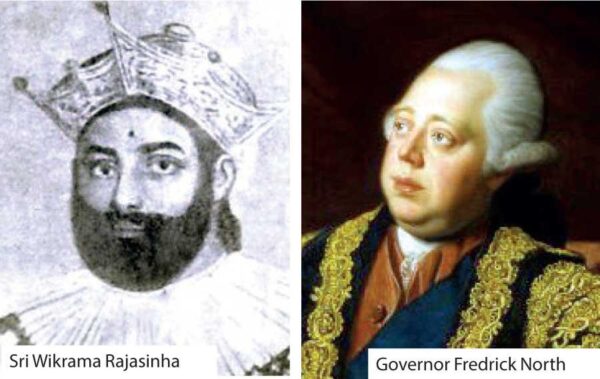
In 1798, the Prime Minister of the Kandyan kingdom, Pilimatalavuva Maha Adikaram (or Pilame as he is referred to in the book) had placed on the throne of Kandy, Sri Wickrama Rajasinha, the 18 year old nephew of the wife of the deposed King Rajadhi Rajasinha. Pilame wanted to rule Kandy and replace the “Naicker dynasty” with an indigenous “Sinhalese” with the help of the British; the latter who had replaced the Dutch as the European power in Ceylon in 1796.
When Pilame conveyed his plan to Governor Fredrick North, the latter got excited at the prospect of turning Kandy into a British Protectorate. Kandy had been doggedly defying European attempts to subdue or absorb it. But North disapproved Pilame’s proposal for a British attack on Kandy to put his puppet Mootoo Samey (Muthu Swamy) on the throne. North said he would not object if Pilame himself removed Sri Wickrama Rajasinha, and yet he wanted to protect the king! “The troops’ presence in Kandy will be the only means of preserving the poor man’s life and dignity, which otherwise will be sacrificed to the ambition of his minister,” North wrote.
 He also wanted Sri Wickrama Rajasinha to formally agree to the stationing of British troops. And to talk about this, he sent Maj.Gen. Hay MacDowell backed by 2500 troops. But MacDowell was made to wait inordinately for an audience and had to kneel before the King. The annoyed General returned to Colombo. But Pilame would not give up. In 1802, to force the British to take punitive action against the king, he relieved some Moor merchants from the coast of their property and put the blame on the king. Gen. MacDowell proceeded to Kandy on a punitive mission. Sri Wickrama Rajasinha fled, but not before setting Kandy on fire. Pilame put Mootoo Samey on the throne and MacDowell left for Colombo leaving a small contingent of troops in Kandy under Major Davie. But the doughty Kandyans put back Wickrama Rajasinha on the throne.
Misadventure
Thus thwarted, Pilame planned to kidnap Governor North during the talks they had at Dambedenia and also attack British garrisons. The timely arrival of Malay troops put paid to his plans. Nevertheless, Kandyans attacked the British troops, most of whom were too sick to fight. Maj.Davie surrendered Mootoo Samey and also his arms. The Kandyans “massacred” all but Davie and Corporal Barnsley, who escaped. The massacre sparked calls for revenge. But North’s plan to send the troops to Kandy did not fructify as the Madras Governor could not send the 3000 men he sought.
Commenting on the misadventure, the author of the book says: “The great fault of all those engaged in this terribly ill-managed Kandyan affair was placing any reliance on the word of an Asiatic, or entering into any negotiations or conventions with them, in which Europeans are sure to be foiled by their superior finesse and want of faith. In dealing with these people there is only one policy to be adopted, a bold, straightforward one, with a firm reliance on one’ own right arm and a good display of physical force –the only argument they understand, or at least are likely to attend to.”
When North took up the massacres with Sri Wickrama Rajasinha, the latter blamed Pilame from whom, he said, he had long since withdrawn his confidence. North suspected that the king was being dismissive and dodgy because he was expecting assistance from the French Adm. Alexandre Durand Linois, who was harassing British shipping in the Indian Ocean.
“Continually disturbed by the plots and insurrections by his chiefs,” Sri Wickrama Rajasinha became a “sanguinary despot.” The crafty Pilame was found plotting to assassinate the king, who beheaded him in 1812. Pilame was succeeded as Adigar by his nephew Eheylapola (Ahalepola). But Eheylapola had inherited his uncle’s disposition for plotting and secretly tried to get Governor Robert Brownrigg’s aid for dethroning Sri Wickrama Rajasingha and assuming power himself. Brownrigg declined to help.
Meanwhile, the king had discovered Eheylapola’s conspiracy. Eheylapola fled to Colombo. But “the tyrant (Sri Wickrama Rajasinha) wreaked his vengeance on his (Eheylaypola’s) wife and family and everyone within his reach. The place of execution in Kandy flowed with blood and the neighbourhood echoed with the shrieks of the victims. Eheylapola’s wife and four children and his brother and wife, were either beheaded or drowned, and the mothers were compelled, under the dread of being disgracefully tortured, to pound the decapitated heads of their children in a paddy pounder.”
As a consequence of this outrage, war was proclaimed against Sri Wickrama Rajasinha in January 1815. In a few weeks, Kandy was again in the possession of the British, thanks to the defection of the king’s General Mollegodde ( Molligoda) and the gang up the principal chiefs against the king . The king, who was hiding, was found out by eheylapola’s men and handed over to the British. Upon capture, a remorseful Sri Wickrama Rajasinha told the British: “Your English governors have one advantage over us kings. They have counselors near them who never allow them to do anything in passion. But unfortunately for us the offender is dead before our resentment has subsided!” In the eyes of the British, Sri Wickrama Rajasinha was “not unprepossessing in appearance, except when he was excited, when his eyes gleamed with the fire of a demon, and his face assumed an air or malignant cruelty.”
Ancient privileges guaranteed
In March 1815, the Kandyan Convention, by which the kingdom was handed over to the British by the chiefs, was signed. The chiefs were guaranteed their ancient privileges and powers, the impartial administration of justice and the maintenance and protection of Buddhism. However, according to eye witness Dr.Marshall, “both the chiefs and the people began to show signs of impatience and openly wished for the departure of the British from Kandy inquiring when they intended to leave the country.”
One of the Kandyans told Marshall: “ You have deposed the king and now nothing more is required. You may leave us now.”
“They showed no dislike to us individually, but as a nation they abhorred us; they made no complaint of misrule or oppression, simply wishing we should leave the country,” Marshalls adds. These feelings broke out into an open revolt in 1817, secretly fomented by Eheylaypola, “the professed friend of England”. By 1818, the revolt had spread like wild fire. A monk was made a claimant to the Kandy thrown and the tooth relic was taken out from the temple at Kandy and “shown to the people to arouse their fanatical enthusiasm.”
In the 10-month desultory 1880 war, 1000 Indian soldiers fighting in the British army died, which was one fifth of the entire force deployed.
“The Kandyans never met their enemies openly, gave quarter or showed any mercy to those who fell into their hands, and the army imagined they would eventually be obliged to evacuate the country and fight their way out,” an observer said.
Eventually, the Kandyans submitted due to the destruction of their villages, cattle and crops and the loss of nearly 10,000 people due to famine, fever and war. Disunion had also emerged among the rebellious chiefs. Some submitted and others were executed. Peace was restored after the “accidentally discovered” Tooth Relic (Dalada) was reinstalled at its rightful place in Kandy.