


Kitulgala and the Classic Movie “Bridge on the River Kwai”-by Michael Roberts
Source:Thuppahis
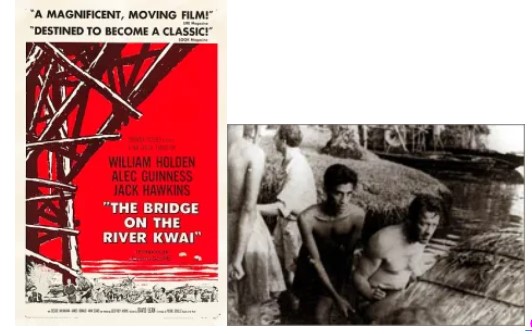
Nihal Rajapaksa has sent me three video clips[1] pertaining to that classic film “The Bridge on the River Kwai,” starring actors William Holden (American), Alex Guinness (British) and Jack Hawkins (British) – a film that was directed by David Lean and was shot in Ceylon in 1957 — with local links aided by the collaboration of Chandran Rutnam among other locals. Whatever your age, these clips are a “Must See” category (three specific web-references afe served up below in RED).
Chandran Rutnam and William Holden while shooting The Bridge on the River Kwai.
The Bridge On The River Kwai Film Location Sri Lanka
ONE: The first clip is quite remarkable in depicting the Kitulgala arena today – a landscape that has returned to nature and swallowed the elaborate film-set constructed over several months by the British-American film production team — a set that included a railway bridge over the river [blown-up as part of the film sequel] and a travel lodge (out of sight) to house the actors and production crew. In this clip a grey-haired Sinhalese lady is deployed to clarify the scenario and disclose the remnants of the props and sets in broken English (a brilliant stroke this — thus amplifying the authenticity).

The fictional Bridge on the River Kwai is a representation of an actual event during World War Two when a British commando team was marshalled and trained in the island of “Ceylon” for a mission to destroy a strategic railway bridge that was being constructed over the Kwai river in Thailand by the Japanese war machine in 1942/43 as a key link between Bangkok and Rangoon. Captured British, Dutch and American troops were part of the labour force utilized for this work.
The commando team assigned for this far-reaching assignment was assembled and trained in Ceylon — a British colony which housed the HQ of the British HQ for the Asian theatre headed by Lord Mountbatten. These HQ included military buildings on the banks of the Mahaweli at Peradeniya in the area which later became part of Peradeniya University (which took over some of remaining military buildings). It is probable that the commandoes assembled for this venture undertook part of their training in the forested landscape which was a feature of the area then.
The Bridge on the River Kwai is widely regarded as one of the greatest films of all time. It was the highest-grossing film of 1957 and received overwhelmingly positive reviews from critics. The film won seven Academy Awards (including Best Picture) at the 30th Academy Awards. In 1997, the film was deemed “culturally, historically, or aesthetically significant” and selected for preservation in the National Film Registry by the United States.” (Wikipedia ………………………………………………………………………….. https://en.wikipedia.org/wiki/The_Bridge_on_the_River_Kwai).


TWO: Serendipity
Michael Roberts is well-suited to deepen the coverage of the film itself and its sites. For those born after the 1950s, let me note the pertinent background facts supporting this outrageous claim on my part.
For one, as a young lad growing up in the 1950s, Michael Roberts nourished himself on war stories, both fictional and operational: (a) fictional through tales of “Biggles,” Cockleshell Heroes, Guns of Navarone, et cetera with war films featuring Audie Murphy featuring as one of his exemplars; and (b) recorded actual tales via the accounts and pictorial illustrations in the London Illustrated News lodged in the library of St. Aloysius College – a source he poured over regularly during lunch breaks.
(b) Secondly, Michael Roberts has always had an eye for landscape and its potentialities in imagined military skirmishes.
Secondly, Michael Roberts had lived in Peradeniya University and was quite familiar with the Faculty Club and the Economics Department – both buildings converted from the British HQ of the war years.
Third: he had been captivated by the David Lean film Bridge on the River Kwai and was totally enamoured of its musical score Colonel Bogey March[2] — inclusive of the popular adaptation which converted the tune to this ditty
”Hitler – oh, Hitler had only one big ball
But Goebbles had no balls at all.”[3]
(e) Fourth: he had, as happenchance would have it, visited the Kitulgala area once in the 1980s(?) and stayed overnight in the well-appointed rest-house there – a building constructed by the David Lean production team.
(f) Finally, and by further happenchance, he and his family had spent a few days at a hotel on pontoons on the river Kwai during the 1980s; while also taking care to visit a Thai museum in the locality which displayed items relating to the Japanese occupation and the specific railway building programme enforced by their war machine.
 Kwai bridge in Thailand in recent times — The River Kwai railroad bridge in 2017. The arched sections are original (constructed by Japan during WWII); the two sections with trapezoidal trusses were built by Japan after the war as war reparations, replacing sections destroyed by Allied aircraft.

Shona Roberts at the hotel on the River Kwai in the 1980s
END NOTES
[1] Sent to Nihal Rajapakse by one Patrick Ranasinghe.
[2] See https://en.wikipedia.org/wiki/Colonel_Bogey_March
[3] Unconfirmed Sri Lankan folklore (still retained in the memory of one Michael Roberts) asserts that the choice of this score viz Colonel Bogey’s March was not in David Lean’s original scheme of things. It developed from an áccident’ in the course of filming. The extras cast as British POWs were mostly Burgher lads and one was a notorious street corner né er-do-well (let us call him BG) from Bambalapitiya. David Lean was disgusted at the first instance when the contingent of “British POWs” marched in … their marching had no verve or swing associated with military types. So, he asked for a re-run and shouted “For God’s sake, sing as you march“!! BG responded by leading the group with the Hitler version of Colonel Bogey’s March. Ah! that had verve and swing. Just watch the result in two of the video clips.