Can wetlands be protected amidst development initiatives?
– By Arundathie Abeysinghe
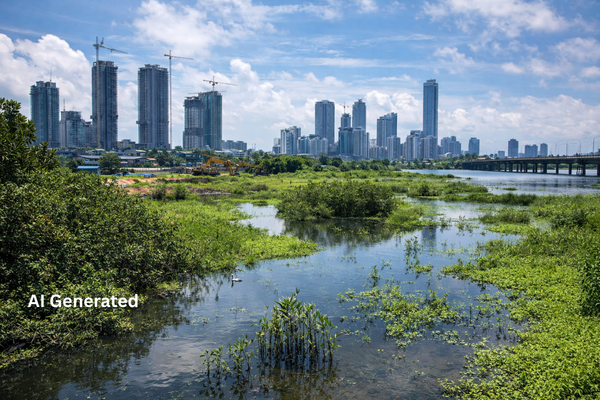
 Center for Environmental Justice (CEJ) has warned that efforts to protect Sri Lanka’s wetlands which includes lakes, rivers, swamps, peatlands, estuaries, mangroves, coral reefs, rice fields, reservoirs, and tidal flats are meaningless, if development projects continue to destroy them. Wetlands cover approximately 6% of the Earth’s land surface, yet are home to 40% of plant and animal species. World Wetlands Day is observed annually on February 2, to mark the adoption of the Ramsar Convention on Wetlands in Iran in 1971.
Scholars are of the view that wetlands provide critical ecosystem services, including flood control, water regulation, water purification while supporting biodiversity, health, food supply and tourism. Globally, over one billion people depend on wetlands for their livelihoods and they play a significant role as a buffer against climate change.
Meanwhile, land reclamation too threatens critical ecosystems such as the Muthurajawela Swamp (Swamp of Royal Treasure), the largest saline coastal quagmire. Despite legal frameworks, including unchecked infrastructure projects and weak enforcement are causing irreversible damage to its biodiversity.
According to environmentalists “major infrastructure projects, including the Colombo-Katunayake Expressway, which bisects the wetland have significantly impacted critical areas like Muthurajawela, covering 3,068 hectares. Industrial expansion and housing construction are prioritized over conservation, thus, reducing the ability of wetlands to act as natural buffers against flooding. Colombo’s wetlands, a 900-hectare system that includes marshes, lakes, and urban canals, despite being designated as the world’s first Ramsar Wetland City Accreditation in 2018, continue to face immense pressure from urbanization. These vital ecosystems which include Beddagana Wetland Park and Thalangama Lake act as natural flood buffers, protecting the city by storing vast amounts of water.”
“These wetlands function as sponges for flood management, reducing temperatures, treating wastewater and are biodiversity hotspots. Despite its Ramsar status, the area faces a 1.2% annual loss due to rapid development, illegal dumping, including pollution. Projects such as Beddagana Wetland Park and Parliamentary Wetland Park aim to conserve these areas, combining green infrastructure with urban planning,” environmentalists emphasized.
Meanwhile, scholars are of the view that “political connections often compound these threats. With the destruction of wetlands such as Anawilundawa, Negombo Lagoon, and reclamation projects in Muthurajawela, including plans to construct roads, tourist hotels, and industrial facilities encroach these fragile ecosystems.”
“According to the 2006 National Wetlands Inventory by the Central Environmental Authority (CEA), the International Union for Conservation of Nature (IUCN), and the International Water Management Institute, Sri Lanka has 62 wetlands, 18 of which are under high threat. The CEJ has intervened in the proposed development of Wedithalathivu Nature Reserve threatened by an Aquaculture Park, including prawn farming resulting in widespread destruction of mangroves.”
According to senior officials of CEJ “state intervention is crucial and development planning must prioritize the conservation of wetlands to ensure these vital ecosystems are not damaged by development. The government must create and enforce policies, including the National Wetland Policy to prevent the conversion of wetlands into industrial or residential areas as they provide significant benefits such as water filtration, biodiversity as well as flood control. Most often they are treated as wastelands. Hence, it is necessary to enforce strict legislation to promote conservation, instead of destruction.”
As wetlands in the Western Province are essential for preventing urban flooding, their loss is considered as a direct cause of increasing flood risks.
Senior officials of Urban Development Authority’s (UDA) emphasize that “the main objective of UDA ‘Colombo Commercial City Development Plan – 2019-2030,’ (CCCDP – 2019-2030) is to create a citywide network of green spaces linked by wetlands and waterways.”