Come or Go, Chicago-Trump Says He’ll Do It-by Dr Harold Gunatillake

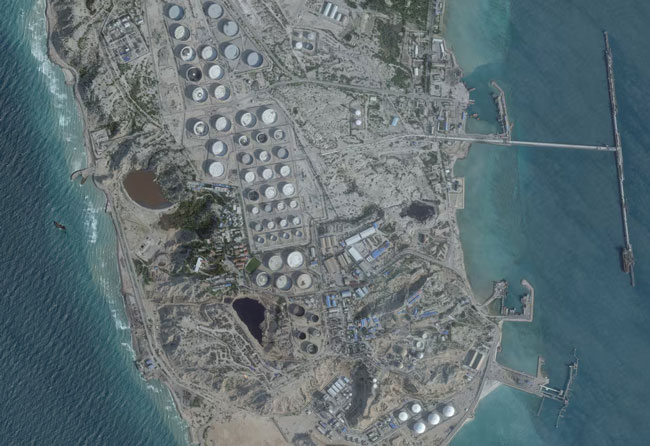
A satellite image shows an oil terminal at Kharg Island, Iran, on February 25, 2026 [Handout/Planet Labs PBC via Reuters]
Image Source:Adaderana
The Middle East is once again engulfed in conflict, and this time the violence has transitioned from the shadows of proxy warfare into a confrontation involving Iran, Israel, and the United States. Oil markets are experiencing turmoil, international powers are reassessing their strategies, and Kharg Island, a small island in the Persian Gulf, has emerged as a critical point of leverage for the global economy. Amidst this situation, Donald Trump has re- emerged, reiterating a promise he previously made somewhat casually in an interview years ago: that the United States could “take the oil in Iran,” including the outright seizure of Kharg Island.
Today, that line no longer appears to be a display of bravado. Instead, it presents itself as a strategic blueprint.
Kharg Island: The Beating Heart of Iran’s Oil Lifeline
Kharg Island is modest in size and lacks glamour. It is not a location that most Americans would readily identify on a map. However, it has historically served as the conduit through which over 90% of Iran’s oil exports passed—a strategic lifeline that Tehran has safeguarded for decades. Presently, it has become a battleground.
During the third week of the US-Israel conflict concerning Iran, President Trump declared that American forces had conducted airstrikes on military installations on Kharg, describing it as “one of the most powerful bombing raids in the history of the Middle East.”
Iran maintained that its oil infrastructure remained undamaged; however, the underlying message was unmistakable: Washington had targeted the island that sustains Iran’s economy.
A War That Has Become an Oil Crisis
The conflict has already precipitated a worldwide oil crisis. Crude oil prices have increased by over 40% since the onset of hostilities, and the Strait of Hormuz — the narrow waterway through which approximately twenty per cent of the world’s oil is transported — has transformed into a critical chokepoint characterised by apprehension.
Trump has actively emphasised this concern. He has cautioned allied nations about the necessity of ensuring the Strait’s security, even going so far as to encourage deploying naval vessels. “The countries of the world that receive oil through the Hormuz Strait must take care of that passage, and we will help — A LOT!” he wrote.
Iran has committed to retaliating against any attacks on its energy infrastructure. Its Revolutionary Guards have previously launched missiles and drones targeting locations in Israel and United States military installations throughout the region.
The conflict has evolved from a purely theoretical concept to active engagement. It is now kinetic, escalating, and becoming more unpredictable.
Trump’s Old Words, Reborn in a New War
Years ago, when Mr Trump stated to the Financial Times that the United States could “take the oil in Iran,” it appeared to be the kind of remark typically heard at a campaign rally or a late-night interview — provocative and headline-grabbing, yet not practically enforceable.
Nevertheless, in light of recent incidents involving missile strikes on Kharg and the United States’ public assessment of the island’s strategic importance, these statements attain renewed significance. Reports have circulated over the years indicating that President Trump contemplated the complete seizure of Kharg Island. This measure would have been deemed unthinkable during peacetime, yet it is currently being reconsidered amid the escalation of conflict.
Whether you come or go, Chicago, Trump will proceed with it.
The pattern is evident: when Trump indicates he might undertake an action, the international community can no longer dismiss the possibility that he will not proceed.
A Conflict With No Clear End
Diplomacy has reached an impasse. Allies have expressed concern. Oil markets have experienced significant volatility. The conflict persists without interruption. Trump has stated that Tehran “appears ready to make a deal,” but that “the terms aren’t good enough yet.”
Meanwhile, Iran has issued a warning indicating its intention to demolish oil facilities associated with the United States, threatening to reduce them to “a pile of ashes” if Kharg’s energy infrastructure is targeted.
This is the new reality:
A small island in the Gulf has emerged as the central nexus around which the global economy is consolidating.
A conflict sparked by missile attacks now threatens to transform the global energy landscape.
And a president who once pondered the idea of “taking the oil” is now directing military strikes against the very island that enables such an idea.
The World Watches the Strait
In Chicago, Washington, Riyadh, and Tehran, the same question persists in the air.
How far will this go?
Because in this conflict, the distinction between rhetoric and action has become increasingly blurred.
And Kharg Island, once a quiet industrial outpost, has become the stage on which the next act of global conflict may be written.
History of Kharg Island
Kharg Island — occasionally spelt Khark — has served as a strategic hub in the Persian Gulf for centuries. Before its significance as the core of Iran’s oil industry, it functioned as a trading centre, a monastic sanctuary, and a disputed colonial outpost.
Key Early Historical Layers
Archaeological remains from the Achaemenid era comprise cuneiform inscriptions dating from approximately 550–330 BCE, underscoring Kharg’s association with ancient Persian imperial networks.
- The ruins of a Christian monastic settlement, presumably originating from the 7th century, suggest that Kharg was historically inhabited by a community associated with the Church of the East.
- Medieval and early modern trade: The island is depicted on 16th-century Portuguese maps and was subsequently governed
by the Dutch East India Company in the 18th century, emphasising its enduring economic significance.
Kharg’s contemporary identity began in the 1960s, when Iran, under the leadership of Mohammad Reza Pahlavi, collaborated with Amoco to develop the island into a major oil terminal. This advancement positioned Kharg as the primary conduit for Iran’s petroleum exports.
Handles up to 90% of Iran’s oil exports.
- Capable of concurrently loading ten supertankers and transporting seven million barrels
- Surrounded by expansive waters that facilitate the docking of the world’s largest tankers—an uncommon strategic advantage in the Gulf region.
- Houses a capacity of up to 30 million barrels of crude
Iranian author Jalal Al‑e‑Ahmad once referred to Kharg as “the orphan pearl of the Persian Gulf,” a designation that retains its significance to this day.
The ‘Forbidden Island’: Militarisation and Secrecy
Kharg is extensively fortified and is frequently referred to as the “Forbidden Island” owing to the stringent control exercised by the IRGC.
- Home to the 112th Zolfaghar Surface Combat Brigade, equipped with fast‑attack boats, anti‑ship missiles, and naval
- Hosts ground‑based air defence systems, radar installations, and hardened bunkers.
This militarisation reflects its role as both an economic lifeline and a strategic shield.
Kharg in the 2026 War
During the ongoing Iran–Israel–United States conflict, Kharg has once again emerged as a focal point.
- The United States conducted an airstrike against military targets on the island on March 14, 2026, intentionally avoiding oil infrastructure while sending a clear signal of its
- Trump has publicly stated that the United States could “take out the island at any time we desire,” describing it as “completely unprotected” — an assertion that military analysts have extensively challenged.
- Analysts caution that possession of Kharg grants control over Iran’s economic
Why Kharg Matters Now
Kharg Island is not merely a geographical location; it functions as the economic, military, and symbolic core of Iran’s modern state. Its history comprises a complex narrative of empires, religious influences, oil dynasties, and, at present, significant conflict.
In the current conflict, Kharg is no longer a backdrop. This is the current phase.
Recent developments and current status.
In March 2026, U.S. forces conducted a series of precise military strikes targeting over 90 military installations on Iran’s Kharg Island. These targets included naval mine storage facilities and missile bunkers. While the strikes inflicted considerable damage on military infrastructure at this strategic oil hub, the oil storage and shipping facilities were intentionally maintained, as announced by President Trump.
Experts caution that the act of capturing Kharg Island involves significant risks, which could potentially escalate the conflict and endanger American lives. A naval lockage is considered a more viable alternative.
Capturing Kharg Island, Iran’s primary oil export terminal, entails several potential implications.
Disrupting Iran’s oil exports could lead to a considerable rise in energy prices, thereby affecting global markets and economies, with Asia being especially susceptible.
Iran may respond with targeted actions against Gulf Arab infrastructure, commercial shipping, or United States military installations, which could potentially enlist other regional actors.
The conflict may lead to increased casualties, displacements, and a humanitarian crisis.
Kharg Island could potentially threaten United States personnel owing to its closeness to Iran’s mainland, thereby elevating the risk of Iranian drone and missile assaults.
Experts in international law have cautioned that deliberate targeting of civilian infrastructure such as power plants and oil facilities may constitute a war crime.
This is the current situation. End