Compassionate Language Patriotism and a Polyglot Nation on the Rise By Sheyana La Brooy

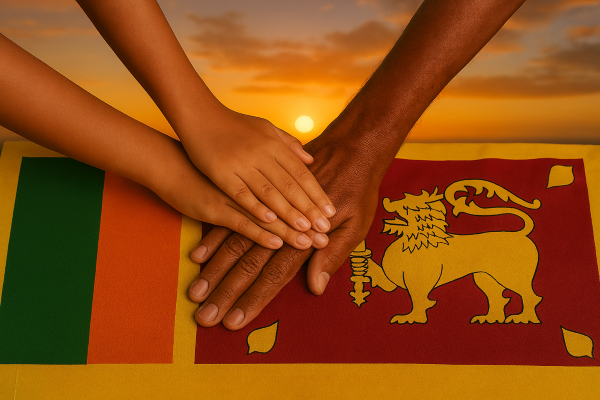
Language is never simply about words and conventions. It serves as a vessel to carry forward culture, empowers and gives dignity to its speakers, creates belonging, and strengthens national identity.
In countries with multiple official languages, a model of compassionate language patriotism, combining intercultural understanding, empathy, inclusion, and equitable access to language education can enrich national identity. The languages children learn influence how they understand their identity, their interactions with peers, and how they will engage with the wider world. For those on the global stage, language shapes how a nation presents itself to the world.
Sri Lanka’s linguistic landscape was shaped by British colonial influence from 1796 to 1948, during which English dominated administration, education, and access to power. This created a hierarchy that placed English above local languages, and its legacy endures. As a result, many communities continue to grapple with feelings of linguistic inferiority rooted in the islands long colonial history. Deliberate empowerment and more inclusive language policies will strengthen identity and social cohesion, whilst alleviating English being tied to status, intelligence, or opportunity.
Sri Lanka’s transition from English as the official language to a trilingual framework has been long and complex. In 1944, the late President of Sri Lanka His Excellency J. R. Jayewardene, then a member of the State Council, proposed replacing English, spoken at the time by only ten percent of the six‑million population, with Sinhala and Tamil as official languages. He noted that only 6–7% of children had access to English‑medium education, underscoring the inequity of maintaining English as the administrative language. In 1956, the Official Language Act No. 33 (“Sinhala Only Act”) replaced English solely with Sinhala, the language spoken by the majority native Sinhalese people of Sri Lanka. This decision had a significant impact on Sri Lanka’s post-independence multi-ethnic community, straining social cohesion and national security.
Over time, constitutional reforms reflected evolving community sentiment. The Thirteenth Amendment of 1987 recognised both Sinhala and Tamil as official languages, while designating English as the link language. The Sixteenth Amendment in 1988 formalised how Sinhala and Tamil would function across administration, legislation, and the courts, while preserving English’s role as a link language. This framework sought to prevent any single language from dominating and ensured that English could promote shared understanding between multilingual Sri Lankans and maintain connections to the world.
The United Nations promotes multilingualism to ensure states can express their ideas, values, and identities in the languages most authentic to them. This remains valid at the national level. Whilst English will assist in relating to the world, it is not a proxy for competence. In international settings, speaking one’s mother tongue signals sovereignty, invites respect, and expresses cultural confidence, without sacrificing clarity, as interpreters exist to bridge linguistic gaps.
Diplomacy depends on strategy, relationship‑building, and precision, qualities that can be articulated in any language. Recognising this helps ensure that talented voices, subject experts, and community leaders are not excluded or undervalued in national or global arenas, simply because they prefer to communicate in their own language.
Diverse languages shape daily life, influence access to education, employment, legal services, public institutions, and even basic administrative processes, such as completing birth registration paperwork. Sri Lanka’s population of over twenty‑one million includes speakers of Sinhala (over 75%), Tamil (approximately 18%), and English (approximately 25%). Smaller linguistic communities speak Malay creole, Portuguese creole, and the endangered indigenous Vedda language. Furthermore, as language proficiency determines opportunities and mobility, access to language education on an equitable basis becomes a national priority and a social good.
Sri Lanka has a long tradition of education empowerment. Over two millennia ago, Sanskrit was introduced and taught in Buddhist temples and monastic colleges. In the modern era by 1945, then Education Minister Dr. C. W. W. Kannangara’s Free Education Bill aimed to ensure that all children, regardless of socioeconomic background, could access education. His curriculum reform emphasised emotional, intellectual, and practical development, supporting the holistic well‑being of students. Sri Lanka remains the only South Asian nation offering free education from kindergarten to university and its adult literacy rate, at 92.66% (World Bank 2023), is also the highest in South Asia and exceeds that of many developing countries.
Strengthening this legacy requires an intergenerational effort from educators, policymakers, and communities. Addressing barriers to a quality education, in Sinhala and Tamil, and to English as the link language, can support healing by promoting dialogue and shared understanding between communities. Increasing the normalised use of official languages in administrative and public settings can also empower future generations to embrace multilingualism as part of their national identity. This deepens national belonging and fosters confident participation in national and global contexts.
Community leaders and the Sri Lankan diaspora have a significant role to support Sri Lanka in reinforcing globally that Sinhala and Tamil are the nation’s official languages, with English serving as the recognised link language. English should function as the bridge it was intended to be, rather than as a marker of superiority or a barrier to advancement. A link language represents a social compact in a multilingual society and strengthens relationships between diverse ethnic groups to promote national identity.
Compassionate language patriotism means taking pride in Sri Lanka’s linguistic heritage, respecting the place of each language so the nation can flourish by using language as a window into the heart of her people. Compassionate language patriotism is also additive rather than subtractive. It encourages investment in Sinhala, Tamil, and English across literature, art, music, performing arts, digital media, and ensures representation in emerging technologies, such as artificial intelligence and large language models. Through such investments, multilingualism becomes a powerful cultural export, enhancing opportunities and safeguarding language and culture for future generations, whilst affirming Sri Lanka’s national identity.
In an era defined by communication and access to information, Sri Lanka’s model of compassionate language patriotism can demonstrate how a nation can remain globally connected, whilst proudly safeguarding its national identity enriched by multilingualism.