DELHI AIR POLLUTION – WILL IT BE A PERMANENT FEATURE ? – By N.S.Venkataraman

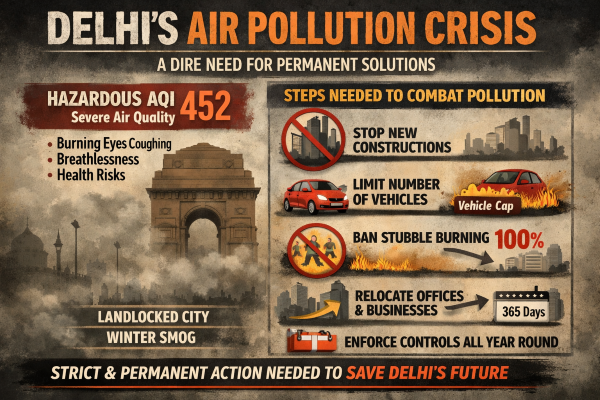
India’s capital Delhi has been suffering with poor air quality index (AQI) during certain period every year, which was recorded as high as 452 on 15th December,2025. An AQI above 400 signifies “Severe” to “Hazardous” air, meaning that the air is toxic, causing immediate irritation (burning eyes, cough, breathlessness) and increasing risks of respiratory infections etc.
In the five years from 2020 to 2025, Delhi reported average annual AQI in the region of less than 200, which is appropriate. However, in certain specific months every year, the AQI level has reached alarming level of more than 450.. Delhi’s Air Quality , whenever it goes above 400 in certain months, has been a subject of concern as seen at present time. It appears that this could become a permanent feature in the coming years, as ultimate solution to overcome this grave issue is yet to be conclusively formulated and implemented.
With Delhi being capital of India and with more than one hundred countries having consulates and embassies in Delhi, with population density of 11,600 persons per square kilometer, high AQI has become a source of embarrassment for India. Certainly, a permanent solution has to be implemented to overcome this grave issue.
A careful analysis of the scenario would indicate that while Delhi government has been earnest in implementing some measures,, it appears that these measures are sort of knee jerk reaction during the months when AQI reach alarming level, as it has now happened in the last quarter of the year 2025 .
Reduction in stubble burning has little impact on AQI
It was argued that the air quality in Delhi become poor particularly during the winter months mainly due to burning of farm stubble, a traditional short cut to quickly shed fields of paddy ramnants and prepare them for a second crop in the nearby state of Haryana, Punjab and Uttar Pradesh. While the government has taken number of measures to stop stubble burning, in a statement to parliament, the Environment Ministry of Government of India claimed that Punjab and Haryana had collectively reduced “fire incidents” by 90% in 2025 compared to 2022. However, a few researchers have disagreed with this claim and have said that the actual land area that had been burned – the reduction was a more gradual 30% from about 31,500 square kilometres in 2022 to 19,700 sq.km . in 2025 as of November,25, this year.
In any case, it is certain that incidence of stubble burning has come down substantially.
However, the issue is that inspite of such steep reduction in stubble burning,it has not contributed to improve AQI in Delhi.
Multi pronged approach too not reducing AQI
When air quality index in Delhi increase beyond 400 every year , Delhi government has been taking multi pronged approach and routinely introducing regulatory measures such as Graded Response Action Plan (GRAP) , implementation of RECD system / dual fuel kits in DG sets, use of cleaner fuels in industries , shift to EV/CNG/BS VI diesel fuel in transport sector, implementation of dust control measures at Construction & Demolition (C&D) waste sites etc.
However, as seen now, the ground reality is that these multiple measures too have not contributed to reduction in AQI,.
Contributing factors to AQI are fundamental:
Delhi city is land locked . It is known that land locked cities are more prone to air pollution because they lack the natural atmospheric ventilation and dispersion mechanisms , that coastal cities benefit from, primarily the daily cycle sea and land breeze and strong winds,.
Delhi’s position / location in the Indo Gangetic Plain also means that it bears the brunt of cross border pollution from other parts of India , compounding its air quality issue.
Winter weather conditions – such as temperature inversions and calm winds further worsen the situation in Delhi by trapping pollutants near the surface, intensifying smog.
These are fundamental factors that contribute to sharp deterioration in AQ I during certain months around winter period.
It is obvious that such factors , as above , are beyond the control of Delhi government.
While several possible measures have been introduced by Delhi government , the past experience clearly show that these measures by themselves cannot be adequate to bring the AQI to acceptable level.
This situation implies that Delhi government has to think out of the box to find permanent solution.
What steps needed now ?:
The population density in Delhi is high. However ,the de congestion of population , if suggested as remedial measure , is impractical.
At the moment, Delhi government launches multi pronged approach only when the AQI reach peak level but do not implement such measures throughout the year. This is a negative approach.
Certainly, the construction of buildings in Delhi have to be stopped permanently.
Registration of new vehicles should be stopped and higher limits should be fixed for the number of permissible vehicles on the road.
Further measures should be initiated to stop the stubble burning in the neighbouring states to 100% level.
The offices and commercial establishments in Delhi , whether belonging to government or private bodies should be encourage d to leave Delhi NCR and no new offices / establishments should be permitted in Delhi.
All the other measures introduced so far must be implemented permanently throughout the year.
As the natural reasons for Delhi remaining pollution prone would be there for all time to come, the measures to combat air standard deterioration should be there for all time to come and throughout the year. In short, Delhi should strive to reach a level of stagnation in growth.