



Elephants in the Fridge and Humans in the Wedge ? Post ‘Ditwah’ urges rationalization of Elephant and Land Management – By Bernard Fernando

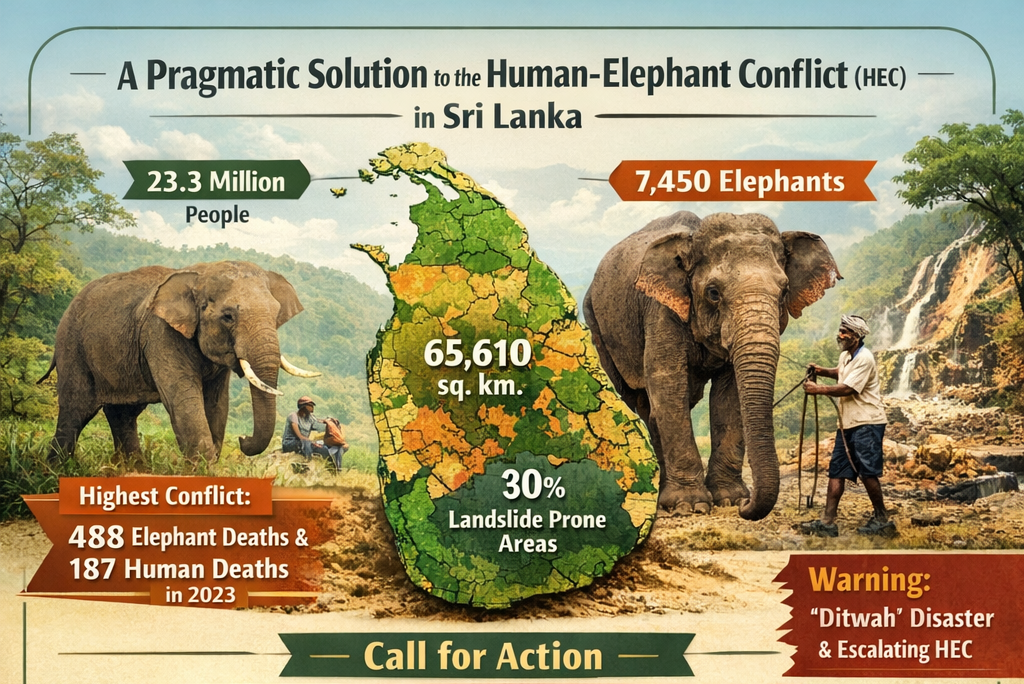
In addition to exposing weaknesses in our Land management policy and practices in terms of Irrigation and Road infrastructure, Soil conservation, crop-diversification, food system and market logistics etc., the recent blitz of nature through ‘Ditwah’ has upstaged the elusive debate of Human Elephant Conflict (HEC), urging decision makers to immediately rationalise our Elephant population and productively manage our now brittle and shatterable small island of 65,210 square kilo meters disproportionately accommodating around 23.3 Mln. Humans and 7,450 Elephants as revealed by the latest Human Population estimate and Elephant census in the year 2024! According to ‘post- Ditwah’ disclosure by National Building Research Organisation (NBRO), 30 % of our Land is prone to landslides and 34% of the Human population resides in those areas.
Thus, the compelling new human settlement imperatives will obviously exert pressure on our forest reserves, Elephant corridors and National Reserves/Parks allocated for Elephant habitat and food which are devoid of savannas as available in large African countries with relatively large Elephant populations. It is reported that already 70 % of our wild Elephant population is living outside the areas dedicated to them and share 44% of the landscape with Humans,(Dr.Sumith Pilapitiya and Malathy Knight) due to scarcity of food and habitat space, perpetuating HEC.
It also reopens the debate that billions of taxpayer monies and Foreign exchange are being wasted over the years in reinventing the wheel with invasive measures to control Elephant movements without striking a logical balance between Human and Elephant populations. Is this stalemate perpetrated by the Conservative Elephant conservationist camp not seeing ‘Eye to eye’ with the Neo-liberal Human rights camp?
Against this backdrop, in the year 2023 alone, the Department of Wildlife Conservation (DWC) reported 488 elephant deaths, the highest on record, alongside 187 human fatalities. From 2011 to mid-2025, 4,600 elephants and 1,528 humans have lost their lives in related clashes. The warning by experts that 2025 is heading towards higher casualty figures is bound to spill over in the aftermath of the ‘Ditwah’ catastrophe, urging a pragmatic solution to this tragic and ill-fated issue.
In the year 2019, when the Wild life Dept. called for proposals from the public via a full page Press notice, to develop a rational policy to resolve the issues of Human Elephant Conflict (HEC) and Elephant Conservation (EC), the writer too submitted his cents worth for an effective method to deal with them. Since such long-term proposals to terminate the long drawn Human Elephant-Conflict (HEC) did not receive much response from the authorities, several articles, by the writer updating facts and his proposals, were published in the Sinhala and English press from time to time until 2022, to mobilise public awareness and awaken the relevant authorities including the Director General of Wildlife.
In early 2025, vehement but sincere protests of helpless farmers came to the fore with strong media support, bringing home the fact that frustrated farmers and their kith and kin are compelled to consider wild elephants as hostile invaders. Now in late 2025, with the ‘gate crash’ by the calamitous ‘Ditwah’, the tragic destruction of homes, properties as well as crops, trees and plots of land cultivated with hard labour, of the helpless, poor farmers whose sole livelihood is farming, has triggered greater sorrow, frustration and anger among the entire citizenry of our small Sri Lanka. The citizenry too is moved with great poignancy and disappointment, hearing and witnessing the continued loss of life of helpless poor people and wild elephants.
Points to be reckoned towards a pragmatic long-term solution for HEC in a small Land vulnerable to natural disasters
- Sri Lanka is the smallest island country in the world, historically endowed with a large wild elephant population. As such, the limited ecological space available to meet the basic food and habitat needs of a naturally increasing wild elephant population, is ostensibly depleting, in the absence of proper management and effective sterilization/birth control methods. How many of us know that a single wild elephant requires at least 150 kgs. of plant food per day, working out to 1,117,500 kgs. of food per day for approximately 7,450 wild elephants? How long can Sri Lanka, as a tiny country struggling to recover from the double whammy of economic ‘bankruptcy’ and the unexpected ‘Ditwah’ catastrophe afford to meet these daily increasing basic food needs of Elephants and Humans? Our inability to provide the basic food and ecological space to our wild elephant population was blatantly exposed more than a decade ago, by the world-renowned actor Leonard DiCaprio when he declared that our wild elephants, which we consider as a priceless resource, are gobbling up junk food mixed with polythene and plastic garbage to satisfy their pangs of hunger. .
- Obviously, in the present context, the space, food and environmental resources of our small and vulnerable land, cannot expand to cater to the growing human and Elephant populations. Thus, the Human-Elephant Conflict (HEC) is posing a formidable challenge without a concrete solution in sight.
- Furthermore, the huge amount of scarce foreign exchange spent on anesthetics, electric fences, firecrackers, mining equipment, and transportation facilities, being used to aggressively control wild elephants, in the face of continuous annual increases in human and property losses have become wasteful investments.
- On the other hand, Sri Lankan elephants play a valuable role in preserving our religious and cultural values as well as in promoting tourism industry. Thus, Elephant Conservation (EC) too has become an imperative that cannot be ignored.
- Clearly, the severe economic damage to Land, property and crops, aggravated by ‘Ditwah’,as well as the number of human/wild elephant deaths brought to limelight by the recent protests of helpless and disgruntled farmers do not require any further evidence, commentary or research to prove the glaring and serious imbalance in our Human-Elephant population.
- According to facts revealed by a scientific research conducted jointly by the Department of Wildlife and the University of Peradeniya, much before the Elephant census in 2024, it has been accepted that our wild elephant population estimated between 5,000 to 6,000, is excessive compared to the human population of 22 million living in a limited space of 65,610 square kilometers.
Towards a sustainable long term solution
Since a long-term solution is imperative for country’s sake to end this tragic situation that is compounding day by day, the writer as a concerned citizen submitted the following proposals to the Press and authorities in the years 2021/2022.
- As the world’s smallest island country with a historical but a disproportionate wild elephant population, we need to determine the number of wild elephants that can be comfortably managed. In other words, it is essential to determine a ‘Convenient Total Carrying Capacity’ (CTCC) of elephants in the country that is sustainable for at least 10-year periods, taking into account key variables such as elephant and human reproduction cycles, mortality rates, food availability, habitat space, climatic, and environmental factors, potential for tourism industry, religious and cultural factors, as well as projections for allocation of land for improving future intensive food cultivation and re-forestation efforts etc.
- If the decennial elephant population exceeds this limit, a policy decision should be made to export the surplus number, as far as possible in pairs, to zoos in needy countries, so that the breeding process of Sri Lankan elephants can be maintained. The wild elephant conservationists in those countries will ensure that the Sri Lankan elephant is not an endangered species. In the event of a shortage of elephants under the existing limit, an agreement with relevant countries should provide for filling the deficit by importing elephants of Sri Lankan origin from them. As a result, it will exceed the expectations under the International Convention on International Trade in Endangered Species of Wild Fauna and Flora signed in 1973. It is a known fact that elephants have been exported since ancient times.
- Implement an appropriate short and medium-term sterilization/birth control measure which is one of the options that the writer outlined in a previous article, in the face of export restrictions.
- Take immediate steps through our diplomatic channels to ease international restrictions on wild elephant exports/Imports through a policy decision.
- Thereafter, take steps to negotiate with governments to export/import elephants to zoos in needy countries by convincing them on the need for a harmonious equilibrium in the global wild elephant population.
Benefits to people and the country from the above solution
1) The short-term re-location of elephants as a preliminary step in research activities will save helpless, poor farmers from their current miserable plight.
2) Reduced crop destruction by elephants, will improve economic growth of the country and the rural poor.
3) Increased availability of ecological habitats for elephants and additional land for the growing human population and food crops in the wake of the damage caused by ‘Ditwah’.
4) Regulated wild elephant population will ensure adequate nutrition to them, and save the natural vegetation, Ecological balance and food crops for humans.
5) Facilitates regulation and protection of forest cover and re-forestation efforts.
6) Opens up a new export route to earn scarce foreign exchange.
7) Saves Billions of foreign exchange wasted on electric fences, crackers, anesthetics, vehicles and other equipment and local labour and transport burden of the Wildlife Department.
8) A part of the savings can be utilised for wild elephant ‘Catch, Tame and Export’ (CTE) exercises.
Abiding with ground reality towards a permanent solution.
It needs to be reiterated that we cannot escape anymore from the bitter realities prevailing and emerging on the ground. Therefore, the Hobson’s choice is to determine and sustain a mandatory ‘delicate balance’ between the growing human and elephant populations in our limited land area as aforesaid.
In this regard, the writer strongly believes that genuine elephant conservationists and environmentalists will admit the results of the Elephant census(2024) conducted after 13 years, and the prior scientific research both of which were conducted amid time and financial constraints affecting our country. Although there are more advanced methods, experts believe that the time and cost required to implement them are not affordable for a country like Sri Lanka.
It is pertinent to state that the DWC which deployed thousands of volunteers and conducted a wild elephant census in August 2024, based on water-holes, reported that there may be minor losses in the count due to rains, which means that the real figure would be more than the arrived figure of 7,450. It is also noted that valuable indicators reflecting the health of Sri Lankan elephants such as female/male elephant ratios and number of calves can be updated with this census.
Concluding request
In order to permanently end this tragedy affecting the lives of poor farmers who contribute to the country’s food economy as well as those of wild elephants who provide value to our religious/ cultural practices and tourism industries, we propose that a Presidential Task Force consisting of Experts from DWC, Land Management Authority, Centre for Environmental Justice, conservationists, environmentalists, farmer representatives and civil activists be immediately appointed, to deliberate on the above-mentioned proposals, and submit a report to the Hon. President within 3 months.
The terms of reference would basically include the determination of the ‘Comfortable Carrying Capacity’ of wild elephants initially for the next 10 years as mentioned above, based on the figures from the latest 2024 elephant census which any way would have reported a lower number due to deficiencies in the ‘Water Hole’ method as aforesaid.
By adopting the said long-term, non-violent export/import strategy, the main issues of food and habitat related to HEC and protecting the species from extinction can be permanently resolved. Furthermore, it will help to mitigate the issues of rationalizing Land Management and current foreign exchange/debt repayment as well.
Bernard Fernando,
Former Deputy General Manager-BOC
Email: fernadobernard81@gmail.com