eLanka

Saturday, 28 Mar 2026
  • Home
  • Read History
  • Articles
    • eLanka Journalists
  • Events
  • Useful links
    • Obituaries
    • Seeking to Contact
    • eLanka Newsletters
    • Weekly Events and Advertisements
    • eLanka Testimonials
    • Sri Lanka Newspapers
    • Sri Lanka TV LIVE
    • Sri Lanka Radio
    • eLanka Recepies
  • Gallery
  • Contact
Newsletter
  • eLanka Weddings
  • Property
  • eLanka Shop
  • Business Directory
eLankaeLanka
Font ResizerAa
Search
  • Home
  • Read History
  • Articles
    • eLanka Journalists
  • Events
  • Useful links
    • Obituaries
    • Seeking to Contact
    • eLanka Newsletters
    • Weekly Events and Advertisements
    • eLanka Testimonials
    • Sri Lanka Newspapers
    • Sri Lanka TV LIVE
    • Sri Lanka Radio
    • eLanka Recepies
  • Gallery
  • Contact
Follow US
© 2005 – 2026 eLanka Pty Ltd. All Rights Reserved.
Home » Goodnews Stories Srilankan Expats » Articles » Epitaph for Sumitra Peries: A Poet of the Sri Lankan Cinema World-by Michael Roberts
ArticlesMichael Roberts

Epitaph for Sumitra Peries: A Poet of the Sri Lankan Cinema World-by Michael Roberts

eLanka admin
Last updated: January 23, 2023 3:58 pm
By
eLanka admin
ByeLanka admin
Follow:
Share
8 Min Read
SHARE
Views: 1

Epitaph for Sumitra Peries: A Poet of the Sri Lankan Cinema World-by Michael Roberts

Uditha Devapriya, in Item on 21 January 2023 entitled “Sumitra Peries Obituary: Poet of Sri Lankan Cinema”

elanka

Source:Thuppahis

Michael Roberts

Sumitra Epitaph Peries lived a life of travel and adventure before enrolling in film school in Brixton and going on to become one of the major, politically conscious figures in Sri Lankan cinema.

One of the defining auteurs of Sri Lankan cinema, Sumitra Peries was also one of few international figures from the island nation. Her films capture, in all their nuances and complexities, the torments of being a woman in Sri Lanka and, by extension, in South Asia. They dwell not merely on the rift between rich and poor, but also on the innocence of childhood and the torments of adolescent love. They centre on the woman’s place in what was, and still largely is, a patriarchal society.


Her first film, Gehenu Lamai (Girls, 1978), establishes these themes remarkably well. At its centre is a poor village girl, Kusum, who has ambitions for a better life. Midway through, she falls in love with an affluent classmate who happens to be her cousin. But after a series of incidents that culminate with the discovery of their affair, Kusum’s situation begins to deteriorate.

elanka

Sumitra Peries as a teenager  © Courtesy of Sumitra Peries

Though hailing from an upper middle-class family, Sumitra came to identify strongly with such women. She was born Sumitra Gunawardena on 24 March 1935 in the village of Payagala and raised in the village of Avissawella, some 30 miles from Colombo. Her mother hailed from a family of affluent arrack distillers, and her father belonged to a household of radical political activists. Two of her paternal uncles became leading socialist politicians; one of them, Philip Gunawardena, earned the epithet ‘Father of Socialism’ in Sri Lanka.

All this shaped Sumitra’s political consciousness from an early age. After she turned 13, a month after Sri Lanka obtained independence from Britain, she was sent to study in Colombo. Devastated by the loss of their mother two years later, her elder brother Gamini “left everything to us and then left the country”. A few years later he got in touch with her: he was in Europe, and he wanted her to join him. “I agreed at once. After scrounging up some money, I got aboard a P&O liner and set sail to the Mediterranean in 1956, on my own. My father had given me his blessings.” She was not quite 21.

Sumitra met her brother in Naples, from where they drove to Malta, where he had a yacht docked and was leading a bohemian life. Dropping anchor across the Mediterranean, she revelled in her new life, “from the people we met to the food we ate”. At Saint-Tropez, she came across Brigitte Bardot and Roger Vadim making And God Created Woman (1956). It was the first time she had seen a film being shot.

After her brother returned to Sri Lanka, she met her future husband, Lester James Peries, at the Ceylon Legation in Paris. Peries had made Rekava (1956), which heralded a breakthrough in Sri Lankan cinema around the same time Satyajit Ray’s Pather Panchali had in Indian cinema.

Lester advised Sumitra to leave for England. She did just that, enrolling at the London School of Film Technique (LSFT) in Brixton, where she was the sole female student in a class of mostly white, middle-class males. Among her teachers was Lindsay Anderson, with whom she would remain friends until his death in 1994.

elanka

Sumitra and Lester Peries in Sydney © Courtesy of Sumitra Peries

Sumitra excelled in her studies, but finding a job was not easy. Only after knocking on the doors of Elizabeth Mai-Harris, a subtitling firm, did she find work; her fluency in French helped her make her case. But after she began to grow homesick, she returned to Sri Lanka, where she worked as an assistant director on Lester’s 1960 film Sandesaya (The Message). Four years later, they were married.

After working her way up in the industry as an editor, including on a few of her husband’s films, Sumitra directed Gehenu Lamai, which became a resounding success, at home and abroad. David Robinson of The Times lauded it for its “holistic feminine sensibility”.

Its success emboldened her to make nine more films, all of them centring on female protagonists: Ganga Addara (By the Bank of the River, 1980), Yahalu Yeheli (Friends, 1982), Maya (1984), Sagara Jalaya Madi Handuwa Oba Sanda (A Letter Written in the Sand, 1988), Loku Duwa (The Eldest Daughter, 1994), Duwata Mawaka Misa (Mother Alone, 1997), Sakman Maluwa (The Garden, 2003), Yahaluwo (Friends, 2007) and Vaishnavee (The Goddess, 2017).

Sagara Jalaya Madi Handuwa Oba Sanda is generally considered to be her finest work. Based on a short story, the film delves into the torments of a village woman (played by one of Sri Lanka’s finest actors, Swarna Mallawarachchi), whose husband, a rice cultivator, dies after falling off a tree. The whole story is told from the point of view of her son, who can’t understand why she becomes embittered towards everyone in the village after his father’s death. The ending, the most poignant in Sumitra’s entire work, shows the boy writing an imaginary letter in the sand to his uncle, urging him to employ him at the uncle’s shop so that he can relieve his mother of her burdens. In its harsh sun-baked setting and its gruelling depiction of village life, it remains, then as now, unsurpassed.

elanka

Sagara Jalaya Madi Handuwa Oba Sanda (1988)

What stands out in these films more than anything is her aesthetic sensibility, a high regard for the right mise-en-scène which, by her own confession, borders on a desire to zoom in and “prettify everything”. Mark Cousins put it best: “using zooms like Robert Altman,” he once observed for me, “she probes shyness and tentative love.”

In addition to her work in film, Sumitra tried her hand in television, having studied the medium in the early 1970s in France, nearly a decade before its arrival in her home country. She also served in a number of official and academic posts, before departing for Paris as Ambassador Extraordinary and Plenipotentiary for France and Spain from 1995 to 1998.

When her husband died in 2018, a series of legal wrangles compelled her to leave her home in Colombo to a nearby suburb. She was still meeting people, particularly young, aspiring directors, and still advising them, while considering story options for her next film. Her death signals not just the passing of an era, but perhaps its very end: a fact Sri Lankans will only too sadly acknowledge.

TAGGED:Sagara Jalaya Madi Handuwa Oba SandaSumitra Epitaph Peries
Share This Article
Facebook Whatsapp Whatsapp LinkedIn Email Copy Link Print
Previous Article Quantem Unlocking the Power of Quantum Computing – Understanding the Basics and Potential Applications By Bhanuka – eLanka
Next Article Douglas and Estelle de Niese Douglas and Estelle de Niese: World-Class Singing Duo in the Mid-20th Century-by Michael Roberts
FacebookLike
YoutubeSubscribe
LinkedInFollow
Most Read
10 Pictures With Fascinating Stories Behind Them!

“A PICTURE SPEAKS A 1000 WORDS” – By Des Kelly

Look past your thoughts so you may drink the pure nectar of this moment

A Life Hack for when we’re Burnt Out & Broken Down – By Uma Panch

Narration of the History of our Proud Ancestral (Orang Jawa) Heritage. by Noor R. Rahim

eLanka Weddings

eLanka Marriage Proposals

Noel News

Noel News

Noel News

Noel News- By Noel Whittaker

EILEEN MARY SIBELLE DE SILVA (nee DISSANAYAKE) – 29 September 1922 – 6 April 2018 – A Woman of Value an Appreciation written by Mohini Gunasekera

K.K.S. Cement Factory

Dr.Harold Gunatillake’s 90th Birthday party

Sri Lanka's women's cricket squad in Melbourne

Cricket: Sri Lanka’s women’s squad in Melbourne

- Advertisement -
Ad image
Related News
Dilruk Jayasinghe is Sri Lanka's pride at the Australian Comedy Festival. - BY TREVINE RODRIGO IN MELBOURNE.
Articles Trevine Rodrigo

Dilruk Jayasinghe is Sri Lanka’s pride at the Australian Comedy Festival. – BY TREVINE RODRIGO IN MELBOURNE.

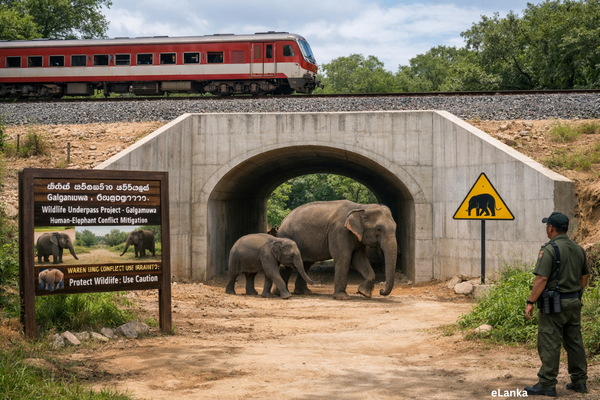
New wildlife underpass at Galgamuwa – solution for Human-Elephant Conflict By Arundathie Abeysinghe According to scholars, the new wildlife underpass at Galgamuwa in North Western Province which will be completed this month, will be a solution for the Human-Elephant Conflict (HEC). Galgamuwa is part of the Mahaweli Development Programme, the largest multipurpose national development programme in the country. Currently, construction of the elephant underpass is being completed beneath the railway line at Kasikote, between Galgamuwa and Ambanpola, an area well-known for frequent elephant crossings. A tunnel is constructed beneath the railway track to allow wild elephants to move safely from one side to the other, reducing the risk of train collisions as well as HEC. In 1977, when the Accelerated Mahaweli Development Scheme was launched, vast extents of forest lands were logged to facilitate new settlements. This led to elephants losing their habitats. According to senior engineers working on the project site, “construction work is expected to be completed in March 2026. The project would have been completed in early March, yet, the design phase of the project could not be finalised as there were challenges in controlling the movements of elephants towards the villages. During the rainy season, the slope that had already been cut was filled with water. Hence, those issues had to be addressed prior to its completion.” Galgamuwa residents are of the view that “this is a key project that should have been completed several decades ago as over 300 people have died in the area due to HEC, while over 50 people are handicapped as a large number of houses were damaged by elephants in search of food. For many years, we have spent sleepless nights due to fear of elephants roaming villages at night. One or two officers of the Department of Wildlife Conservation (DWC) cannot handle several elephants at once.” According to environmentalists “due to new settlements, there is lack of food in existing elephant migratory routes. To prevent elephant encounters, majority of villagers have set up electric fences which are useless as elephants cross the fences by felling large trees over them.” “Kahalla-Pallekele sanctuary was declared in 1989 with the objective of declaring the area up to Kala Wewa and Balalu Wewa as a national park. Yet, after this declaration, illegal land grabbing and human activities have disturbed migratory routes that elephants have been using for many years. Subsequent governments dug trenches, thinking that it would discourage elephants from coming towards villages. But that too was unsuccessful. Elephants now destroy electric fences because there’s lack of maintenance. It is difficult for just one or two wildlife officers to manage these elephant fences. When there’s lack of fodder, they go to people’s backyards in search of vegetables and fruits grown in home gardens.” In certain areas of Galagamuwa, community-based seasonal paddy field fences are constructed to avoid HEC. These are very successful as there is a direct incentive for the farmers to maintain and monitor the fence as their crops may be raided by elephants. In 2024, there were around 300 seasonal paddy field fences erected by Farmer Organisations supported by the Department of Agrarian Development. These seasonal paddy field fences contributed significantly to the number of elephant deaths decreasing from 488 in 2023 to 386 in 2024 as people kill elephants mainly when they raid their paddy or vegetable crops. Scholars are of the view that “although, the project would be completed this month, it is necessary to monitor, at least for a period of one year, if elephants may get used to using the underpass, even though they may not use it immediately.”
Articles Arundathie Abeysinghe

New wildlife underpass at Galgamuwa – solution for Human-Elephant Conflict – By Arundathie Abeysinghe

Australia to host U19 women’s tri-series in April
Articles

Australia to host U19 women’s tri-series in April

Space Exploration-eLanka
Articles

‘Space Exploration’ Looms Within Colombo !!!

Jerusha
Articles

Most Cerebral Palsy Care Stops at 18. This Activist Is Working to Change That

  • Quick Links:
  • Articles
  • DESMOND KELLY
  • Dr Harold Gunatillake
  • English Videos
  • Sri Lanka
  • Sinhala Videos
  • eLanka Newsletters
  • Obituaries
  • Sunil Thenabadu
  • Dr. Harold Gunatillake
  • Tamil Videos
  • Sinhala Movies
  • Trevine Rodrigo
  • Photos
  • eLanka Newsletter

eLanka

Your Trusted Source for News & Community Stories: Stay connected with reliable updates, inspiring features, and breaking news. From politics and technology to culture, lifestyle, and events, eLanka brings you stories that matter — keeping you informed, engaged, and connected 24/7.
Kerrie road, Oatlands , NSW 2117 , Australia.
Email : info@eLanka.com.au / rasangivjes@gmail.com.
WhatsApp : +61402905275 / +94775882546
  • About eLanka
  • Terms & Conditions

Disclaimer:
eLanka is committed to sharing positive and community-focused stories. We do not publish or endorse political, religious, or ethnic viewpoints. The content published on eLanka, including articles and newsletters, reflects the opinions and views of the respective authors and not those of eLanka. eLanka accepts no responsibility or liability for the accuracy, completeness, or consequences of any content provided by contributors.

(c) 2005 – 2025 eLanka Pty Ltd. All Rights Reserved.