


Martin Wickremasinghe and the Catholic Church: An Uneasy Encounter – by Avishka Mario Senewiratne


(text of the speech presented at The Patterns of Ecumenical Thought in Modern Sri Lanka on August 21, 2026 at the Diocesan Chambers, Cathedral of Christ the Living Saviour, Colombo 7)
By Avishka Mario Senewiratne
By now, with the renewed interest and discussions on Martin Wickramasinghe in which you may have taken part before today, let alone the fascinating accounts by my three esteemed colleagues who have spoken would have given you a clear indication that Wickramasinghe was an ‘ideas’ man, who had an opinion and criticism for any subject his eyes or senses laid on. My focus is on a lesser known, hardly discussed perspective, which you will possibly consider as controversial. And that is Martin Wickramasinghe and the Catholic Church.
After Sirimavo Bandaranaike’s SLFP government won the elections of July 1960 there was a period of considerable political and social change. Among its most controversial measures was the state takeover of assisted and denominational schools. The controversy soon went beyond education. It raised larger questions about religion, democracy, and where the authority of the Church should end and that of the State begin.
It was also a lively period in Sri Lanka’s intellectual life. Christianity, democracy and education were debated by formidable minds: Martin Wickremasinghe; Fr. W. L. A. Don Peter, historian and later Rector of St. Joseph’s College; and Bishop Edmund Peiris OMI, the first Sinhalese Catholic bishop and himself a distinguished historian and Sinhala scholar. It is against this background that I approach Martin Wickremasinghe and the Catholic Church.
The first part of my discussion are some thoughts on a series of articles Wickremasinghe wrote to the Silumina in 1960. In his first article, “ආගම, සසුන හ ජනසම්මතවාදය” — Religion, the Church and Democracy — he argues that religion should not merely consist of theories and dogmas but must be practiced by its followers. Surprisingly, on this aspect, Britain interested him because it retained a monarchy while political power had become democratic and religion no longer commanded the machinery of government. From here, Wickremasinghe turns his guns on the Catholic Church.

He attacks the Catholic Church’s history of censoring books from the ancient to recent times. To him, an institution which prohibits ideas sits rather uncomfortably beside democracy. There is also some wit in his observation that censorship rarely works as scholars and serious readers will somehow find the forbidden books and probably become even more determined to read them. One might also note his severe criticism of the Catholic Church in his work Evolution and Revolution (1971) for censoring Fr. Teilhard de Chardin’s The Phenomenon of Man (1955). Wickramasinghe was known to be an admirer of Chardin.

However, his deeper quarrel was with the hierarchical structure of the Church. Catholic priests administering schools, he argues, did not necessarily represent ordinary Catholics but an ecclesiastical establishment answering to bishops and ultimately Rome. He questions Church authority over marriage and birth control and objects to religious intervention in science. Papal infallibility particularly troubled him: how can unquestionable authority, he asks in effect, coexist with a society founded upon questioning?
Yet Catholics are not Wickremasinghe’s only targets. Buddhist monks receive their share of the fire. He criticizes the temperance movement, arguing that prohibition would hardly make people sober. The working classes might simply turn to illicit arrack, damaging their health while depriving the government of revenue. To sum up, Wickramasinghe states that public policy should follow social realities rather than religious morality.
In a subsequent article he argues that religious education fares little better. Both Buddhist Dhamma schools and Catholic Sunday schools come under scrutiny. Religion, Wickremasinghe argues, cannot simply be learnt from books; it must be lived. Despite the multiplication of religious schools, he saw no corresponding decline in crime among Buddhist or Christian youth. More religion classes, therefore, did not necessarily produce more virtuous or better people.
However, four years earlier, in his book Bana Katha Sahithya, he credited S. Thomas’ distinctive artistic tradition to English clergymen formed by Greek and English literature and inspired by religious ideals. He could therefore admire Christianity’s contribution to culture and education while remaining deeply critical of the authority, censorship and institutional power of the Church itself.
His criticism of Catholicism must also be understood against his view of the colonial missionary legacy. He regarded parts of the Christian establishment as elitist and closely associated with educational and institutional power. Accordingly it must be understood that his criticism against the Church was not for its theology but for its impact on privilege, censorship, authority and bureaucracy. The larger question Wickramasinghe asks and one that is still relevant was — where should religion end and democracy begin?
Wickremasinghe also observes that elite schools such as S. Thomas’, Royal and Wesley may produce decent and civilised young men, but questions whether their virtue necessarily comes from religious instruction. Good manners and discipline, he warns, should not automatically be mistaken for religious virtue.
But some of his criticisms are problematic. His treatment of papal infallibility appears to make it a broad claim to unquestionable authority, whereas Catholic doctrine confines it to particular circumstances concerning faith and morals. His larger question about authority remains legitimate, but his treatment of the doctrine of papal infallibility is incomplete.
He also accuses the Church of discouraging Catholics from participating in activities initiated by Buddhists and non-Catholics yet provides no evidence from Ceylon for such a sweeping conclusion. Similarly, he suggests that Catholic schools did more than educate children — and that through religious education they exercised control over parents and families. Catholic schools certainly preserved religious identity, but control is a considerably stronger accusation and requires considerably stronger evidence.
The conclusion of the essay is revealing. Writing amid the growing Sinhalaisation of Ceylon, Wickremasinghe argues that a free Buddhist society required two things: a strong socialist government and a strong Sasana.
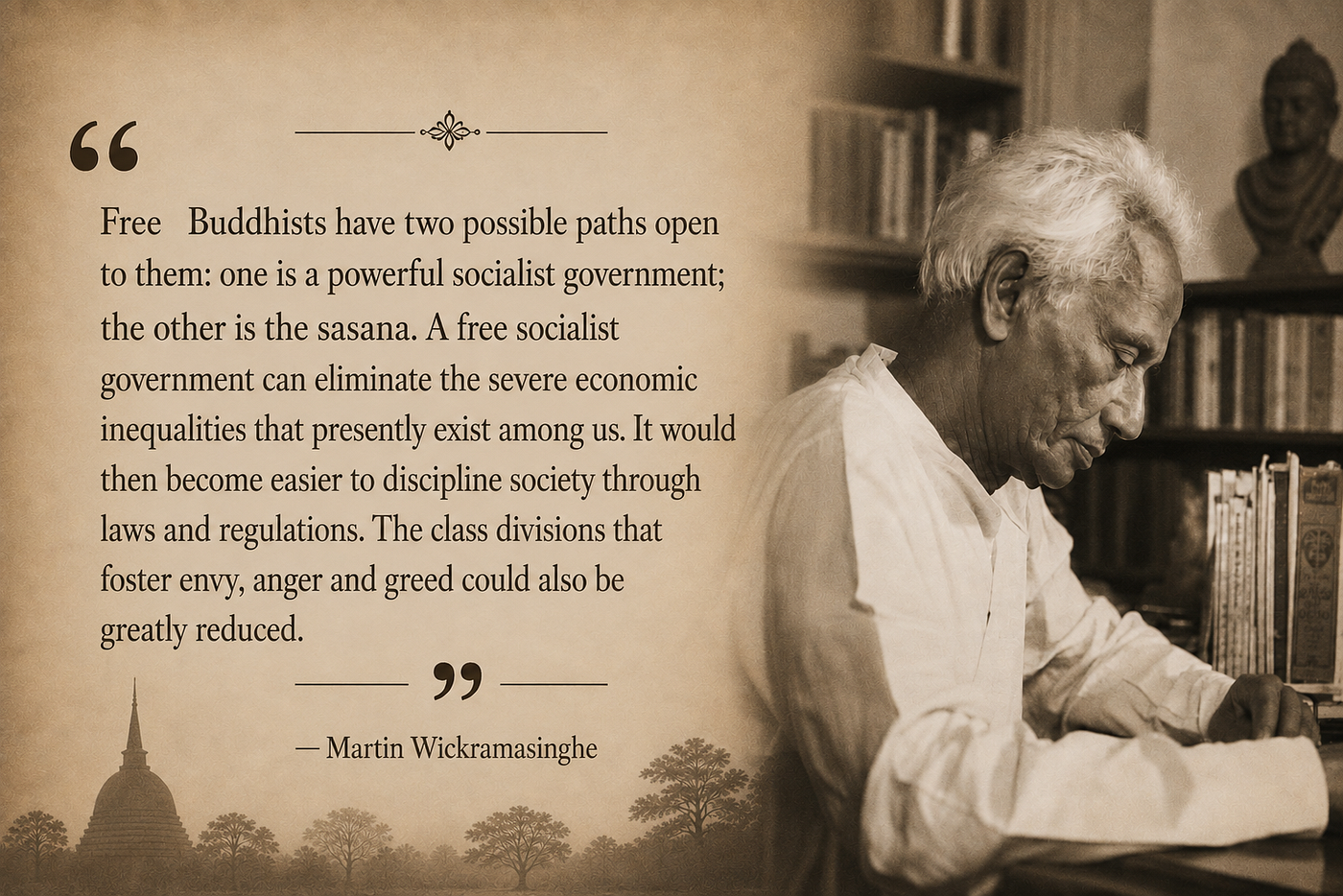
There is an intriguing tension here. He subjects ecclesiastical authority to severe criticism while placing considerable faith in a powerful socialist State. He even goes on to say that socialism could resolve both social and economic anxieties of society. He could not, of course, have foreseen the later record of Sri Lanka’s socialist experiments.
Wickremasinghe soon received an answer from Bishop Edmund Peiris. Peiris corrected what he regarded as Wickremasinghe’s errors concerning Catholic history, doctrine and the functioning of the Church. This was not a quarrel between strangers. Their association went back at least to 1932. Peiris admired Wickremasinghe’s novels and criticism, while Wickremasinghe respected the Bishop’s scholarship. In replying, Wickremasinghe called Peiris an “old friend,” who wishes “not to quarrel,” and clarified an important distinction: his criticism was principally against the institutional Church and the Vatican, not Christianity as an ethical and social teaching.

To support his argument that the Church historically opposed rationalism, democracy and science, Wickremasinghe relied heavily upon J. B. Bury’s A History of Freedom of Thought (1913). He dismissed Hilaire Belloc’s criticism of Bury as largely corrections of dates, statistics and details rather than a refutation of Bury’s central argument.
Here, Wickremasinghe was perhaps too willing to accept an interpretation congenial to his own rationalism. Bury wrote from a strongly rationalist and anti-clerical standpoint; Belloc was a committed Catholic controversialist. Wickremasinghe failed to note that neither gentleman arrived at the argument without luggage.
Nor could modern Catholicism simply be characterized as an opponent of democracy and social progress: by Wickremasinghe’s lifetime, Catholic social teaching had developed considerably on labour, social justice, human dignity and the responsibilities of the State.
With that exchange coming to a close, I would focus on the second aspect of my argument: Martin Wickramasinghe and Fr. Don Peter.

In June 1960, amid the controversy over the school takeover, Archbishop Thomas Benjamin Cooray publicly defended the democratic right of Catholic schools which had played a pivotal role in the freedom struggle to remain under Church ownership while strongly attacking Marxist statism. Ven. Madihe Pannasiha Thera responded in the Dinamina, accusing Catholic education of undermining the Buddha Sasana and provocatively comparing Catholicism with Marxism.

Defending the stance of the Church, Fr. Don Peter replied to the Dinamina. He dismissed the comparison between Catholicism and Marxism as nonsensical and challenged the foundations of Pannasiha Thera’s argument. It was in this milieu that Martin Wickramsinghe, then aged 70, entered the argument as a response to Fr. Don Peter’s article. This response didn’t end up in one article but a series of four others each by Fr. Don Peter and Martin Wickramsinghe.

Martin Wickramasinghe’s first response titled “Is the Catholic Church Democratic?”, starts his argument by saying “මඩිහේ පඥ්ඥසීහ මහහිමියගේ එක් චෝදනාවක් වත් අසාධාරණ නොවේ යයි හැ(ගේ)” Wickramasinghe argued that the political outlook of the medieval Roman Catholic Church was closely associated with a hierarchical and authoritarian conception of the state. He connects this tradition with the philosophy of Aristotle and St. Thomas Aquinas and contrasts it with modern democracy, which he sees as developing largely from the ideas of English thinkers such as John Locke and David Hume. However, Wickramasinghe does not claim that Catholic doctrine explicitly demands an anti-democratic state; he acknowledges that the evidence from Pope Leo XIII does not necessarily prove such a position.

Nevertheless, he stated that the Church’s historical conduct gives some justification to accusations of authoritarianism. He particularly points to the Catholic Church’s support for Francisco Franco’s dictatorship in Spain and cites Pope Pius XI who called the Fascist Dictator Mussolini, “a man sent by Providence,” after the Vatican Treaty of 1929. Wickramasinghe distinguishes the teachings of Jesus and early Christianity from the political character later acquired by the institutional Church. Drawing upon the Marxist scholar Karl Kautsky’s Foundations of Christianity, he suggests that primitive Christianity possessed egalitarian, even communistic or socialist, characteristics. Although Kautsky was a Marxist, Wickramasinghe argues that his historical criticism cannot simply be dismissed. Overall, he presents Christianity as an evolving historical institution whose later authoritarian tendencies should not automatically be attributed to Jesus’s original teachings.

In his response to Wickramasinghe, Fr. Don Peter’s article is titled “කතෝලික පවුලේ පාලනයට ප්රජාතන්ත්රවාදය උවමනා නැත.” He laments stating that he thought Wickramasinghe was a moderate and not an extremist for the first line in the latter’s response “මඩිහේ පඥ්ඥසීහ මහහිමියගේ එක් චෝදනාවක් වත් අසාධාරණ නොවේ.” Here, his strongest contention to Wickremasinghe rests upon a simple distinction: the Catholic Church is not democratic in its internal government, but this does not make it anti-democratic. He argues that the Church does not claim that every legitimate political system must imitate its own hierarchical structure. Nor, he maintains, should the actions of Catholics in a particular country or period be taken as proof that the Church itself is opposed to democracy.

To explain this, Fr. Don Peter compares the Church to a family. A family is not governed democratically: children do not elect their parents or vote upon every decision. They obey their father because they trust his love, judgement and concern for their welfare. In the same manner, Catholics regard the Pope as a spiritual father and accept his authority as the representative of Christ. This obedience, Fr. Don Peter stresses, concerns principally religious and spiritual matters and applies to Catholics, not to society as a whole.
The distinction is important and exposes a weakness in Wickremasinghe’s argument. A hierarchical institution is not necessarily hostile to a democratic State. Universities, armies and even political parties may contain hierarchies while functioning within democracies.
Yet Fr. Don Peter’s family analogy is not totally convincing. Children possess limited autonomy because they are minors; adult Catholics are morally and intellectually responsible individuals. Comparing ecclesiastical obedience to a child’s obedience to his father risks becoming paternalistic and may actually strengthen Wickremasinghe’s concern about unquestioned authority. Don Peter successfully demonstrates that non-democratic and anti-democratic are not synonymous, but his argument does not entirely answer the larger question Wickremasinghe raises: how should a hierarchical religious authority operate within a society increasingly committed to individual judgement, intellectual freedom and democratic values? Though Wickramasinghe’s criticism is about the Catholic Church’s lack of democracy, he fails to mention how or how not Buddhism or any other main religion functions in a democratic hegemony.
In his next response, titled “ජනසම්මතවාදය හා රෝමානු පල්ලිය,” Wickremasinghe began by apologising to Fr. Don Peter and clarifying that he had actually written, “මඩිහේ පඥ්ඥසීහ හිමියගේ එක් චෝදනාවක් අසාධාරණ නොවේයැයි මට හැගේ,” rather than “එක් චෝදනාවක් වත් අසාධාරණ නොවේ.” The editor of the Dinamina also apologised to readers for the erroneous addition of “වත්,” which had significantly altered the meaning and perhaps contributed to Fr. Don Peter escalating the debate.
From this point, however, the exchange became increasingly polemical. Wickremasinghe revealed some confusion regarding the distinction between the Roman Catholic Church and the local Church in Sri Lanka, an issue Fr. Don Peter readily seized upon. He also invoked an earlier criticism by Panditha Vimalawansha Thero, who had claimed that Wickremasinghe lacked sufficient knowledge of Buddhism and the history of its propagation. Don Peter therefore questioned how someone accused of misunderstanding his own religious tradition could confidently pronounce upon the Catholic Church.
The debate consequently drifted further from its original argument about Catholicism and democracy. The Gnanartha Pradeepaya joined the controversy, attacking Wickremasinghe with the cutting remark, “වික්රමසිංහ මහතා පණ්ඩිතකම කට ගාගත්තෙකැයි.” Thereafter, the exchange gradually petered out without a proper resolution, leaving behind considerable disagreement and evidently some resentment among those involved.

Two years after this exchange, in 1962, Wickremasinghe published Sinhala Sakaskada, a collection of essays on culture, anthropology, democracy and religion, including his articles on the Catholic Church, the school takeover and his responses to Fr. Don Peter. On 14 July 1962, Don Peter wrote to Wickremasinghe questioning why his replies had been omitted, arguing that Catholic readers had thereby been denied the other side of the debate. Wickremasinghe replied that the book was essentially a collection of his own writings but encouraged Fr. Don Peter to publish the entire exchange himself. Fr. Don Peter accepted the suggestion and subsequently published his own Sakaskädé.
In 1964 Fr. Don Peter made a surprising gesture. He invited Wickremasinghe, then nearly seventy-five, to be Chief Speaker at the Sinhala Day of St. Joseph’s College. Wickremasinghe accepted the invitation. Fr. Don Peter later recalled that the two had a long conversation near the College swimming pool and finally resolved the differences arising from their 1960 controversy. Their friendship continued until Wickremasinghe’s death. At St. Joseph’s College, Wickramasinghe who spoke for nearly an hour urged English-educated Sinhalese to value their mother tongue, literature and culture, arguing that without such knowledge they could not understand or live harmoniously with their fellow countrymen. Afterwards, the Literary Association staged Amal Biso, written by Fr. Marcelline Jayakody OMI and produced by Fr. Joe Neththasinghe.

His friendship with Bishop Edmund Peiris likewise endured. More importantly, Wickremasinghe was closely observing the remarkable transformation occurring within Catholicism through the Second Vatican Council of 1962–65. He welcomed its liturgical and ecumenical reforms, greater openness towards other Christian traditions and the growing indigenization of the Church, regarding these as important steps in making Catholicism relevant to the modern world. For the Century Jubilee of the Gnanartha Pradeepaya in 1966, Martin Wickrasinghe wrote the following:
“I cannot help but say that I have always had a great fondness for the paper, because of the taste and skill with which it is produced, and because, although its articles are religious in character, they are written in a manner that appeals to anyone. I believe that the editor deserves the highest praise for bringing out a publication of this kind.” (Translated by the writer)

When Edmund Bishop Peiris retired as Bishop of Chilaw in 1972, Wickremasinghe even contributed an article to the Gnanartha Pradeepaya, ironically, the same Catholic newspaper which had attacked him during the earlier controversy, praising Peiris as an important scholar and historian. Bishop Edmund Peiris later wrote perhaps one of the finest assessments of Wickremasinghe’s vast literary output, “The Sage of Koggala,” for his 85th birthday in 1975. More recently, Fr. Ivan Perera recalled to me that, as a seminarian in 1960, he typed Fr. Don Peter’s correspondence with Wickremasinghe for the Dinamina and years later when the controversy mellowed down accompanied Wickremasinghe to the Ampitiya National Seminary, where he addressed the seminarians and even spent the night in Ampitiya. All these are indications of how relations had changed as Wickremasinghe observed the evolution of the Church.
The reconciliation went further. Fr. Tissa Balasuriya, then Rector of Aquinas College, invited Wickremasinghe as Chief Guest at its convocation. Addressing the gathering Wickremasinghe spoke admiringly of Teilhard de Chardin and encouraged the students in their pursuit of learning and embedding an indigenous, original culture and religion.
Thus, the story did not end with the polemics of 1960. Wickremasinghe’s judgement became more nuanced, while the Catholic Church itself was undergoing significant change. Perhaps the lasting value of this episode lies not in deciding who won the argument, but in what followed it. Wickremasinghe and Fr. Don Peter disagreed sharply, yet dialogue eventually gave way to mutual respect and friendship. Their story reminds us that a civil exchange of opposing views need not deepen divisions. At its best, intellectual disagreement can correct misunderstandings, refine convictions and, ultimately, bring both sides towards a better understanding of one another.

Although Wickremasinghe’s relations with the Church improved, many of the questions he raised in the 1960s remain relevant. Less than twenty years after his death, Fr. Tissa Balasuriya’s Mary and Human Liberation came under severe ecclesiastical scrutiny, eventually leading to his temporary excommunication and controversy over the censorship of his work. Once again, Fr. Don Peter (then in his late 70s) firmly defended the position of the Church.
The episode almost brings the story full circle. Questions of censorship, intellectual freedom and ecclesiastical authority, the very issues that had troubled Wickremasinghe decades earlier, had returned in a different generation and circumstance. One can only wonder: had Martin Wickremasinghe lived to witness it, what would he have said?
*Special thanks to Prof. C.R. de Silva, Prof. Sandagomi Coperahewa and Dr. Kanchanakesi Warnapala.