eLanka

Saturday, 28 Mar 2026
  • Home
  • Read History
  • Articles
    • eLanka Journalists
  • Events
  • Useful links
    • Obituaries
    • Seeking to Contact
    • eLanka Newsletters
    • Weekly Events and Advertisements
    • eLanka Testimonials
    • Sri Lanka Newspapers
    • Sri Lanka TV LIVE
    • Sri Lanka Radio
    • eLanka Recepies
  • Gallery
  • Contact
Newsletter
  • eLanka Weddings
  • Property
  • eLanka Shop
  • Business Directory
eLankaeLanka
Font ResizerAa
Search
  • Home
  • Read History
  • Articles
    • eLanka Journalists
  • Events
  • Useful links
    • Obituaries
    • Seeking to Contact
    • eLanka Newsletters
    • Weekly Events and Advertisements
    • eLanka Testimonials
    • Sri Lanka Newspapers
    • Sri Lanka TV LIVE
    • Sri Lanka Radio
    • eLanka Recepies
  • Gallery
  • Contact
Follow US
© 2005 – 2026 eLanka Pty Ltd. All Rights Reserved.
Home » Goodnews Stories Srilankan Expats » Articles » Riding High on Ocean Waves-by Hannah Ellis Petersen
Articles

Riding High on Ocean Waves-by Hannah Ellis Petersen

eLanka admin
Last updated: March 9, 2022 4:43 pm
By
eLanka admin
ByeLanka admin
Follow:
Share
10 Min Read
SHARE
Views: 0

Riding High on Ocean Waves-by Hannah Ellis Petersen

Shamali Sanjaya

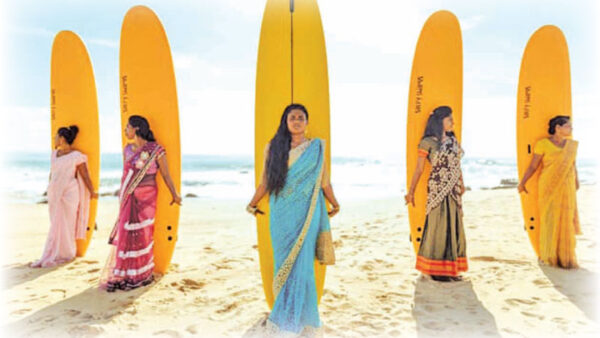
Shamali Sanjaya (centre) with members of the Arugam Bay Girls Surf Club
Source:Dailynews

Women and girls have challenged conservative attitudes  in the hallowed surf spot of Arugam Bay, Sri Lanka

Growing up in a small fishing village along the East Coast of Sri Lanka, Shamali Sanjaya would often sit on the beach and look out at the boisterous waves. She would watch in envy as others, including her father and brother, grabbed surfboards, paddled out into the sea and then rode those waves smoothly back to shore. “I longed for it in my heart,” she said.

But as a local woman, surfing was strictly out of bounds for her. In Sri Lanka’s conservative society, the place for women was at the home and it was only the men, or women tourists, who were allowed to ride the hallowed waves in Arugam Bay, considered Sri Lanka’s best surf spot and one of the best in Asia.

The Arugam Bay Girls Surf Club has about a dozen core members, aged from 13 to 43

Yet now, as a 34-year-old mother of two and with another baby on the way, Sanjaya is at the forefront of a quiet women surfing revolution that has swept not just her village but the whole country. In 2018, she helped set up Sri Lanka’s first all-women surf club in Arugam Bay and in 2020, competed in Sri Lanka’s first women-only category in a national surfing competition. At four months pregnant, she is still hitting the waves several times a week, and plans to compete again after her baby is born.

It began in 2011 with a knock from a neighbour. Tiffany Carothers, a surfing enthusiast and mother of two who had just moved in next door from her native California, USA, asked Sanjaya if she wanted to come surfing. It did not matter that she had only tried it once before, Carothers assured her, they would lend her a board and give her some lessons.

Once she had a taste for the waves, Sanjaya could not be stopped. She proved to be a natural, taking after her father, who had once taught surfing, and her brother, who is a national surf champion in Sri Lanka.

“When I surf, it is such a happy feeling for me,” she said. “I am filled with this energy, I feel so strong. Life is full of all these headaches and problems, but as soon as I get into the water, I forget about it all.”

Shamali Sanjaya helped set up Sri Lanka’s first all-women surf club in Arugam Bay in 2018

Yet she faced fierce disapproval, particularly from her brother. Their parents had died when she was seven and he was protective of his sisters, believing that their place was inside the home.

“My brother told me that it is not our culture for women to be surfing, that I should stay inside and do the cooking and cleaning,” said Sanjaya. Known for being headstrong, she decided to ignore him and would instead co-ordinate secret surf rendezvous, rushing to the beach at lunchtime when her brother was eating or going out at the crack of dawn.

In 2015, after interest from other women in the village, Carothers decided to set up an event to teach more local girls in Arugam Bay how to surf. She and Sanjaya went house to house, talking to women and their families to persuade them to come along.

Initially many parents were reluctant, fearful about safety and that surfing meant partying, drugs and alcohol, or that, in a society that still subscribes to outdated views of light skin equating to beauty, being out in the sun would darken their daughters’ skin. “We told them we never do anything that disrespects our culture,” said Sanjaya. “We do not wear bikinis, we do not drink, it is just about getting into the waves.”

More local girls started to join the surfers after an event teaching them how to surf in 2015

The first event proved so popular that they decided to make it a weekly gathering. But as gossip and local disapproval began to swirl, Carothers was pulled in by the Sri Lanka Tourist Board. “They accused me of trying to change the culture, that girls in Sri Lanka do not surf and if I wanted to help their families I should give them sewing machines,” she said. “They threatened to kick my family out of the country if they saw me teaching surf lessons to girls.”

The Police also began questioning the members, asking whether Carothers was giving them alcohol and drugs, and over half the girls stopped attending. But rather than stopping altogether, the remaining women took their club underground and would meet secretly on the beach and go on clandestine surf trips to other parts of the island.

Finally in 2017, after the Surfing Federation of Sri Lanka was set up, there was a pathway for their own official surf club and in August 2018, the Arugam Bay Girls Surf Club was born.

Nandini Kaneshlingam says after her husband died ‘surfing made me feel happy again’

They now have about a dozen core members, ranging from ages 13 to 43. Though they have broken through many of the local taboos, many of the women still face a backlash from their families and communities. Nandini Kaneshlingam, a 43-year-old mother of four whose husband killed himself in 2011, said she suffered so much stigma over being a mother and widow in her 40s on a surfboard that she almost quit the club several times.

But having persisted at the insistence of the other women, Kaneshlingam said that surfing had given her a new lease of life. “It was my children who came and pushed me on to waves,” she said. “After my husband died I was very sad and things were very difficult, but with surfing, it made me feel happy again.”

Ammu Anadarasa, 14, one of the club’s youngest members, said she had been mercilessly teased at school. “My friends at school used to fight with me about it, they would say ‘Why are you doing surfing?’ and call me a boy,” she said. But when she showed her friends photos in a local newspaper of her surfing, they were impressed. “Now they know I am a good surfer,” she said. “I just wish more girls would do surfing.”

Most of the women said they had learned to brush off the criticism, and had seen their husbands, family members and communities won over. Mona Nadya Pulanthiram, 35, a mother of two, had been terrified of the sea after her mother died in the 2004 tsunami that devastated coastal areas in Sri Lanka. But after giving birth to her second child, friends persuaded her to give surfing a try, and she was amazed to feel her fear gradually disappear. Now she is regularly out chasing the big waves, sometimes with her daughter in tow.

“People are always questioning my husband, asking why I do not just stay at home and be a quiet, nice mum,” she said. “To those people I say: I am already a mum, surfing does not change that. When I am in the ocean, I do not think about anything except catching the perfect wave.”

For Sanjaya, her greatest triumph was finally winning her brother’s approval. At Main Point, where waves are often two metres high, the pair can often be spotted out surfing together.

(The Guardian)

Surfing  at  Arugam Bay
Arugam Bay at sunset
Arugam Bay
TAGGED:Arugam BayShamali Sanjaya
Share This Article
Facebook Whatsapp Whatsapp LinkedIn Email Copy Link Print
Previous Article Lakmini blends academic and skilfulness to achieve aesthetic splendour – by Sunil Thenabadu Lakmini blends academic and skilfulness to achieve aesthetic splendour – by Sunil Thenabadu
Next Article Kandy Sri Lanka First Impressions Kandy Sri Lanka
FacebookLike
YoutubeSubscribe
LinkedInFollow
Most Read
10 Pictures With Fascinating Stories Behind Them!

“A PICTURE SPEAKS A 1000 WORDS” – By Des Kelly

Look past your thoughts so you may drink the pure nectar of this moment

A Life Hack for when we’re Burnt Out & Broken Down – By Uma Panch

Narration of the History of our Proud Ancestral (Orang Jawa) Heritage. by Noor R. Rahim

eLanka Weddings

eLanka Marriage Proposals

Noel News

Noel News

Noel News

Noel News- By Noel Whittaker

EILEEN MARY SIBELLE DE SILVA (nee DISSANAYAKE) – 29 September 1922 – 6 April 2018 – A Woman of Value an Appreciation written by Mohini Gunasekera

K.K.S. Cement Factory

Dr.Harold Gunatillake’s 90th Birthday party

Sri Lanka's women's cricket squad in Melbourne

Cricket: Sri Lanka’s women’s squad in Melbourne

- Advertisement -
Ad image
Related News
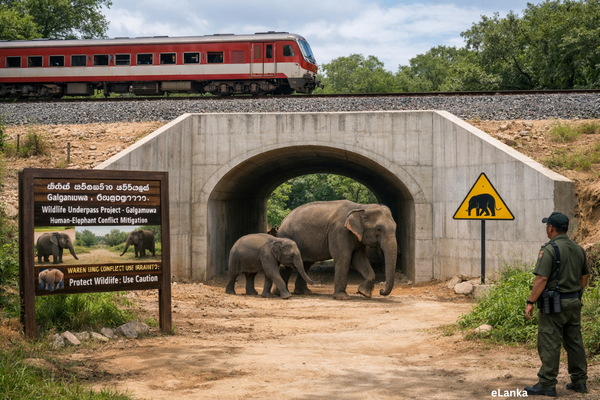
New wildlife underpass at Galgamuwa – solution for Human-Elephant Conflict By Arundathie Abeysinghe According to scholars, the new wildlife underpass at Galgamuwa in North Western Province which will be completed this month, will be a solution for the Human-Elephant Conflict (HEC). Galgamuwa is part of the Mahaweli Development Programme, the largest multipurpose national development programme in the country. Currently, construction of the elephant underpass is being completed beneath the railway line at Kasikote, between Galgamuwa and Ambanpola, an area well-known for frequent elephant crossings. A tunnel is constructed beneath the railway track to allow wild elephants to move safely from one side to the other, reducing the risk of train collisions as well as HEC. In 1977, when the Accelerated Mahaweli Development Scheme was launched, vast extents of forest lands were logged to facilitate new settlements. This led to elephants losing their habitats. According to senior engineers working on the project site, “construction work is expected to be completed in March 2026. The project would have been completed in early March, yet, the design phase of the project could not be finalised as there were challenges in controlling the movements of elephants towards the villages. During the rainy season, the slope that had already been cut was filled with water. Hence, those issues had to be addressed prior to its completion.” Galgamuwa residents are of the view that “this is a key project that should have been completed several decades ago as over 300 people have died in the area due to HEC, while over 50 people are handicapped as a large number of houses were damaged by elephants in search of food. For many years, we have spent sleepless nights due to fear of elephants roaming villages at night. One or two officers of the Department of Wildlife Conservation (DWC) cannot handle several elephants at once.” According to environmentalists “due to new settlements, there is lack of food in existing elephant migratory routes. To prevent elephant encounters, majority of villagers have set up electric fences which are useless as elephants cross the fences by felling large trees over them.” “Kahalla-Pallekele sanctuary was declared in 1989 with the objective of declaring the area up to Kala Wewa and Balalu Wewa as a national park. Yet, after this declaration, illegal land grabbing and human activities have disturbed migratory routes that elephants have been using for many years. Subsequent governments dug trenches, thinking that it would discourage elephants from coming towards villages. But that too was unsuccessful. Elephants now destroy electric fences because there’s lack of maintenance. It is difficult for just one or two wildlife officers to manage these elephant fences. When there’s lack of fodder, they go to people’s backyards in search of vegetables and fruits grown in home gardens.” In certain areas of Galagamuwa, community-based seasonal paddy field fences are constructed to avoid HEC. These are very successful as there is a direct incentive for the farmers to maintain and monitor the fence as their crops may be raided by elephants. In 2024, there were around 300 seasonal paddy field fences erected by Farmer Organisations supported by the Department of Agrarian Development. These seasonal paddy field fences contributed significantly to the number of elephant deaths decreasing from 488 in 2023 to 386 in 2024 as people kill elephants mainly when they raid their paddy or vegetable crops. Scholars are of the view that “although, the project would be completed this month, it is necessary to monitor, at least for a period of one year, if elephants may get used to using the underpass, even though they may not use it immediately.”
Articles Arundathie Abeysinghe

New wildlife underpass at Galgamuwa – solution for Human-Elephant Conflict – By Arundathie Abeysinghe

Australia to host U19 women’s tri-series in April
Articles

Australia to host U19 women’s tri-series in April

Space Exploration-eLanka
Articles

‘Space Exploration’ Looms Within Colombo !!!

Jerusha
Articles

Most Cerebral Palsy Care Stops at 18. This Activist Is Working to Change That

Councillor Sam Karnib receives the honour roll citation for his late father Councillor Ali Karnib from NSW Premier Chris Minns-eLanka 01
Articles

LCC MEDIA RELEASE – Councillor Ali Karnib listed on NSW Multicultural Honour Roll

  • Quick Links:
  • Articles
  • DESMOND KELLY
  • Dr Harold Gunatillake
  • English Videos
  • Sri Lanka
  • Sinhala Videos
  • eLanka Newsletters
  • Obituaries
  • Sunil Thenabadu
  • Dr. Harold Gunatillake
  • Tamil Videos
  • Sinhala Movies
  • Trevine Rodrigo
  • Photos
  • eLanka Newsletter

eLanka

Your Trusted Source for News & Community Stories: Stay connected with reliable updates, inspiring features, and breaking news. From politics and technology to culture, lifestyle, and events, eLanka brings you stories that matter — keeping you informed, engaged, and connected 24/7.
Kerrie road, Oatlands , NSW 2117 , Australia.
Email : info@eLanka.com.au / rasangivjes@gmail.com.
WhatsApp : +61402905275 / +94775882546
  • About eLanka
  • Terms & Conditions

Disclaimer:
eLanka is committed to sharing positive and community-focused stories. We do not publish or endorse political, religious, or ethnic viewpoints. The content published on eLanka, including articles and newsletters, reflects the opinions and views of the respective authors and not those of eLanka. eLanka accepts no responsibility or liability for the accuracy, completeness, or consequences of any content provided by contributors.

(c) 2005 – 2025 eLanka Pty Ltd. All Rights Reserved.