News & Community eLanka

eLanka

Monday, 27 Apr 2026
  • Home
  • Read History
  • Articles
    • eLanka Journalists
  • Events
  • Useful links
    • Obituaries
    • Seeking to Contact
    • eLanka Newsletters
    • Weekly Events and Advertisements
    • eLanka Testimonials
    • Sri Lanka Newspapers
    • Sri Lanka TV LIVE
    • Sri Lanka Radio
    • eLanka Recepies
  • Gallery
  • Contact
Newsletter
Sri lankan news
  • eLanka Weddings
  • Property
  • eLanka Shop
  • Business Directory
eLankaeLanka
Font ResizerAa
Search
  • Home
  • Read History
  • Articles
    • eLanka Journalists
  • Events
  • Useful links
    • Obituaries
    • Seeking to Contact
    • eLanka Newsletters
    • Weekly Events and Advertisements
    • eLanka Testimonials
    • Sri Lanka Newspapers
    • Sri Lanka TV LIVE
    • Sri Lanka Radio
    • eLanka Recepies
  • Gallery
  • Contact
Follow US
© 2005 – 2026 eLanka Pty Ltd. All Rights Reserved.
Home » Goodnews Stories Srilankan Expats » Articles » The Avukana Buddha – a masterpiece of Buddhist art-by ACB Pethiyagoda
Articles

The Avukana Buddha – a masterpiece of Buddhist art-by ACB Pethiyagoda

eLanka admin
Last updated: March 25, 2024 6:28 pm
By
eLanka admin
ByeLanka admin
Follow:
Share
4 Min Read
SHARE
Views: 10

The Avukana Buddha – a masterpiece of Buddhist art-by ACB Pethiyagoda

elanka

Source:Island

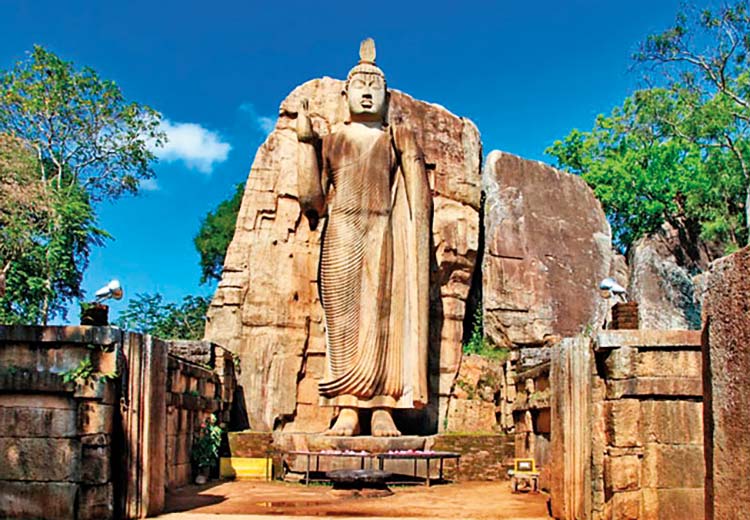
Some of the outstanding contributions to the Sri Lanka heritage are its Buddhist temple art and architecture, statuary, dagabas, dance forms and water and soil conservation ecosystems. Of Buddha statues, the one at Avukana is certainly a masterpiece; hewn out of solid granite it stands 11.3 meters high and 12.8 meters inclusive of the lotus flower pedestal. There are only four other comparable standing Buddha statues in Sri Lanka; Rasvehera in Anuradhapura, Maligawila and Buduruwagala in Moneragala and Dova in Badulla. Of these the ones at Rasvehera and Avukana are in the open and to the layman’s eye, there are hardly any signs of damage due to exposure to the elements.

The stone carver or carvers names are not known or for that matter in which king’s rule the Avukana Statue was carved. Some think it was during the period of King Datusena (459-477 AC) the builder of the mighty Kalawewa/Jayaganga irrigation system in the neighbourhood while others think it was during the rule of Parakramabahu I in the 12th century. Ananda Cumaraswamy was in agreement in regard to this period but Senarath Paranavithana thought it was much earlier in the late 5th Century AC.

However, in style the statue is considered characteristic of the Amaravathi period of art in India in the second and third Centuries; such influences were common in those times. Further, it is said that standing Buddha statues in many Buddhist countries came into being in the early Christian period. Hence, on these two counts and in the absence of other evidence, it seems most plausible that this state belongs to the second or third Century AC.

The carving on the head of the statue is called Sirisaputa symbolising rays of resplendence and glory. It is said to be the eighth of the 80 unique signs on the body of the Buddha.

It was in the second half of the fifth Century AC that statues with the Sirisaputa were first seen. Hence, statues of earlier periods had these added and King Datusena is said to have had many statues thus adorned. It is, therefore, most likely that this was an addition to the Avukana statue of two or three centuries earlier.

The art of the language of the hands of the Buddha is called Mudra. In this statue the right hand with the fingers stretched out and palm facing outwards signifies fearlessness and is called Abhaya Mudra. The position of the left hand bent at the elbow holding the robe is called Kataka Mudra.

To the average Buddhist layman, the period during which the statue was carved, when the Sirisaputa was placed or what the Mudras means does not matter very much. What does create a lasting impression on him is the beauty, perfection in proportion and the sublime serenity which compels him to bow in veneration of the Buddha.

(First published in the Sunday Island in March 2003)

TAGGED:Ananda CumaraswamyBuddhist templeSenarath ParanavithanaSri Lanka heritage
Share This Article
Facebook Whatsapp Whatsapp LinkedIn Email Copy Link Print
Previous Article Vision Care Celebrates International Women's Day 2024 Championing Inclusion and Equality 01 (1) Vision Care Celebrates International Women’s Day 2024 Championing Inclusion and Equality
Next Article Cart-eLanka When I was your age…- BY R.S. KARUNARATNE
FacebookLike
YoutubeSubscribe
LinkedInFollow
Most Read
10 Pictures With Fascinating Stories Behind Them!

“A PICTURE SPEAKS A 1000 WORDS” – By Des Kelly

Look past your thoughts so you may drink the pure nectar of this moment

A Life Hack for when we’re Burnt Out & Broken Down – By Uma Panch

Narration of the History of our Proud Ancestral (Orang Jawa) Heritage. by Noor R. Rahim

eLanka Weddings

eLanka Marriage Proposals

Noel News

Noel News

Noel News

Noel News- By Noel Whittaker

Appreciation: Eileen Mary Sibelle De Silva

K.K.S. Cement Factory

Dr.Harold Gunatillake’s 90th Birthday party

Sri Lanka's women's cricket squad in Melbourne

Cricket: Sri Lanka’s women’s squad in Melbourne

- Advertisement -
Ad image
Related News
Articles Dr Harold Gunatillake

Enough magnesium in your body is really important and can truly help you prioritise your health. Magnesium plays a vital role in many bodily functions-by Harold Gunatillake

Lions Club Celebrates Avurudu with Music, Games, and Tradition-by Trevine Rodrigo
Articles Trevine Rodrigo

Lions Club Celebrates Avurudu with Music, Games, and Tradition-by Trevine Rodrigo

story of black dog
Articles

The Black Four-Legged Peace Walker: A Silent Guide on Day 4 in Sri Lanka

Ratnapura
Articles

“CITY OF GEMS” RATNAPURA Ratnapura, known as the “City of Gems” in Sri Lanka, derives its name from the Sanskrit words “ratna” (gemstone) and “pura” (town or city). As the hub of Sri Lanka’s gem mining industry. The name is derived from Sanskrit and Pali, languages that heavily influenced the region over 2000 years ago. The city earned this name because it has been the traditional center of Sri Lanka’s gem trade for over 2,000 years. It is the primary source of world-renowned precious stones, including blue sapphires, rubies, and cat’s eyes.Some historical accounts suggest a different origin linked to the Portuguese colonial era. There is a view that the name could be derived from the Portuguese word “Rapadura,” which refers to jaggery. Ratnapura is the heart of Sri Lanka’s gem industry, often called the “gem capital of the world” due to its incredible geological wealth and ancient trading history. The region is famous for producing over 40 of the 85 known gemstone varieties in the world. The most famous is the “Ceylon Sapphire,” prized for its vivid cornflower and royal blue hues. Other varieties include yellow, pink, and the rare orange-pink Padparadscha. Specialty Stones: Includes the rare Alexandrite (which changes color in different light), Cat’s Eye Chrysoberyl, Spinel, Tourmaline, Garnet, and Moonstone. The sapphire in Princess Diana’s Iconic engagement ring is a Ceylon sapphire from the Ratnapura area. Many world-renowned gems were unearthed in the Ratnapura district. One of the largest faceted blue sapphires ever found in Ratnapura, Blue Giant of the Orient is over 465 carats. The city features remains of a Portuguese-Dutch Fort, which now houses the National Gem and Jewellery Authority. Ratnapura is the starting point for the “classic” hard route (Gilimale route) to the sacred Sripada. Ratnapura district is home to a significant number of spectacular waterfalls, often described as having the highest concentration of waterfalls in Sri Lanka. – By Francis Paul Welangoda

Kirindi Ella Falls
Articles

Kirindi Ella Falls: Sri Lanka’s Majestic Multi-Tiered Wonder in Ratnapura – By Francis Paul Welangoda

  • Quick Links:
  • Articles
  • DESMOND KELLY
  • Dr Harold Gunatillake
  • English Videos
  • Sri Lanka
  • Sinhala Videos
  • eLanka Newsletters
  • Obituaries
  • Sunil Thenabadu
  • Dr. Harold Gunatillake
  • Tamil Videos
  • Sinhala Movies
  • Trevine Rodrigo
  • Photos
  • eLanka Newsletter

eLanka

Your Trusted Source for News & Community Stories: Stay connected with reliable updates, inspiring features, and breaking news. From politics and technology to culture, lifestyle, and events, eLanka brings you stories that matter — keeping you informed, engaged, and connected 24/7.
Kerrie road, Oatlands , NSW 2117 , Australia.
Email : info@eLanka.com.au / rasangivjes@gmail.com.
WhatsApp : +61402905275 / +94775882546
  • About eLanka
  • Terms & Conditions

Disclaimer:
eLanka is committed to sharing positive and community-focused stories. We do not publish or endorse political, religious, or ethnic viewpoints. The content published on eLanka, including articles and newsletters, reflects the opinions and views of the respective authors and not those of eLanka. eLanka accepts no responsibility or liability for the accuracy, completeness, or consequences of any content provided by contributors.

(c) 2005 – 2025 eLanka Pty Ltd. All Rights Reserved.