The Glory of Gadaladeniya & Lankathilaka Temples-by Dishan Joseph
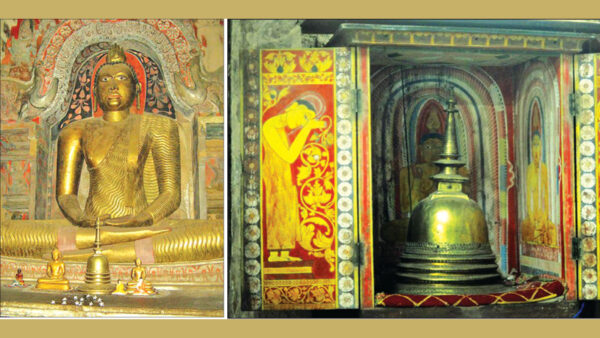
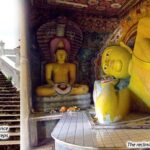
Inner sanctum at Gadaladeniya-The Reliquary at Gadaladeniya temple
I have written previously about the Embekke Devalaya, which is one of the three prominent temples built during the Gampola era. The kings of Gampola did not control the entire country during their reign; in fact, they were regional regents of the hill country.
Lankathilaka Viharaya
From the Embekke Devalaya, you can travel to Lankathilaka temple. We walked part of this distance which is about two kilometres. On the way, I noticed trees full of nutmeg, known as saddikkai in the rural areas. The lush paddy fields were ready for harvest. The Lankathilaka temple was built on a rock. My Buddhist friend Kumuduni and I climbed about 100 steps, which have been cut from the solid rock. The wind is chilly as you ascend. The three-storied structure dominates the rock. The view from the summit is refreshing. The stone foundation of the temple is very impressive.
 Lankathilaka Viharaya is a Buddhist temple situated in Udunuwara of Kandy. It is located in the village of Daulagala. The village name Daulagala has a beautiful meaning. In the period of the kings, the royal messenger was sent to deliver the king’s messages. He played a daula (drum) from the top of a small rock (gala). Hence, the name Daulagala, meaning the rock from which the drum was played. The history of the temple goes back to the 14th century. According to historical reports, this temple was built by King Buwanekabahu IV. He entrusted the construction of this temple to his Chief Minister named Senalankadhikara, who successfully finished the sacred task. The architecture of the temple is said to be designed by a South Indian architect named Sathapati Rayar.
The vihara buildings were built on a natural rock called Panhalgala Rock. Among the buildings, the image house displays outstanding architecture, featuring traditional Sinhalese sculptures.
According to the facts in the Lankathilaka copper plaque, this image house was constructed as a four-storeyed mansion with a height of 80 feet, but today only three storeys can be seen at this serene temple. The pure white building resonates with tranquillity. At each corner of the main temple, you can identify the image of a protruding elephant which is holding a crest, suspended from its trunk. Another unique visual at Lankathilaka is the image of the ‘hansa puttuwa’- here it shows four swans, instead of the traditional two swans.
I experienced a lovely moment near the large Bo tree. A schoolgirl in uniform was offering her prayers before the A/L exam. After she finished, this amiable student turned around and knelt down in front of us, seeking our blessing. This was indeed a surprise. I was delighted to see this child respecting adults, something not seen much in Colombo city. Lankathilaka temple has a separate Stupa. This ancient temple is a golden example which shows the cohabitation of Buddhist- Hindu worship, augmenting the fact that we all are Sri Lankans.
After descending the rock, it was time to visit the third temple of the Gampola era.
Gadaladeniya Viharaya
A short three-wheeler ride brings you to the magnificent Gadaladeniya Viharaya also known as Saddharmatilaka Viharaya. This Buddhist edifice is situated in Pilimathalawa, Kandy. It is located on the Gadaladeniya Road to the west of Kandy.
The solid Gadaladeniya Viharaya is considered one of the largest rock temples in Sri Lanka. The history of this temple can be traced back to the 14th century. According to historical reports, this temple was built in 1344, under the patronage of King Buwanekabahu IV by Ven. Seelavamsa Dharmakirti Thera. At the temple entrance, there is a visitors’ room where a middle-aged man was patiently engaged in drawing designs found within the temple. It was nice to watch him at work, recreating ancient art in this digital era.
We know that King Buwanekabahu IV was the first king of Gampola. He succeeded his father Vijayabahu V of Dambadeniya and became the king of Gampola. King Buwanekabahu IV ascended to the throne after his father shifted the capital from Kurunegala to Gampola, with the support of General Senalankadhikara. He was duly succeeded by his brother Parakramabahu V.
According to oral tradition, the architecture of Gadaladeniya temple was designed to manifest Hindu artistic styles by a South Indian architect named Ganeshvar-aachariyar. On the solid rock outcrop upon which the temple stands, we can observe a carved inscription regarding the temple’s construction. Another two inscriptions are found on the rock near the Bodhiya. In 1934, Archeology Commissioner H.C. Bell had found the stone slab inscription. Five rock inscriptions are found on the south side. It is said this beautiful temple was constructed in the Dravidian architectural style infused with Sinhalese architecture from the Polonnaruwa era. The architecture is similar to the Vijayanagar styles of South India. Celebrated scholarly monks who have resided at this temple include Sangharaja Dharmakirti II and Vimalakirti I. The temple was abandoned until King Vira Parakrama Narendra Sinha (1707–1739) handed over the care of this sacred site to Ven. Weliwita Sri Saranankara Thera, whose students have faithfully looked after the temple for centuries.
 The central temple building is unique because it is built entirely of sculptured granite, except for two sikharas which are built of brick, and sit on a large stone slab. It shows the determination of the ancient builders. The sikharas, which are located above the sanctum begin in an octagonal shape but have been bestowed with the features of a dagoba. After the original construction of the temple building, a multi-tiered and tiled roof, resting on brick piers and wooden pillars was added to the temple. At the entrance to the shrine room is an elegantly sculptured Makara Thorana (Dragon Arch).
Inside the shrine room is an eight-feet-tall statue of a seated Buddha, with four standing Buddha statues flanking the main statue. The doors to the main shrine are adorned with beautiful art. The colours remain fresh after 700 years, which is a testament to the artist’s skill. The topmost panels depict the sun on the left wing and the moon on the right wing.
I also noted mythological creatures painted amidst floral designs. The reliquary can be seen on the left. The wooden doors are painted to depict the Buddha’s senior disciples, Ven. Sariputta and Moggallana in pious adoration. Their halos indicate they are arahants (enlightened beings).
Adjacent to the main shrine room, is a devale dedicated to the Hindu God Vishnu. According to oral tradition, the devale was originally dedicated to Varuna when it was built, however, as Vishnu became more popular with devotees the shrine to Varuna was replaced with Vishnu. In the middle of the temple compound is a secondary shrine, the Vijayothpaya or Vijayantha Prasada named after the mythical palace of God Indra. It was built on the turtleback section of the natural rock. This shrine was supposedly constructed after the main shrine by King Parakramabahu V.
The shrine consists of a central Stupa, built on a square platform. The entire Stupa is covered by a four-sided roof supported by four stone pillars. On the four sides of the main Stupa are four mini stupas, extending in cruciform angles out in the four cardinal directions – said to denote spiritual sovereignty over the world. Interestingly, each of these four smaller Stupas is built on stone platforms with their own individual shrine rooms. You can enter each room via a small door, but the inside area is pretty small.
The white Stupas form a contrast to the black rock. The incumbent chief priest has done an excellent job in creating a good atmosphere to educate all devotees. Of the three Gampola era temples, Gadaladeniya Viharaya is the best maintained, with all facilities. A visit to these temples enriches our personal appreciation of our Sri Lankan identity and respect for all religions.