The Journey of a Book-By George Braine
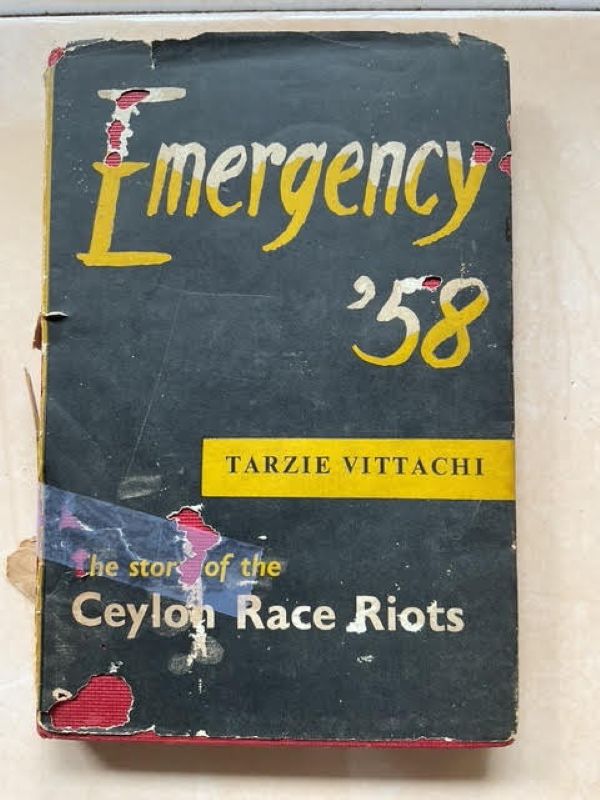
I have owned this autographed, tattered and browning copy of “Emergency ‘58” for 42 years. And there lies a tale.
People my age will recall the devastating race riots that Ceylon experienced in 1958. “An island where for many centuries the Sinhalese and a substantial Tamil minority had lived side by side without serious trouble, a fever of race hatred had broken out”.
A stringent press censorship prevented the outside world and even most people in Ceylon from learning about the horrors in which hundreds died.
Tarzie Vittachi, the Editor of the “The Ceylon Observer” newspaper decided to write a full account of what had occurred. Because it could not be published in Ceylon under Emergency Law, Mr. Vittachi took the manuscript to London and had it published by Andre Deutsch. BTW, Mr. Vittachi was the youngest editor, at 32 years, of the oldest newspaper in Asia.
Later, back in Ceylon, Mr. Vittachi came to know that he was going to be arrested and, with hardly any money in hand, fled abroad with his family.
MYRA KEMMER
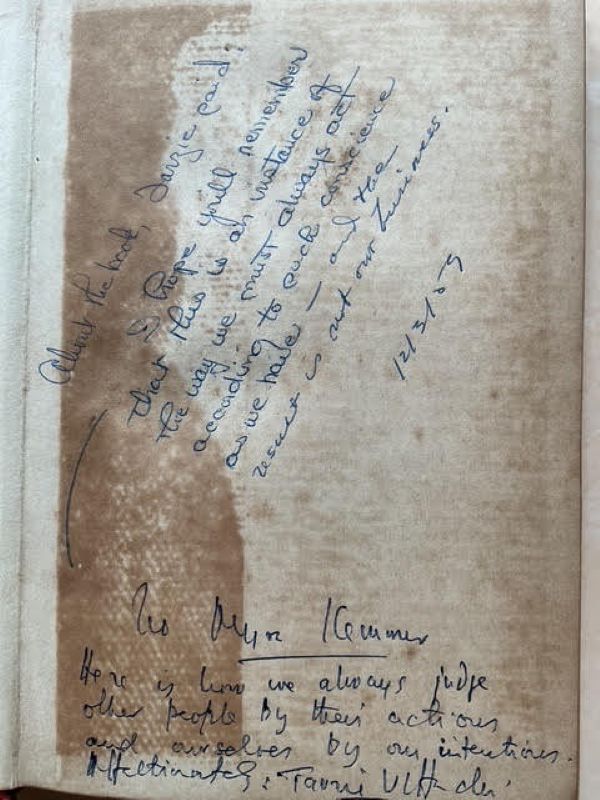
Ms. Kemmer was a secretary at the US Embassy in Colombo and a friend of Mr. Vittachi. He presented her a copy of “Emergency ‘58” with the following inscription: “To Myra Kemmer. Here is how we always judge other people by their actions and ourselves by our intentions. Affectionately, Tarzie Vittachi”.
WASHINGTON DC
In 1984, I enrolled at the American University in Washington DC. All international students were encouraged to form links with local host families. Accordingly, I requested a host family and was later informed that a Mike Schlesinger was interested in meeting me.
When I met Mike, “he” turned out to be a she, a diminutive, lively lady whose actual name was Myra. Over lunch, I learned that she had served at the US Embassy in Colombo. Hence her interest in “hosting” a Sri Lankan student. Mike was married to Joe Schlesinger, a respected Canadian journalist and the Washington correspondent for the Canadian Broadcasting Corporation (CBC).
The Schlesingers lived within walking distance of the university and we soon formed an easygoing friendship. I was invited for the occasional meal, concert or outing to a museum. They treated me with kindness and I enjoyed their company. But, for me, the main benefit of our friendship was listening to Joe’s stories, about growing up in Nazi occupied Europe and of the numerous hot spots from which he had reported.
Joe grew up as a Jewish child in Czechoslovakia, and, with his brother, was sent by train to Britain to escape the Nazis when World War II broke out. Exiled from his homeland after the Communist takeover, Joe sought refuge in Canada and eventually joined CBC. He was in Dacca when the war of liberation began in 1971, and was witness to the horrors that resulted. He reported from Vietnam during that war, and from inside China during the Cultural Revolution. He went onto have a distinguished career, always covering the hotspots.
One day, Mike presented “Emergency ‘58” to me, saying it was time a Sri Lankan owned the book. She described living safely in Colombo while violence raged across the country. Her inscription to me read “About this book, Tarzie said: I hope you’ll remember that this is an instance of the way we must always act according to such conscience as we have – and the result is not our business”.
HONG KONG
Nury Vittachi, the noted writer in Hong Kong, is Tarzie’s son.