The Lindamulage Clan banner that influenced the colours used in the Buddhist flag-by John de Silva
The eLanka of 15 February 2026 carried an article about the Buddhist flag. In it the author, Kalani, mentions briefly about its origin. I wish to enlarge on that aspect of the flag and document what I have been able to gather on the colours used in the Buddhist flag.
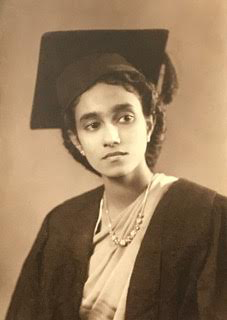
The flag was initiated by the Buddhist Theosophical Society in 1885. Anagarika Dharmapala had in this committee the eminent Colonel Henry Steel Olcott. It was to this Committee that Mrs A J R de Soysa – nee Mary Margaret de Silva daughter of David and Isabella de Silva – provided the Lindamulage Clan pennant for consideration as a prototype for the new Buddhist flag.
The Lindamulage flag/banner is illustrated on page 668 of the tome ‘The Twentieth Century Impressions of Ceylon’ 1907 authored by Arnold Wright. This is a Pancharanga – a banner of five stripes. The colours from top to bottom are: blue, gold, red, white and purple. Below is my interpretation of the banner.

Image Source:Thuppahis
The narration goes back to the time of King Parakrama Bahu
- Quoting from the English translation of the ola book Aditya Wansaya: ‘This was the time when India was overrun by the Muslims and the latter began to establish their rule. The same fate befell this land of Rajaputana and many princes and princesses left their land and emigrated to other domains. Of them a group of Thakuraka, some prominent members of the Arya Kihathiyas migrated into Ceylon. With the help of a king reigning at that time they settled themselves in the neighbourhood of Kurunegala. These princes were extremely warlike and it appears that they served in the army of Kalikala Sathithye Sarvakgna Panditha Parakrama Bahu II. The Aryakshathiyas played a leading part in the battle that Prince Vijayabahu waged against the Jawakas at the instance of his
father King Parakrama Bahu. It was in this battle that their loyalty and warlike qualities were evinced. Thakuratha the chief of the Aryakshathiyas army became the commander of the Aryasenawa.’
Thakuraka, aka Thakura, brought with him his clan banner which is the one depicted above. On a visit to Jaipur, I was drawn to the flag that was hoisted over the Fort.
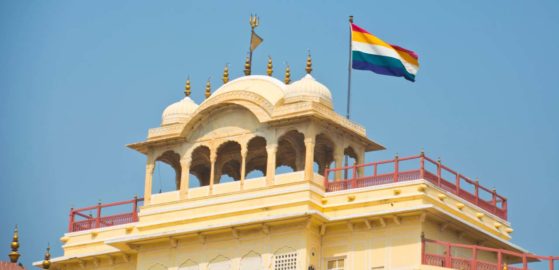
Image Source:Mysimplesojourn
If the Jaipur flag colours are re-ordered, and the colour green is replaced with purple, it seems pretty convincing that Thakuraka who came from the Jaipur region based his flag on Rajput flags existing at the time.

Image Source:Lankaweb
The Lindamulage banner colours resonated with the colours of the rays that were supposed to have emanated from the Lord Buddha on his enlightenment. The order needed no change.
The colour change that was made from the Lindamulage banner was to replace the purple with the colour orange to represent the universality of Buddhism.
At first the suggestion was to have a pennant much like the Lindamulage banner but Colonel Olcott pointed out the difficulty in carrying the flag in processions and hanging it in temples and in homes and suggested that it conform in shape with the many national flags. The Committee finally approved the flag that we see flown today all around the world by Buddhists.
It is very interesting indeed to see how a banner brought from Jaipur those many years ago, in 1885 influenced the colour scheme of the universally used Buddhist Flag.
Johnny de Silva