WEEK DAY FEATURE | WHY TRUMP’S TWO-DAY CHINA VISIT MATTERS TO SRI LANKA-by Harold Gunatillake

A WORLD IN CRISIS, AN ISLAND FEELING THE HEAT
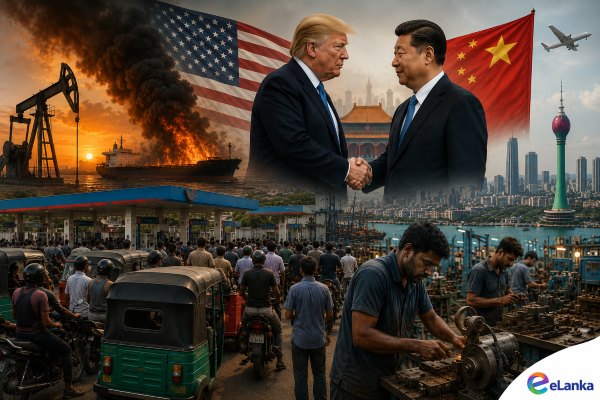
When President Donald Trump lands in Beijing this week for a quick two-day summit with Chinese President Xi Jinping, many around the world will be eager to see signs of diplomatic progress. But the effects are already being felt right here in Sri Lanka—not in government offices or think tanks, but at petrol stations, in three- wheeler queues, and inside the workshops and small factories that support the middle class.
The conflict in Iran has pushed global oil prices to their highest in years. The blockade of the Strait of Hormuz has cut off key supply routes, and Sri Lanka, which relies heavily on imported fuel, is feeling the immediate impact, struggling.
This is why Trump’s brief visit to China—just 48 hours of intense diplomacy—holds such significant importance for this small island, thousands of kilometres away.
THE GLOBAL STORM BEHIND SRI LANKA’S FUEL CRISIS
For two months, the conflict in Iran has been causing significant disruptions to one of the world’s most vital oil routes. Nearly one- fifth of the world’s crude oil passes through the Strait of Hormuz. As tankers reroute around Africa, shipping costs have increased considerably, insurance premiums have doubled, and delivery times have lengthened by several weeks.
Sri Lanka, already facing financial challenges, has been most affected.
Let’s think about the impact at home and how it can affect us all.
Petrol prices are climbing almost every week, leading to long lines at fuel stations. Tuk-tuk drivers find their earnings shrinking even as they put in longer hours. Small industries are cutting shifts to save on diesel, which in turn pushes up food prices due to increased transport costs. The middle class—already feeling the strain from years of economic ups and downs—is now facing a fresh challenge in this global squeeze.
Here’s why Trump’s trip to China is important for us— understanding its implications helps us stay informed about global developments.
Trump’s visit isn’t just a formal one; it’s a crucial mission to address urgent issues that significantly impact Sri Lanka’s economy. First, it’s about trying to end or ease the Hormuz blockade, which could lower petrol prices, reduce shipping delays, and help households and small businesses. If talks don’t go well, the opposite hardships
could happen. Second, it aims to avoid a new U.S.–China trade war, which could slow down global growth and increase the costs of imported goods—a problem that Sri Lanka, which depends on both, would definitely feel. Third, the visit aims to secure key international shipping routes, especially as delays and higher costs are affecting Colombo Port—a key hub in South Asia—due to tanker rerouting. An understanding between the U.S. and China on maritime stability could make shipping more predictable again. Lastly, the goal is to promote cooperation between these two giants, which would help calm markets globally. For Sri Lanka, this would mean fewer sudden price hikes and more stability in import costs.
The tuk-tuk driver truly reflects Sri Lanka’s sense of struggle. Their experiences serve as a heartfelt indicator of the nation’s
challenges, offering a glimpse into the everyday resilience and spirit of the people.
If you want to really grasp how global geopolitics affect Sri
Lanka, chat with a tuk-tuk driver. They’re the first to feel the pinch when petrol prices go up and the last to benefit when they drop. Their daily experiences include spending more on fuel than on food, facing tougher bargaining from customers as fares increase, dealing with long lines at petrol stations that cut into their working hours, and finding it harder to make loan payments. A small drop in global oil prices could instantly bring some relief to their challenging situation.
Small industries often go unnoticed, yet they play a vital role in our communities. They face many challenges but remain resilient, quietly contributing to the economy and providing essential services.
Recognising their efforts helps us appreciate the backbone of our local markets.
Sri Lanka’s middle-class industries—like bakeries, carpentry shops, delivery fleets, and small manufacturers—are quietly facing some tough times. Their challenges include higher diesel costs, higher prices for imported raw materials, reduced consumer spending, and difficulty maintaining steady profit margins. If oil prices can stabilise, it could really give these businesses a much-needed boost to get through the next quarter.
Here’s why the visit is just two days—and why that’s actually plenty of time!
Trump’s brief visit is a deliberate choice. It’s not aimed at resolving the U.S.–China rivalry, but rather at preventing a global split.
Diplomats see the summit as a focus on ‘maintaining stability, not solving every issue.’ In simple terms: stop the bleeding now, address the cracks later. For Sri Lanka, that’s precisely what’s needed.
The Sri Lankan angle offers some interesting developments to watch in the coming weeks. Stay tuned as we explore what’s ahead and how it might impact everyone involved.
Sri Lankans should keep an eye on three key outcomes:
- Any signs of easing in the Hormuz blockade This is the biggest factor influencing petrol
- Commitments to maritime stability
If shipping lanes normalise, freight costs could decrease.
- Market reactions
Even a small thaw in relations between Washington and Beijing can help cool oil markets.
The bottom line is that a small island can withstand a big storm, reminding us of the resilience and strength found even in the tiniest places.
Even though Sri Lanka is quite distant from Beijing and Washington, it finds itself right at the heart of the worldwide oil shock. Trump’s two-day visit to China isn’t just making headlines—it could really be a turning point for the island’s fuel crisis.
End