‘The Great Resignation’; In search of work-life balance
by Amil Prema
 The Great Resignation – also known as the ‘Big Quit’ or ‘The Great Reshuffle’ – was a term coined by Professor Anthony Klotz from Texas University in early 2021, used to describe the large trend of employees deciding to voluntarily quit their jobs.
Propelled by the COVID-19 pandemic, a need for more flexible hours, a greater work-life balance, and a desire for more holistic benefits are some of the reasons for the mass resignations over the past two years. In 2021, the US alone saw a staggering 47 million people leave their jobs, with quit rates reaching a 20-year high.
Whilst this has created certain headaches for employers, it has also opened up a host of opportunities for remote work – those who have developed the right skills and who are not afraid to take on new challenges, are prime candidates to thrive in this current environment.
What drove the Great Resignation?
Mental wellbeing
Although resignations had been slowly cropping up over the past decade, COVID-19 was the real catalyst for employees to start rethinking what they really wanted from their jobs. The pandemic created numerous stressors on employees; personal, mental, and financial. As a result, people were forced to re-examine the role of work in their own lives. Jobs that required long hours, with no incentives, and struggled to provide adequate job satisfaction were prime examples that showed workers were not afraid to walk out the door.
Work-life balance
Employees who were required to travel frequently or had to commute long distances also started to look for work that provided more flexibility. Several corporate workers, particularly in industries such as financial services, technology & engineering, quit their jobs in search of roles that provided a better overall work-life balance.
Workers who were dissatisfied with their current conditions were quick to resign from their steady office jobs, to find roles which supported their overall lifestyle – fewer hours, greater autonomy, and the ability to work from home, just to name a few.
Economic benefits
The great explosion of social media and online marketing meant that starting your own business became exponentially easier. With barriers significantly reduced, people realised that they did not have to work for a boss to earn a paycheck – savvy individuals who could monetise their skills were quick to realise that they could make just as much, if not more, by working for themselves.
As a result, instead of slogging it out at a company working overtime for a fixed salary, many employees resigned to pursue their own ventures. Website design, digital marketing, and copywriting are examples of roles where people left the corporate model to start their own business.
What countries were affected?
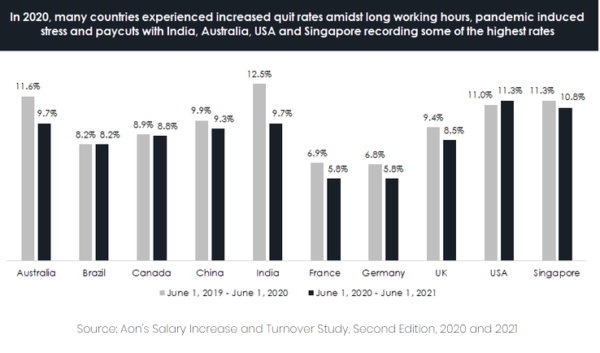
The Great Resignation was not just limited to the United States – inadequate pay, excessive hours, and rigid working conditions – seem to be common across several other countries. Australia, Singapore & India also saw an uptick in quit rates.
Source: Aon’s Salary Increase and Turnover Study, Second Edition, 2020 and 2021
The general trend saw quit rates rise initially and then gradually taper off by the middle of 2021. With many workers resigning from their jobs in the mid stages of the pandemic, companies had to rethink how to create the ideal environment to retain talent.
By the latter half of 2021, as the economic cycle started to pick up, companies finally had some breathing room – giving more focus to managing people rather than purely making profits. With an improved overall workplace culture, employees had less reason to look elsewhere, and quit rates slowed accordingly.
Which demographics were affected?
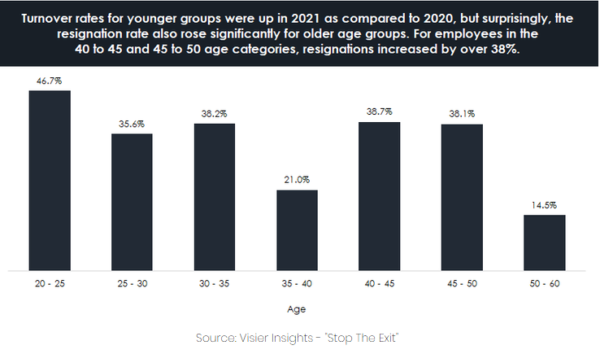
Resignation rates also varied from country to country; however, the general trend has seen both young and experienced aged workers leave their jobs. As seen from the graph below, the largest group of resignations came from workers in their early 20s.
Source: Visier Insights – “Stop The Exit”
Young workers
Workers between the ages of 20-25 primarily occupy casual or part-time work, which rely on a good culture and fun environment to keep workers happy. With the enforcement of COVID-19 restrictions, additional benefits such as work events and parties had to be cancelled – the result; many young workers quit to focus on other opportunities that fit in with their lifestyle.
Experienced hires
Workers aged 40-50 also saw high resignation rates during the past two years. Workers in this age bracket are those with significant experience and mostly in managerial positions. Many were seeking rewards for their longevity in the form of promotions, pay raises, and additional benefits.
In addition to pay, challenges brought about by the pandemic including family obligations and additional work stress such as long working hours, being responsible for the well-being of the team, and managing deadlines across geographically dispersed teams, took its toll.
However, as many businesses struggled to cope with the turbulent business cycle, they were unable to meet these demands – which meant their top talent had no choice but to look elsewhere.
Additionally, there were also increased quit rates among the experienced female workforce who took on family obligations such as homeschooling and managing the home front, leading to higher quit rates among the 40-50 age group.
Which industries were impacted?
 Many industries across the board were heavily impacted by the pandemic. Initially, companies reacted to slowing business conditions by laying off staff to cut costs. Service based sectors that involved face-face interactions were hit hard during the lockdown period.
However, as COVID-19 restrictions began taking their toll, companies were forced to adjust to the new environment. Many benefits such as work events and incentive schemes had to be stopped.
Whilst companies were not letting go of staff anymore – the company culture and general working conditions did not seem to meet the demands of workers. This time, employees seemed to take matters into their own hands and started voluntarily resigning.
Retail and hospitality
The retail and hospitality industries were some of the worst hit with the onset of the pandemic, and a large number of layoffs took place throughout 2020. However, once business conditions turned around and re-hiring began, many workers were reluctant to stay on while hiring became a concern.
In the retail space, long hours, random schedules, inability to take time off, low pay, and difficult customers were some of the key reasons for the high quit rates.
Frontline workers in the hospitality industry who are on the lower end of the wage scale and who typically endure high levels of customer engagement, usually occupy roles which bring about high levels of stress. This, coupled with busier working conditions meant that employees experienced heightened levels of burnout and consequently left their jobs to find more enjoyable work.
Financial services
The financial services sector also saw many resignations from experienced hires. The pandemic provided headwinds particularly for large multinationals, as they had to restrict their international business ventures.
Because of these limitations, many mid to high-level executives were the ones to feel the pinch, as many companies had to cut back on benefits such as business travel and executive bonuses. With a lack of incentives for experienced employees, many workers felt the need to resign and look for other opportunities at competitors.
Healthcare
Healthcare was another area that saw a significant number of workers quit their jobs. As COVID-19 started to spread rapidly, it placed a major burden on workers in hospitals and those in aged care services.
As the number of cases grew, demand for medical treatment increased dramatically and meant that many workers had to work overtime to compensate. Roles such as nursing and social workers are examples of jobs where many voluntarily quit, due to heightened levels of stress and lack of financial compensation.
What new jobs were taken up?
 The Great Resignation also meant that companies had a pressing need to hire workers to fill in the gaps that were left. The pandemic forced businesses to rethink their general strategy and provided many opportunities for employees with the necessary experience.
Moreover, employees who had resigned now had time to reinvent themselves professionally. This period saw many people upskilling in areas outside their traditional industry to increase their employability and to be able to pursue work which aligned with their interests.
Many experienced workers in disciplines such as finance and engineering started to educate themselves in fields such as technology, online marketing and content creation – broadening their skill set and enabling them to explore new roles in different industries.
Information technology
People with experience in programming and coding became highly sought after. As experienced hires quit across many industries, companies looked to hire young talent with skills in technology to help streamline their operations.
Social media
With COVID-19 restrictions in place, physical interactions became limited and prompted companies to start growing their online presence. People with experience in social media production and digital marketing were ideal for companies looking to promote their brand through online channels.
Despite COVID-19 restrictions being reduced and the business environment beginning to normalise, companies continue to place importance on expanding their audience and growing their social media presence.
Consulting
As the business cycle proved to be extremely volatile during the past two years, companies looked to industry ‘outsiders’ to help return to profitability. People with experience in consulting became highly sought after, to give businesses a fresh perspective and offer unbiased advice in highly specialised industries.
Independent contracting
A large portion of high skilled workers who resigned from their jobs took the opportunity to take up freelance work. In addition to this, as companies were looking to cut costs, contractors became extremely valuable – as companies could avoid paying a regular salary and pay a contractor per specific project.
How was remote work affected?
 Remote work was heavily impacted by the Great Resignation. Prior to the movement, working remotely was mainly reserved for sole traders and lifestyle entrepreneurs. SMEs and larger corporations on the other hand, were still reluctant to give their employees such flexibility.
However, as restrictions started to take hold and resignation rates started to gather pace, companies were forced to adjust to meet the demands of disgruntled workers. The Great Resignation showed that there were common issues in the workplace, which stifled worker productivity and overall job satisfaction.
A steady paycheck was not good enough anymore to keep workers onside – employees wanted jobs that offered more comprehensive benefits that aligned with their financial and personal needs.
In response to these demands, companies started to offer the option of working remotely. As this became more common, entrepreneurs and freelancers also started to see the value of not being tied down to any particular location. Remote work started to become a genuine path that employees could take – the number of employees that started working from home increased substantially.
Reasons for increased remote work post ‘The Great Resignation’
Autonomy
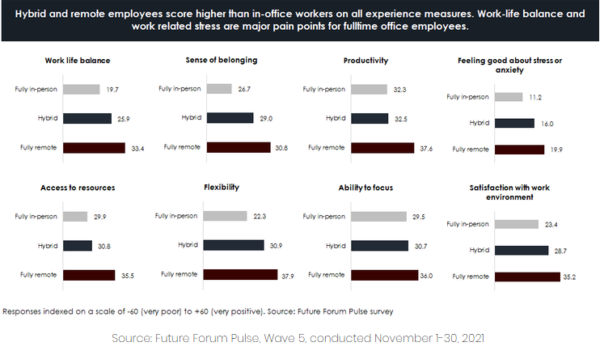
‘Workplace culture’ was a major reason why many employees resigned from their jobs. With new roles that offered the ability to work remotely, employees found it easier to manage without their boss constantly looking over their shoulder. This newfound independence also meant employees could work more diligently and produce better quality work.
Flexibility
Working from home also meant that employees could manage their work to better suit their personal lives. Many middle-aged workers could now arrange their schedule to balance their working day whilst also taking care of their families. Telephone consultations, online meetings, and virtual summits afforded workers the ability to attend important business events without being limited by their location.
Productivity
Working remotely also offered workers a major time-saving benefit. Many workers who normally had to spend hours travelling to and from work, could now use the extra time to be with their family and friends, focus on fitness and health, or learn new skills. People also reportedly found that working from home meant they were freed from common office distractions and consequently experienced much higher levels of productivity.
Source: Future Forum Pulse, Wave 5, conducted November 1-30, 2021
In conclusion, the Great Resignation has demonstrated that employees are looking for much more than just financial benefits. The past few years have shown that employees will not tolerate average working conditions – and that people are not afraid of leaving their jobs to seek out roles which provide more flexibility, autonomy, and overall fulfilment.
The trend of working from home will only become more commonplace as the online marketplace grows and companies respond to these changing employee needs.
About the author
Amil Prema is a former financial services professional with over four years of experience working in corporate foreign exchange. He is currently a freelance writer, covering subjects such as financial markets, entrepreneurship and health & wellness. He holds a Bachelor of Commerce from Macquarie University in Sydney, Australia.
Follow ReMAtics on LinkedIn, Facebook and Instagram, for more thought-provoking pieces on global topics and our company updates.