News & Community eLanka

eLanka

Friday, 29 May 2026
  • Home
  • Read History
  • Articles
    • eLanka Journalists
  • Events
  • Useful links
    • Obituaries
    • Seeking to Contact
    • eLanka Newsletters
    • Weekly Events and Advertisements
    • eLanka Testimonials
    • Sri Lanka Newspapers
    • Sri Lanka TV LIVE
    • Sri Lanka Radio
    • eLanka Recepies
  • Gallery
  • Contact
Newsletter
Sri lankan news
  • eLanka Weddings
  • Property
  • eLanka Shop
  • Business Directory
eLankaeLanka
Font ResizerAa
Search
  • Home
  • Read History
  • Articles
    • eLanka Journalists
  • Events
  • Useful links
    • Obituaries
    • Seeking to Contact
    • eLanka Newsletters
    • Weekly Events and Advertisements
    • eLanka Testimonials
    • Sri Lanka Newspapers
    • Sri Lanka TV LIVE
    • Sri Lanka Radio
    • eLanka Recepies
  • Gallery
  • Contact
Follow US
© 2005 – 2026 eLanka Pty Ltd. All Rights Reserved.
Home » Goodnews Stories Srilankan Expats » Articles » Amputation Surgery from 24,000 Years Back !!! -by Michael Roberts
ArticlesMichael Roberts

Amputation Surgery from 24,000 Years Back !!! -by Michael Roberts

eLanka admin
Last updated: September 19, 2022 4:41 pm
By
eLanka admin
ByeLanka admin
Follow:
Share
7 Min Read
SHARE
Views: 13

Amputation Surgery from 24,000 Years Back !!! –by Michael Roberts
Foot

Source:Thuppahis

Michael Roberts

ONE: Sara Hussein: “Missing foot kicks surgery back thousands of years,” in The Australian, 7 September 2022

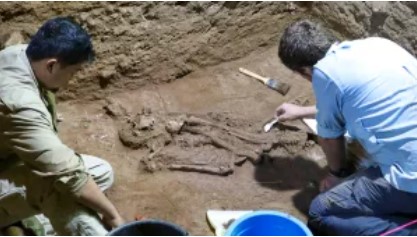
A skeleton with a missing foot discovered in a remote corner of Borneo rewrites the history of ancient medicine and proves amputation surgery was successfully carried out about 31,000 years ago. Previously, the earliest known amputation involved a 7000-year-old skeleton found in France, and experts believed such operations only emerged in settled agricultural societies.

Scientists excavating remains dating back some 31,000 years in the Liang Tebo cave in East Kalimantan. Picture: AFP

The finding also suggests that Stone Age hunter-gatherers living in what is now Indonesia’s East Kalimantan province had sophisticated medical knowledge of anatomy and wound treatment.

“It rewrites our understanding of the development of this medical knowledge,” said Tim Maloney, a research fellow at Australia’s Griffith University, who led the work.

The skeleton was uncovered in 2020 in the imposing Liang Tebo cave known for its wall paintings dating back 40,000 years.

Surrounded by bats, terns and swiftlets, and interrupted by the occasional scorpion, scientists painstakingly removed sediment to reveal an astoundingly well-preserved skeleton. It was missing just one notable feature: its left ankle and foot. The base of the remaining leg bone had a surprising shape, with knobbly regrowth over an apparently clean break, strongly indicating that the ankle and foot were removed deliberately. “It’s very neat and oblique, you can actually see the surface and shape of the incision through the bone,” Dr Maloney said on Wednesday.

Other explanations, like an animal attack, crushing injury, or fall, would have created bone fractures and healing different from those seen in the skeleton’s leg.

     *************

TWO:  “Foot missing from Stone Age skeleton may show oldest amputation,” 7 Sept 2022, … courtesy of Copyright 2022 Nexstar Media Inc….. https://www.wfla.com/news/world/foot-missing-from-stone-age-skeleton-may-show-oldest-amputation/

The 31,000-year-old skeleton of a young adult found in a cave in Indonesia that is missing its left foot and part of its left leg reveal the oldest known evidence of an amputation, according to a new study.

Scientists say the amputation was performed when the person was a child — and that the “patient” went on to live for years as an amputee. The prehistoric surgery could show that humans were making medical advances much earlier than previously thought, according to the study published Wednesday in the journal Nature.

The 31,000 year-old-skeleton was found in a cave in East Kalimantan, Borneo Indonesia …. Tim Maloney/Griffith University via AP

Researchers were exploring a cave in Borneo, in a rainforest region known for having some of the earliest rock art in the world, when they came across the grave, said Tim Maloney, an archaeologist at Griffith University in Australia and the study’s lead researcher.

Though much of the skeleton was intact, it was missing its left foot and the lower part of its left leg, he explained. After examining the remains, the researchers concluded the foot bones weren’t missing from the grave, or lost in an accident — they were carefully removed.

The remaining leg bone showed a clean, slanted cut that healed over, Maloney said. There were no signs of infection, which would be expected if the child had gotten its leg bitten off by a creature like a crocodile. And there were also no signs of a crushing fracture, which would have been expected if the leg had snapped off in an accident.

The person appears to have lived for around six to nine more years after losing the limb, eventually dying from unknown causes as a young adult, researchers say.

The human skeleton was discovered in Borneo …Photo Courtesy of Tim Maloney/Griffith University via AP

This shows that the prehistoric foragers knew enough about medicine to perform the surgery without fatal blood loss or infection, the authors concluded. Researchers don’t know what kind of tool was used to amputate the limb, or how infection was prevented — but they speculate that a sharp stone tool may have made the cut, and point out that some of the rich plant life in the region has medicinal properties.

Also, the community would have had to care for the child for years afterward, since surviving the rugged terrain as an amputee wouldn’t have been easy.

This early surgery “rewrites the history of human medical knowledge and developments,” Maloney said at a press briefing.

  The human skeleton was discovered in Borneo. (Photo Courtesy of Tim Maloney/Griffith University via AP)

Before this find, the earliest example of amputation had been in a French farmer from 7,000 years ago, who had part of his forearm removed. Scientists had thought that advanced medical practices developed around 10,000 years ago, as humans settled down into agricultural societies, the study authors said.

But this study adds to growing evidence that humans started caring for each other’s health much earlier in their history, said Alecia Schrenk, an anthropologist at the University of Nevada, Las Vegas, who was not involved with the study.

“It had long been assumed healthcare is a newer invention,” Schrenk said in an email. “Research like this article demonstrates that prehistoric peoples were not just left to fend for themselves.”

TAGGED:Griffith University in AustraliaTebo cave
Share This Article
Facebook Whatsapp Whatsapp LinkedIn Email Copy Link Print
Previous Article nine arch bridge sri lanka The natural beauty of Sri Lanka – By Angelo Vansanden Jansen
Next Article Sri Lanka’s T20 World Cup squad For Australia: Sri Lanka’s Cricket Squad for T20 World Cup-by Michael Roberts
FacebookLike
YoutubeSubscribe
LinkedInFollow
eLanka Wedding
- Advertisement -
Ad image
Most Read
TBS 1

The 90s are calling: The Body Shop announces the return of cult classic, Dewberry

Today – Tasha Marikkar, Vesak Lights, Cannes & more!

Today – Tasha Marikkar, Vesak Lights, Cannes & more!

Blue Ocen

Eid uI Adha Mubarak

හදගැස්ම - THE UNPLUGGED CONCERT -18th September ( New Zealand Event )

හදගැස්ම – THE UNPLUGGED CONCERT -18th September ( New Zealand Event )

Gampola’s Ambuluwaawa Biodiversity Complex

Ambuluwaawa Magic: Sri Lanka’s First Ever Vesak Cultural Zone

Related News
SEO Keywords: Ocean Lanka rainforest restoration, Sinharaja Forest Reserve restoration, Sri Lanka rainforest conservation, Ocean Lanka sustainability project, Sinharaja biodiversity restoration, rainforest restoration Sri Lanka, native tree planting Sri Lanka, ecological conservation Sri Lanka, Sinharaja buffer zone restoration, sustainable corporate initiatives Sri Lanka, Ocean Lanka environmental project, biodiversity conservation Sri Lanka, Dilmah Conservation Restoration Project, Greenwood Growers Sri Lanka, University of Colombo environmental project, Waddagala rainforest restoration, Delwala conservation project, Sri Lanka native flora restoration, endemic species conservation Sri Lanka, rainforest biodiversity Sri Lanka, habitat restoration Sri Lanka, environmental sustainability Sri Lanka, corporate social responsibility Sri Lanka, Sinharaja rainforest protection, tropical rainforest restoration, ecological recovery Sri Lanka, Sri Lanka environmental news, Ocean Lanka Phase 02, Sri Lanka conservation initiatives, sustainable development Sri Lanka
Articles

Nature Wins Ocean Lanka Successfully Restores Rainforest Buffer Near Sinharaja

Institute of Chartered Accountants of Sri Lanka , Sri Lanka sustainability summit , CA Sri Lanka Sustainability Summit 2026 , ESG Sri Lanka , sustainable business Sri Lanka
Articles

Leading the Way: CA Sri Lanka’s Inaugural Sustainability Summit

Chola Copper Plates of Leiden and connections to Buddhism
Articles

Chola Copper Plates of Leiden and connections to Buddhism- by Admiral Ravindra C Wijegunaratne

Dry mouth-eLanka
Articles Dr Harold Gunatillake

Saliva is like a gentle protector, keeping our mouths feeling nice and comfortable throughout the day-by Harold Gunatillake

Centre of Excellence honours six graduates 01
Articles

Centre of Excellence honours six graduates

  • Quick Links:
  • Articles
  • DESMOND KELLY
  • Dr Harold Gunatillake
  • English Videos
  • Sri Lanka
  • Sinhala Videos
  • eLanka Newsletters
  • Obituaries
  • Sunil Thenabadu
  • Dr. Harold Gunatillake
  • Tamil Videos
  • Sinhala Movies
  • Trevine Rodrigo
  • Photos
  • eLanka Newsletter

eLanka

Your Trusted Source for News & Community Stories: Stay connected with reliable updates, inspiring features, and breaking news. From politics and technology to culture, lifestyle, and events, eLanka brings you stories that matter — keeping you informed, engaged, and connected 24/7.
Kerrie road, Oatlands , NSW 2117 , Australia.
Email : info@eLanka.com.au / rasangivjes@gmail.com.
WhatsApp : +61402905275 / +94775882546
  • About eLanka
  • Terms & Conditions

Disclaimer:
eLanka is committed to sharing positive and community-focused stories. We do not publish or endorse political, religious, or ethnic viewpoints. The content published on eLanka, including articles and newsletters, reflects the opinions and views of the respective authors and not those of eLanka. eLanka accepts no responsibility or liability for the accuracy, completeness, or consequences of any content provided by contributors.

(c) 2005 – 2025 eLanka Pty Ltd. All Rights Reserved.