Change Managers, you’re fighting the wrong battle. We keep trying to… – By Alok Das

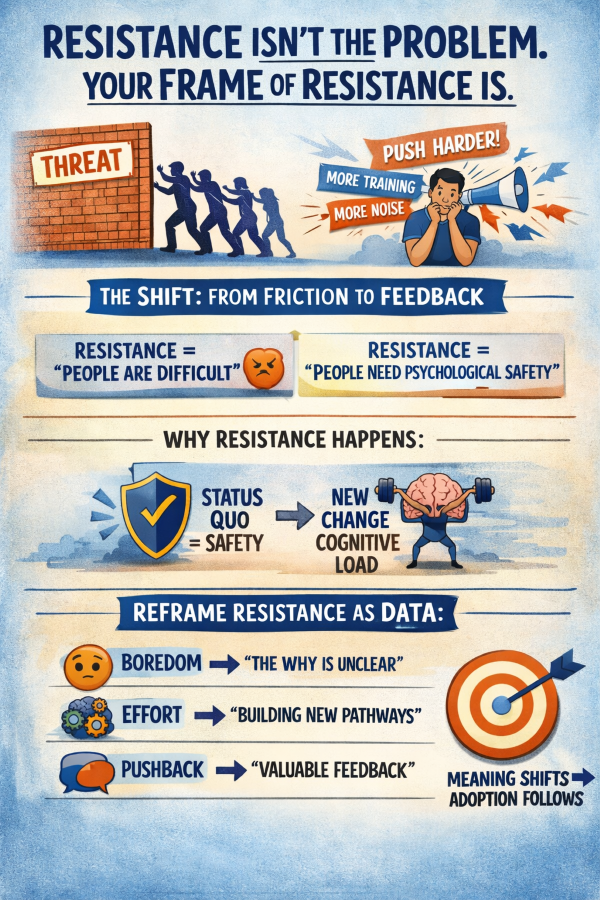
We keep trying to eliminate resistance.
Train it away.
Communicate it away.
Workshop it away.
But here is the truth we don’t say out loud: resistance isn’t the problem. Your frame of resistance is.
Most change programs fail because we treat resistance as a threat. A blocker. A sign that “people just don’t get it.”
So we push harder.
More comms.
More training.
More noise.
And the resistance grows.
The shift: from friction to feedback.
High performing Change Managers don’t fight resistance. They reframe it. Reframing is the ability to shift the meaning of a behavior so the behavior itself changes.
In behavioral science, we call this shifting the “choice architecture.” In coaching, it’s NLP (Neuro-linguistic Programming). In leadership, it’s empathy.
Instead of: “People are resisting because they are difficult.”
Try: “People are resisting because the status quo provides psychological safety, and the new behavior creates a cognitive load.”
That one shift changes your entire strategy.
Why resistance is a biological constant: Humans aren’t wired for new workflows. We are wired for certainty and energy conservation.
When a team says a tool is “too slow” or “confusing,” it isn’t sabotage. It’s the nervous system saying: “This feels unfamiliar. I don’t feel competent here yet.”
When you stop treating resistance as a “bug” and start seeing it as “data,” you can finally work with it.
Reframing turns:
- Boredom → A signal that the “Why” hasn’t landed.
- Effort → The friction of building new neural pathways.
- Pushback → High-value feedback on process gaps.
It transforms the emotional meaning of the change. And when meaning shifts, adoption follows.
This is how you move people from dopamine-driven habits to discipline-driven results without the fatigue.
I’m curious to hear from my fellow Change Leads / Change Managers and Project Managers: what’s the most common “resistance” you’re seeing right now?