Introduction to Economics – Markets and Markers – By Dr. Gnana Sankaralingam
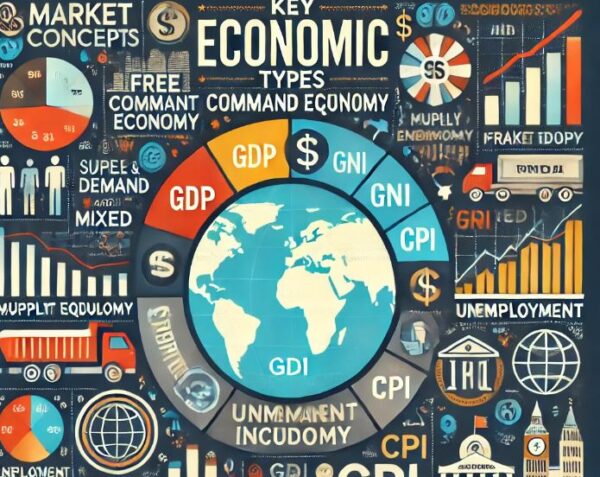
 Markets are a way of allocating resources, which need not be a place or involve exchange of physical objects. Each buyer or seller in markets choose to exchange something they have for something they would prefer to have instead. Trading things in this way would eventually result in a particular allocation of resources. Markers are indicators employed by government to measure economic performance of a country such as rate of growth, rate of inflation, level of unemployment, poverty rate and state of balance of payments.
Market economies combine free markets and state interventions. Free markets allocates resources based on demand and supply and the price mechanism, that is anything can be sold at any price which people will pay for. Advantages of free market economy are efficiency, entrepreunership and choice. Any product could be bought and sold where only those of best value will be on demand, in which way firms have an incentive to make goods in as efficient way as possible. In a market economy, the rewards for good ideas can make a lot of money for the entrepreuner, which encourages risk taking and innovation. Incentives for innovation can lead in an increase in choice for the consumers, not restricted to buying what the government recommends. Disadvantages of free market economy are inequalities leading to large differences in incomes and those unable to work not receiving any income, non-profitable goods not being made and creation of monopolies where succesful business becoming sole supplier of a product (market dominance). Market failure occurs when free market results in undersirable outcomes, where government often intervenes by changing laws, offering tax breaks (reducing taxes) for particular activities or creating incentives to influence people’s behaviour. They could also buy or provide goods and services.
Command or planned economy is where it is the government and not markets that decides how resources should be allocated. Advantages of command economy are that it maximises welfare as the governments have more control of the economy which prevent inequality and redistribute income fairly and ensure production of goods that people need and are beneficial to the welfare of the society. Government could try to provide everyone with a job and salary lowering unemployment and also prevent monopolies. Disadvantages of it are poor decision making about what needs to be produced due to lack of information, restricted choice for consumers as firms will produce what they were told to make, lack of risk taking and efficiency as government owned firms do not need to make profits thereby they have no incentive to increase efficiency, take risks or innovate. Mixed economy is when both governments (public sector) and markets (private sector) play the part in allocation of resources. Privately owned businesses have to break even or make profits to survive. There is no public sector in free markets and no private sector in a command economy.
Competitive markets exist when there are large number of buyers (consumers) and sellers (producers) and when no single or group of consumer or producer can influence the allocation of resources by the market or the price at which goods or services be bought. Consumers look to maximise welfare by buying goods and services to maintain or improve their quality of life. Producers compete to provide buyers with what they want at the lowest possible price, so that they can maximise their profits by selling to most customers. Market equilibrium is a situation when the price is such that, quantity that consumers wish to buy is exactly balanced by quantity that firms wish to supply. If price of a good is set high by a firm at which it wants to sell but the consumers are not willing to buy it at that price, stocks will build up (excess supply). If the firm reduces price of the good, consumers would like to buy lots of them at that low price (excess demand). Firms then realise that they can increase the price a little more and the price at which there is a balance between quantity the consumers demand and quantity the firms supply is market equilibrium, at which price and output are stable. In free markets, demand and supply determines the equilibrium position.
Growth is a fundamental aspect of the overall performance of an economy, as it is through growth that people of a country can become better off. Gross domestic product (GDP) is a measure of the total economic activity during a particular period of time carried out by residents of a country both nationals and foreign firms. It is calculated as the average of total value added produced by firms, total expenditure and total income earned. Gross national income (GNI) is the total earned by nationals of a country resident and expatriate remittences. It does not take into account earnings of foreign firms that are taken abroad. Thus GDP focuses on location than nationality and GNI focuses on nationality than location. Large difference between GDP and GNI suggest integration into global economy. Per Capita Income (PCI) measures average income earned by a person in a specified region in an year. It reflects the standard of living, derived by dividing GDP/GNI by total population.
Human development index (HDI) is based on development factors such as life expectancy, education, food, shelter and health, and capabilities such as employment, per capita income and social activities. Poverty rate is the ratio of number of people in a given demographic group whose income falls below poverty line which is half the median income of the population. Unemployment rate is the proportion of people above a particular age who are available for work but not in paid employment or self employed. Inflation describes the drop in purchasing power of a currency over a period of time, which result in sustained rise in avearge price of goods and services and deflation is when there is an opposite effect. Recession is where there is decline in the economic growth over two consecutive quarters. Balance of payments of a country is the difference between money flowing into the state and money that flowed out to the rest of the world in a particular period of time.
Consumer price index (CPI) is used in measurement of inflation, calculated by carrying out two surveys, first to find out what people spend their money on and second to find out changes in price of the most commonly used goods and services often called basket of goods. They are useful to help determine salaries, pensions and benefits. If CPI is higher, goods will cost more, become less competitive and exports will fall while imports will rise as foreign goods will be relatively cheaper. Above are various indicators to assess growth and development of the economy and internal and external interactions of a country.