New primates discovered in SL; hiding in jungles for years-by Avi Kumar
Source:Daily Mirror
For more than a century, scientists considered lorises, a type of reclusive, tree-dwelling primates, to have two distinct species in Sri Lanka —however, new research indicates 5 to six new species. They’ve been hiding in plain sight, coming out at night and are thus not easy to observe.
About the size of a squirrel with long limbs, this shy, furry, nocturnal primate is found in the tropical forests of Sri Lanka and grows to between 6-10 inches. It has a round head, two large eyes – imagine a miniature monkey with owl-like eyes. It is very cute, almost like a cartoon character/ a skinny teddy bear. Apart from being so cute, what makes it so interesting is its cryptic nature. This is why it took so long to discover the new species/ subspecies.
Compared to how the Sinhala words for the two native monkeys, Rilawa (macaque) and vanthura (languor) reflect knowledge of the two different species vs how unuhapuluwa is used as an umbrella term for all native lorises. In Tamil, another native language, they also have one word (thevangu) to describe this tiny mammal.
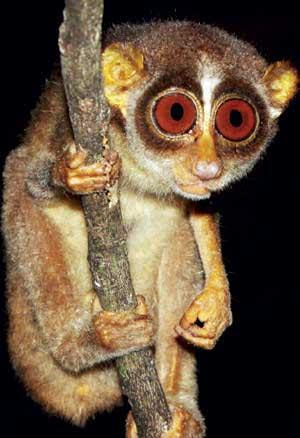
Historically, many primate species worldwide went unrecognised as they were falsely clumped together as the same species. Recently, the number of ‘identified’ primate species has doubled, just in the past 20 years mostly due to science and DNA study advancements.
Unlike leopards, elephants or even lions; the latter of which isn’t even found in Sri Lanka and yet seen on the national flag, in contrast you seldom see lorises in indigenous art, mythology or culture. You rarely see them in modern tourist ads either.
The epic Indian classic Ramayana is set in the isle of Lanka (believed to be Sri Lanka). And there are references to monkeys but not to the loris. Still, there are some legends and cultural references, since people had interacted them even if rarely – some say that it is a bad omen to see a loris, sometimes the term is used as an insult to refer to a skinny person (unuhapuluwa wagē). There is also a myth that lorises eat peacock flesh. So, people definitely have encountered them but not as much as other larger, more seen animals.
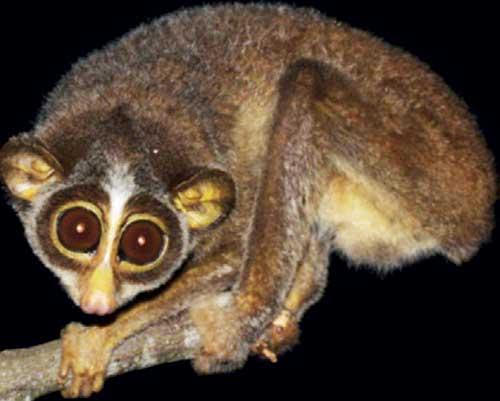
It is in the primate family – closer related to the lemur in Madagascar than to monkeys. Lorises are also found in Indonesia and Africa. The red loris is indigenous to Lanka once thought extinct but ‘rediscovered’ by Dr. Kalinga Padmalal in 2002. Grey lorises also are found in India.
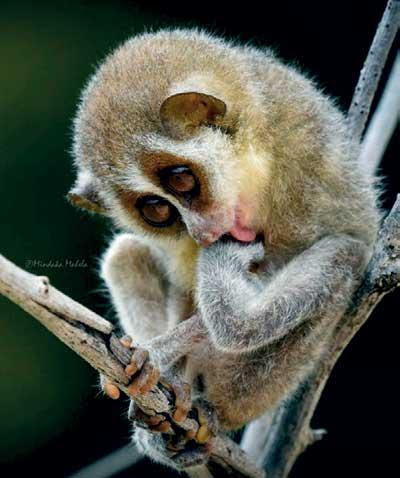
The recent study, headed by Padmalal, considered the father of Sri Lankan zoology. This groundbreaking work utilized modern DNA analysis and could reveal new species (some formerly describes as subspecies). The study reflects that the mini primate’s evolutionary history and biogeography are still poorly understood. The team analysed DNA of over a hundred Loris specimens collected from seven different regions in the island to be analyzed as well as skeletons from museums.
They would waltz in the forest for hours using red-light, as a regular torch would scare the critter away. Then catch and quickly take a blood sample. They need gloves as lorises bite and then released them back in the wild.
It’s believed that the newly identified species rarely interbreed even if they overlap, although it is possible hybrids could sterile like lion-tiger hybrids. Still, enough credibility to make it new species. Some defining factors that inspired this search were minor markings, ear size, throat color and other minor features that are hard to observe unless you look up close.
Lorises come out at night, sleep in the day and are very shy. According to many photographers, “you know you’re an expert on Sri Lanka wildlife when you’ve seen a loris.” – That is the hardest animal to see, followed by the fishing cat. In the daytime, it curls up in a ball and sleeps. Usually, a group of around six are huddled together, so we think that it exhibits some social behavior and hierarchy. A few are observed in a radius of 2 km so we assume there is some social behaviour. They have also been seen grooming and exhibiting some other social behaviour. The female usually gives birth to a single offspring, although twins have also been observed.
The loris eats bugs, reptiles, poisonous frogs and ‘pretty much anything it can get in its hands on’ according to field researcher, Lasanthi Wijayathunga. A loris will bite if you try to catch it. It transmits rabies, but Sri Lankan species are not as poisonous as certain Indonesian lorises.
According to German born researcher, based in Sri Lanka, Wolfgang Dittus, inquisitive baby Toque monkeys have been observed disturbing sleeping lorises in the day, but not eating them. Although orangutans have been seen eating lorises, these apes aren’t found in Sri Lanka. We know less about loris social behavior and hierarchy than we do the other primates. Lasanthi says that Dambulla is best to spot them in their highest density and also around Sigiriya. While on most tours in Yala and Wilpattu you’re unlikely to see them but if you do night walks in certain hotels, you might have luck.
Zoology Professor Saman Gamage doesn’t advice one to keep it as a pet. It is hard to breed in captivity and they might be cute but while it’s tempting, you’re not doing them a favour as won’t live long due to specific requirements found only in their native habitat.
Padmalal says that the lack of funds is a hindrance and they hope the wildlife department will somehow obtain the means to do this. They were given some assistance from the Zoological society in London for DNA studies but progress has stalled sadly.
The olinguito and kabomani tapir were also recently ‘discovered’ new species that were confused with similar animals. In the past, they were mistaken for the similar olingo (another carnivorous mammal) and Amazonian tapir respectively. DNA studies however, showed that they were unique and different animals altogether. This was only in the last decade!
A similar phenomenon happened when the African Golden wolf was identified as a wolf only in 2015, it previously identified as a subspecies of golden jackal (an animal also found in Sri Lanka). In Sri Lanka, the biggest threat is habitat loss and fragmentation caused by people clearing forest land. The loris fortunately was not badly affected by the 26 year civil war either.
The new species are as follows:
Red slender loris ( Loris tardigradus) now reclassified as:-
North western red slender loris,
Loris tardigradus parvus
South western red slender loris,
Loris tardigradus tardigradus
Rakwana slender loris
Loris tardigradus ?
Montane slender loris
Loris tardigradus nycticeboides
Grey loris is now reclassified into:
Highland grey slender loris
Loris lydekkerianus grandis
Uva red slender loris
Loris lydekkerianus uva
Northern grey slender loris
Loris lydekkerianus nordicus
“I am 100% sure these are new species altogether and some are probably as different to each other as gorillas and chimpanzees are to each other, maybe even more so. They live and move only within a small range and therefore have not interbred in thousands of years. They have diverged enough through evolution.” Padmalal says.
When the DNA studies are concluded, we will soon ‘officially’ have the new loris species identified added to the list of mammals in Sri Lanka.
Photo credit
Grey Loris : Mindaka Mahela
Red loris : Saman Gamage/ Kalinga Padmalal