Sada Gamana: NASA’s Artemis II and the New Era of Human Moon Travel – By Bhanuka – eLanka
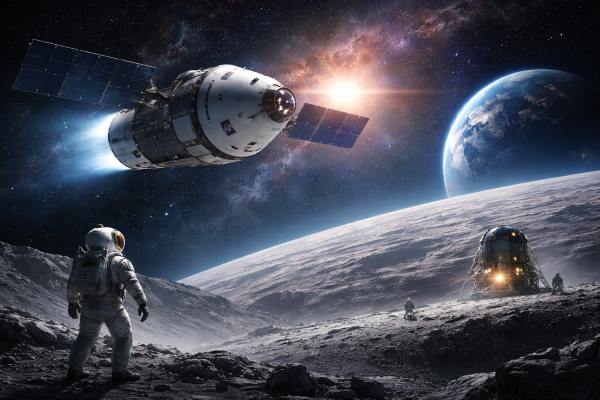
Humanity has once again taken a bold step toward the Moon. After more than five decades since the Apollo era, NASA’s Artemis II mission has reignited the dream of lunar exploration. This modern Sada Gamana—or journey to the Moon—is not just a mission, but a symbol of scientific progress, global collaboration, and the future of space exploration.
A Historic Return to Lunar Travel
On April 1, 2026, NASA successfully launched the Artemis II mission from Kennedy Space Center aboard the powerful Space Launch System (SLS) rocket. Carrying astronauts Reid Wiseman, Victor Glover, Christina Koch, and Jeremy Hansen, this mission marks the first time since 1972 that humans are traveling beyond Earth’s orbit toward the Moon.
This 10-day mission is designed as a test flight, aiming to validate critical systems before future lunar landings under the Artemis program.
Breaking Free from Earth’s Orbit
A major milestone in the mission occurred when Orion performed the translunar injection burn, a six-minute engine firing that pushed the spacecraft beyond Earth’s gravitational influence.
This maneuver is one of the most important phases in space travel. It requires precise calculations and timing to ensure that the spacecraft follows the correct trajectory toward the Moon, approximately 384,400 kilometers away.
Advanced Spacecraft and Technology
The Orion spacecraft, named “Integrity” by its crew, represents the next generation of human spaceflight technology. After launch, it deployed solar array wings to generate power from sunlight, ensuring a sustainable energy supply during the journey.
Key technologies onboard include:
- Life support systems to maintain oxygen, temperature, and pressure
- Deep Space Network communication for long-distance data transmission
- Automated and manual navigation systems for precision control
- Radiation protection systems for astronaut safety in deep space
Scientific and Operational Achievements
During the mission, astronauts are conducting a range of tests and activities, including:
- Manual piloting demonstrations in space
- System checkouts in high Earth orbit (up to 46,000 miles)
- Adapting to microgravity conditions
- Testing onboard systems such as waste management and exercise equipment
Additionally, small satellites called CubeSats were deployed to conduct independent scientific experiments.
Exploring the Moon’s Far Side
One of the most exciting parts of the mission is the planned lunar flyby. The astronauts will observe and capture high-resolution images of the Moon, including its mysterious far side, which is never directly visible from Earth.
The unique lighting conditions during the flyby will highlight:
- Deep craters
- Mountain ridges
- Surface textures and slopes
These observations will provide valuable scientific data and enhance our understanding of the Moon’s geology.
The Future of Lunar Exploration
Artemis II is only the beginning. NASA’s Artemis program aims to:
- Establish a sustainable human presence on the Moon
- Build lunar infrastructure such as space stations and habitats
- Use the Moon as a launch point for Mars missions
This new era represents what many call a “Golden Age of Space Exploration.”
Conclusion
Sada Gamana, the journey to the Moon, is no longer a distant dream—it is happening now. With Artemis II, humanity is once again reaching beyond Earth, driven by curiosity, innovation, and the desire to explore the unknown.
As we watch this mission unfold, one thing is clear: the Moon is not the final destination, but the beginning of a much greater journey into the universe.