News & Community eLanka

eLanka

Wednesday, 22 Apr 2026
  • Home
  • Read History
  • Articles
    • eLanka Journalists
  • Events
  • Useful links
    • Obituaries
    • Seeking to Contact
    • eLanka Newsletters
    • Weekly Events and Advertisements
    • eLanka Testimonials
    • Sri Lanka Newspapers
    • Sri Lanka TV LIVE
    • Sri Lanka Radio
    • eLanka Recepies
  • Gallery
  • Contact
Newsletter
Sri lankan news
  • eLanka Weddings
  • Property
  • eLanka Shop
  • Business Directory
eLankaeLanka
Font ResizerAa
Search
  • Home
  • Read History
  • Articles
    • eLanka Journalists
  • Events
  • Useful links
    • Obituaries
    • Seeking to Contact
    • eLanka Newsletters
    • Weekly Events and Advertisements
    • eLanka Testimonials
    • Sri Lanka Newspapers
    • Sri Lanka TV LIVE
    • Sri Lanka Radio
    • eLanka Recepies
  • Gallery
  • Contact
Follow US
© 2005 – 2026 eLanka Pty Ltd. All Rights Reserved.
Home » Goodnews Stories Srilankan Expats » Articles » The gateway to history-by Mahil Wijesinghe
Articles

The gateway to history-by Mahil Wijesinghe

eLanka admin
Last updated: March 4, 2024 4:10 pm
By
eLanka admin
ByeLanka admin
Follow:
Share
9 Min Read
SHARE
Views: 9

The gateway to history-by Mahil Wijesinghe

elanka

Source:Sundayobserver

According to chronicles, the Bihalpola Raja Maha Vihara is believed to have been constructed during the reign of King Devanampiyatissa and later renovated by King Walagambahu (89-77 BC). Among the ruins at the site are a stone pillar inscription, several stone pillars and a stone carved flight of steps possibly belonging to the Anuradhapura period

elanka

During the Kandyan period, there was a unique type of Vihara called the ‘Tampita Vihara’. Tampita Vihara is a temple on pillars. Its most prominent feature is that it is mounted on monolithic pillars or dwarfed rock pillars.

This type of Vihara that stood on raised platforms of wood standing on stone pillars on huge rock boulders was constructed to prevent white ants or other vermin from entering and damaging it.

On a recent tour around the interior of Kurunegala, not far from the city, we came to know that there are a few such ‘Tampita’ Viharas in the surrounding areas. The Panavitiya Ambalama which is close to the Bihalpola Vihara has also been built using this method.
elanka

These archaic monuments are preserved by the Department of Archaeology. In our ramblings around Kurunegala, we were fortunate to come across one such Tampita Vihara at a place called Bihalpola, seven kilometres from Narammala on the road to Kuliyapitiya.

About 25 kilometres away towards the North-West of Kurunegala lies the Bihalpola Raja Maha Vihara on a rocky hill. It is a unique Tampita Vihara that dates back centuries. It is just five kilometres down the Kuliyapitiya Road from the Kadahapola junction on the Kurunegala-Madampe road.

Shrine room

The superstructure of the Bihalpola Tampita Vihara is composed of wattle and daub and square in shape. There are three Viharas altogether which belong to different periods of time built on a huge rock boulder on the top of the hill, of which the Relic Chamber (Dhatu Mandiraya) in the middle is a three-storied building.

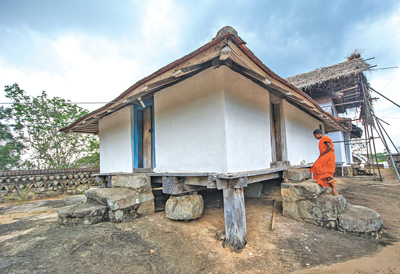
The building at the far end of the temple complex is also a shrine room, decorated with murals, which houses the main image of the Buddha that belongs to the Kandyan period. A dramatic architectural feature of this small building is that it is on a framework of massive wooden beams that rest on elevated solid rocks placed on a rock boulder. Some of the wooden pillars have been driven into the rock boulder in some places. The walls of the square Vihara are composed of wattle and daub. It also has a characteristic roof covered with Kandyan Pethi-Ulu (flat tiles).
elanka

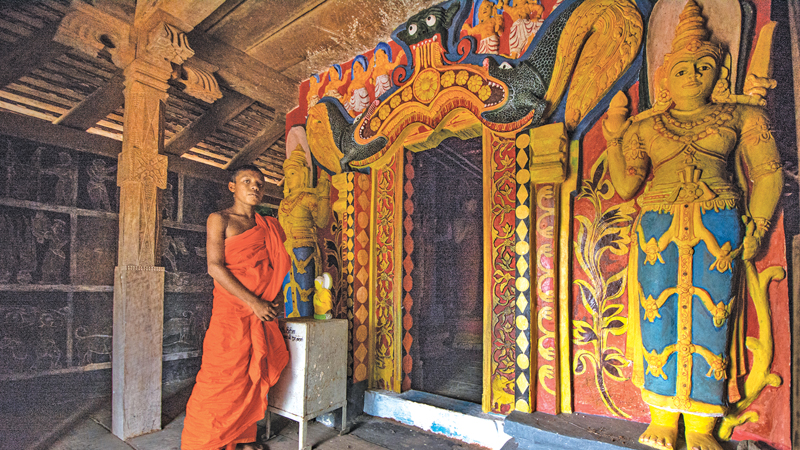
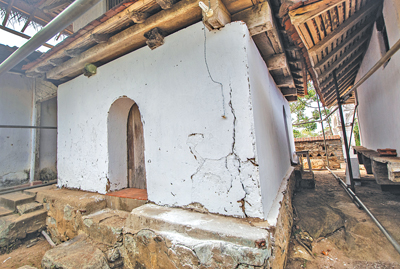
There are two small doorways in the Vihara placed on two sides. The height of the doorways is about six feet and all wooden frames are decorated with intricately carved floral motifs.

One door frame is painted in blue while the other is plain. Several solid rock slabs with plain moonstones have been placed in front of the doorways which lie on elevated platforms for pilgrims to enter the image house of the Vihara. The doorway is so small that one has to bend down as if in obeisance to enter the Vihara. Such Tampita Viharas enshrine Buddha statues.

After a brief chat with the Chief incumbent of the Vihara at the foot of the hill, we were accompanied by a Samanera of the Vihara.

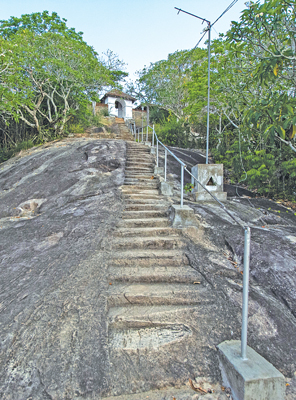
Having climbed a steep rock cut flight of steps around 20 metres up to the summit under the many white Frangipani trees laden with blossoms, we first saw a beautifully structured arched entrance. Around the summit is an elaborately built stone wall around six feet tall with rectangular holes carved into the wall to light lamps around the upper terrace of the Vihara which contains three structures and the glistering ancient Chaitya on top of the hill that give a picturesque setting to the Vihara.
elanka

The lower terrace contains a huge Bo-tree and a Devale. We saw heaps of fallen Araliya freshly swept into piles, and emanating a glorious fragrance. We experienced the tranquility and the amazing bird’s eye view of a lush green landscape of the area from the higher elevation of the summit where the Tampita Vihara is.

According to chronicles, the Bihalpola Raja Maha Vihara is believed to have been constructed during the reign of King Devanampiyatissa and later renovated by King Walagambahu (89-77 BC). Among the ruins at the site are a stone pillar inscription, several stone pillars and a stone carved flight of steps possibly belonging to the Anuradhapura period.

Image houses

The Samanera bhikkhu took us to every nook and corner of the Vihara, opening the shrine rooms for us. Entering the image houses, we first visited the modern image house which contains a reclining Buddha statue and a couple of seated statues with murals of delightful lotus designs painted on the ceiling probably around the early part of the 20th Century.

The second one, the three-storied ‘Dhatu Mandiraya’ (Relic Chamber) of the Vihara, was closed due to the restoration work carried out by the Department of Archaeology. The whole structure is on the verge of collapse and covered with a cadjan thatched temporary roof. We couldn’t visit the interior of the building because of the ongoing renovation.

Next to the three-storied relic chamber is a Tampita Vihara erected on a huge wooden frame on four rock slabs on a rock boulder of the temple. This is one of the most striking features of the Vihara.

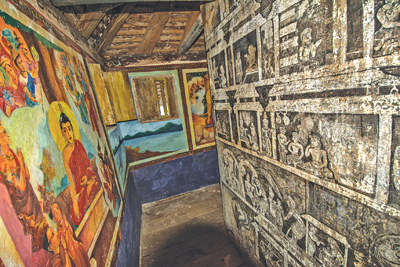
Climbing a short flight of steps, the Samanera bhikkhu opened a door and showed us the interior of the image house which comprised seated and standing Buddha statues and exquisite designs depicting Jathaka stories covering the walls while on the ceiling, there is a painting of flowers and creepers with tendrils, which is fast deteriorating.

Jathaka stories

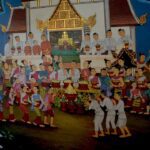
Paintings on the Jathaka stories – stories of Buddha’s previous life on the Vihara walls are fast decaying. The stories are visually retold in long panels and there is a small strip that is just sufficient to give a short explanatory note of the Jathaka story. Along the outer walls of the corridor of the image house, fairly large panels depicting the Buddha’s life had been painted in the recent past.
elanka

Many of Sri Lanka’s ancient temples have decaying historic murals due to neglect and damage by treasure hunters. Bihalpola is no exception. Tragically, a fire has damaged a number of priceless paintings and a beautiful wooden Makara Thorana at the Tampita Vihara image house in 1997, while treasure hunters have taken away several priceless Buddha statues at the Vihara.

Observing the wooden pillars in the image house of the Tampita Vihara, we noticed that they are unique creations resembling the wooden pillars at the Panavitiya Ambalama. The murals on the Tampita Vihara are believed to have been repainted over a black background. Probably, all the vibrant colours (red and yellow) have faded and been destroyed in the fire.

Similar to the Bihalpola Tampita Vihara and the many temples and kingdoms in this area are places where our rich history comes alive. Kurunegala which is an entry point to these splendours of our past is indeed a gateway to history.

TAGGED:Bihalpola Raja Maha ViharaPanavitiya AmbalamaTampita Viharas
Share This Article
Facebook Whatsapp Whatsapp LinkedIn Email Copy Link Print
Previous Article INTRODUCTION As of 2010, there were 45,159 Sri Lankans living in the US. Substantial immigration began in the 1990s when many fled the violence of the Sri Lankan Civil War. The majority of Sri Lankan-Americans live in the vicinity of either New York City (where there’s a Little Sri Lanka on Staten Island), central New Jersey, or Los Angeles. Sri Lanka’s 76th Independence Day Celebrated in Wellington, New Zealand: Strengthening Bilateral Ties – by Mazhar Abbas
Next Article historical Buddhist Temple-eLanka Welgamvehera: A sacred place that promotes unity-by M.A.R.Manukulasooriya, Hiriyala group corr.
FacebookLike
YoutubeSubscribe
LinkedInFollow
Most Read
10 Pictures With Fascinating Stories Behind Them!

“A PICTURE SPEAKS A 1000 WORDS” – By Des Kelly

Look past your thoughts so you may drink the pure nectar of this moment

A Life Hack for when we’re Burnt Out & Broken Down – By Uma Panch

Narration of the History of our Proud Ancestral (Orang Jawa) Heritage. by Noor R. Rahim

eLanka Weddings

eLanka Marriage Proposals

Noel News

Noel News

Noel News

Noel News- By Noel Whittaker

Appreciation: Eileen Mary Sibelle De Silva

K.K.S. Cement Factory

Dr.Harold Gunatillake’s 90th Birthday party

Sri Lanka's women's cricket squad in Melbourne

Cricket: Sri Lanka’s women’s squad in Melbourne

- Advertisement -
Ad image
Related News
Sri Lankan hoppers Australia, hopper Sydney vs Melbourne, appa Sri Lankan food, Sri Lankan diaspora Australia cuisine, best hoppers Sydney, best hoppers Melbourne, Sri Lankan restaurants Sydney, Sri Lankan restaurants Melbourne, hopper recipe Sri Lanka, crispy edge hopper, soft centre hopper, appachatti cooking, fermented rice flour pancakes, Sri Lankan street food Australia, Lankan Filling Station Sydney, Kurumba Sydney hoppers, Hopper Joint Melbourne, Sri Lankan food culture Australia, authentic Sri Lankan cuisine, hopper bar Sydney, Sri Lankan food Melbourne Prahran, Toongabbie Sri Lankan food, Sri Lankan catering Melbourne, Crunchy Hoppers Melbourne, Chef Ceylon Sydney, Sri Lankan community Australia food, traditional Sri Lankan breakfast, modern Sri Lankan dining Australia, coconut milk hopper, fermented batter cooking
Articles

The Great Hopper Debate: Where to Find the Crispiest Edges in Sydney vs. Melbourne

Sri Lankan Australians, Sri Lankan diaspora Australia, Sri Lankan community Melbourne, Sri Lankan community Sydney, Sri Lankan culture in Australia, Sri Lankan migration Australia, Sri Lankan traditions abroad, Sri Lankan food short eats, Sri Lankan hospitality culture, backyard cricket Australia Sri Lanka, Singlish language Sri Lankan diaspora, Sri Lankan suburbs Australia, Little Sri Lanka Melbourne, Sri Lankan festivals Australia, Sinhala Tamil New Year Australia, Vesak Australia Sri Lanka, Deepavali Sri Lankan diaspora, Sri Lankan professionals Australia, Sri Lankan education values, Sri Lankan family traditions, multi generational households Sri Lanka, Sri Lankan weddings diaspora, eLanka community portal, Sri Lankan identity abroad, Sri Lankan lifestyle Australia, migrant success stories Australia, multicultural Australia Sri Lanka, Sri Lankan heritage preservation, Sri Lankan food culture abroad, Sri Lankan expat life Australia
Articles

10 Signs You’re a Sri Lankan Living in Australia

Sri Lankan New Year Melbourne, Bakmaha Ulela 2026, Sinhala Tamil New Year Festival Australia, Dandenong Showgrounds event, Sri Lankan diaspora Melbourne, SLGTTIOBA Australia, Sri Lankan cultural festival Melbourne, Avurudu celebrations Australia, Sri Lankan community events Australia, Melbourne multicultural festivals 2026, Sinhala Hindu New Year overseas, Sri Lankan traditions abroad, Kiri Ithirima ritual, Avurudu food Sri Lanka, Kiribath Kavum Kokis Aluwa, Sri Lankan sweets festival, traditional Sri Lankan games, Kotta Pora Melbourne, Sri Lankan cultural preservation, Sri Lankan heritage Australia, Melbourne Sri Lankan events, diaspora cultural identity, Sri Lankan festivals outside Sri Lanka, Aluth Avurudu celebration, Sri Lankan food festival Melbourne, community events Dandenong, Sri Lankan music and dance Australia, multicultural Australia events, Sri Lankan charity Melbourne, Cyclone Ditwah donation, Sri Lankan organisations Australia, eLanka news, Sri Lankan diaspora stories, Melbourne community festivals, Sri Lankan New Year games, Avurudu Mesaya, Sri Lankan traditions Melbourne, cultural events Australia 2026, Sri Lankan expat life, Sri Lankan gatherings Melbourne, Melbourne festival attendance record, Sri Lankan New Year celebration abroad
Articles

Sri Lankans in Melbourne Celebrate Grand “Bakmaha Ulela” with Record Attendance

Celebrating Together: Gratitude from Sunfest 2026
Articles Photo Gallery

Celebrating Together: Gratitude from Sunfest 2026

eLanka Newsletter - 19th April 2026
Articles eLanka Newsletters

eLanka Newsletter – 19th April 2026 – 3rd Edition – Sri Lankans In Australia

  • Quick Links:
  • Articles
  • DESMOND KELLY
  • Dr Harold Gunatillake
  • English Videos
  • Sri Lanka
  • Sinhala Videos
  • eLanka Newsletters
  • Obituaries
  • Sunil Thenabadu
  • Dr. Harold Gunatillake
  • Tamil Videos
  • Sinhala Movies
  • Trevine Rodrigo
  • Photos
  • eLanka Newsletter

eLanka

Your Trusted Source for News & Community Stories: Stay connected with reliable updates, inspiring features, and breaking news. From politics and technology to culture, lifestyle, and events, eLanka brings you stories that matter — keeping you informed, engaged, and connected 24/7.
Kerrie road, Oatlands , NSW 2117 , Australia.
Email : info@eLanka.com.au / rasangivjes@gmail.com.
WhatsApp : +61402905275 / +94775882546
  • About eLanka
  • Terms & Conditions

Disclaimer:
eLanka is committed to sharing positive and community-focused stories. We do not publish or endorse political, religious, or ethnic viewpoints. The content published on eLanka, including articles and newsletters, reflects the opinions and views of the respective authors and not those of eLanka. eLanka accepts no responsibility or liability for the accuracy, completeness, or consequences of any content provided by contributors.

(c) 2005 – 2025 eLanka Pty Ltd. All Rights Reserved.