News & Community eLanka

eLanka

Sunday, 13 Sep 2026
  • Home
  • Read History
  • Articles
    • eLanka Journalists
  • Events
  • Useful links
    • Obituaries
    • Seeking to Contact
    • eLanka Newsletters
    • Weekly Events and Advertisements
    • eLanka Testimonials
    • Sri Lanka Newspapers
    • Sri Lanka TV LIVE
    • Sri Lanka Radio
    • eLanka Recepies
  • Gallery
  • Contact
Newsletter
Sri lankan news
  • eLanka Weddings
  • Property
  • eLanka Shop
  • Business Directory
eLankaeLanka
Font ResizerAa
Search
  • Home
  • Read History
  • Articles
    • eLanka Journalists
  • Events
  • Useful links
    • Obituaries
    • Seeking to Contact
    • eLanka Newsletters
    • Weekly Events and Advertisements
    • eLanka Testimonials
    • Sri Lanka Newspapers
    • Sri Lanka TV LIVE
    • Sri Lanka Radio
    • eLanka Recepies
  • Gallery
  • Contact
Follow US
© 2005 – 2026 eLanka Pty Ltd. All Rights Reserved.
Home » Goodnews Stories Srilankan Expats » Articles » The Glory of Gadaladeniya & Lankathilaka Temples-by Dishan Joseph
Articles

The Glory of Gadaladeniya & Lankathilaka Temples-by Dishan Joseph

eLanka admin
Last updated: March 12, 2022 6:22 am
By
eLanka admin
ByeLanka admin
Follow:
Share
10 Min Read
SHARE
Views: 48

The Glory of Gadaladeniya & Lankathilaka Temples-by Dishan Joseph

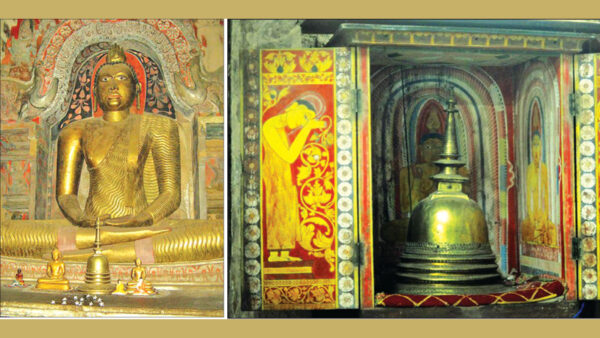
Gadaladeniya temple

Inner sanctum at Gadaladeniya-The Reliquary at Gadaladeniya temple

I have written previously about the Embekke Devalaya, which is one of the three prominent temples built during the Gampola era. The kings of Gampola did not control the entire country during their reign; in fact, they were regional regents of the hill country.

Lankathilaka Viharaya

From the Embekke Devalaya, you can travel to Lankathilaka temple. We walked part of this distance which is about two kilometres. On the way, I noticed trees full of nutmeg, known as saddikkai in the rural areas. The lush paddy fields were ready for harvest. The Lankathilaka temple was built on a rock. My Buddhist friend Kumuduni and I climbed about 100 steps, which have been cut from the solid rock. The wind is chilly as you ascend. The three-storied structure dominates the rock. The view from the summit is refreshing. The stone foundation of the temple is very impressive.

Lankathilaka Viharaya is a Buddhist temple situated in Udunuwara of Kandy. It is located in the village of Daulagala. The village name Daulagala has a beautiful meaning. In the period of the kings, the royal messenger was sent to deliver the king’s messages. He played a daula (drum) from the top of a small rock (gala). Hence, the name Daulagala, meaning the rock from which the drum was played. The history of the temple goes back to the 14th century. According to historical reports, this temple was built by King Buwanekabahu IV. He entrusted the construction of this temple to his Chief Minister named Senalankadhikara, who successfully finished the sacred task. The architecture of the temple is said to be designed by a South Indian architect named Sathapati Rayar.

The vihara buildings were built on a natural rock called Panhalgala Rock. Among the buildings, the image house displays outstanding architecture, featuring traditional Sinhalese sculptures.

According to the facts in the Lankathilaka copper plaque, this image house was constructed as a four-storeyed mansion with a height of 80 feet, but today only three storeys can be seen at this serene temple. The pure white building resonates with tranquillity. At each corner of the main temple, you can identify the image of a protruding elephant which is holding a crest, suspended from its trunk. Another unique visual at Lankathilaka is the image of the ‘hansa puttuwa’- here it shows four swans, instead of the traditional two swans.

I experienced a lovely moment near the large Bo tree. A schoolgirl in uniform was offering her prayers before the A/L exam. After she finished, this amiable student turned around and knelt down in front of us, seeking our blessing. This was indeed a surprise. I was delighted to see this child respecting adults, something not seen much in Colombo city. Lankathilaka temple has a separate Stupa. This ancient temple is a golden example which shows the cohabitation of Buddhist- Hindu worship, augmenting the fact that we all are Sri Lankans.

After descending the rock, it was time to visit the third temple of the Gampola era.

Gadaladeniya Viharaya

A short three-wheeler ride brings you to the magnificent Gadaladeniya Viharaya also known as Saddharmatilaka Viharaya. This Buddhist edifice is situated in Pilimathalawa, Kandy. It is located on the Gadaladeniya Road to the west of Kandy.

The solid Gadaladeniya Viharaya is considered one of the largest rock temples in Sri Lanka. The history of this temple can be traced back to the 14th century. According to historical reports, this temple was built in 1344, under the patronage of King Buwanekabahu IV by Ven. Seelavamsa Dharmakirti Thera. At the temple entrance, there is a visitors’ room where a middle-aged man was patiently engaged in drawing designs found within the temple. It was nice to watch him at work, recreating ancient art in this digital era.

We know that King Buwanekabahu IV was the first king of Gampola. He succeeded his father Vijayabahu V of Dambadeniya and became the king of Gampola. King Buwanekabahu IV ascended to the throne after his father shifted the capital from Kurunegala to Gampola, with the support of General Senalankadhikara. He was duly succeeded by his brother Parakramabahu V.

According to oral tradition, the architecture of Gadaladeniya temple was designed to manifest Hindu artistic styles by a South Indian architect named Ganeshvar-aachariyar. On the solid rock outcrop upon which the temple stands, we can observe a carved inscription regarding the temple’s construction. Another two inscriptions are found on the rock near the Bodhiya. In 1934, Archeology Commissioner H.C. Bell had found the stone slab inscription. Five rock inscriptions are found on the south side. It is said this beautiful temple was constructed in the Dravidian architectural style infused with Sinhalese architecture from the Polonnaruwa era. The architecture is similar to the Vijayanagar styles of South India. Celebrated scholarly monks who have resided at this temple include Sangharaja Dharmakirti II and Vimalakirti I. The temple was abandoned until King Vira Parakrama Narendra Sinha (1707–1739) handed over the care of this sacred site to Ven. Weliwita Sri Saranankara Thera, whose students have faithfully looked after the temple for centuries.

The central temple building is unique because it is built entirely of sculptured granite, except for two sikharas which are built of brick, and sit on a large stone slab. It shows the determination of the ancient builders. The sikharas, which are located above the sanctum begin in an octagonal shape but have been bestowed with the features of a dagoba. After the original construction of the temple building, a multi-tiered and tiled roof, resting on brick piers and wooden pillars was added to the temple. At the entrance to the shrine room is an elegantly sculptured Makara Thorana (Dragon Arch).

Inside the shrine room is an eight-feet-tall statue of a seated Buddha, with four standing Buddha statues flanking the main statue. The doors to the main shrine are adorned with beautiful art. The colours remain fresh after 700 years, which is a testament to the artist’s skill. The topmost panels depict the sun on the left wing and the moon on the right wing.

I also noted mythological creatures painted amidst floral designs. The reliquary can be seen on the left. The wooden doors are painted to depict the Buddha’s senior disciples, Ven. Sariputta and Moggallana in pious adoration. Their halos indicate they are arahants (enlightened beings).

Adjacent to the main shrine room, is a devale dedicated to the Hindu God Vishnu. According to oral tradition, the devale was originally dedicated to Varuna when it was built, however, as Vishnu became more popular with devotees the shrine to Varuna was replaced with Vishnu. In the middle of the temple compound is a secondary shrine, the Vijayothpaya or Vijayantha Prasada named after the mythical palace of God Indra. It was built on the turtleback section of the natural rock. This shrine was supposedly constructed after the main shrine by King Parakramabahu V.

The shrine consists of a central Stupa, built on a square platform. The entire Stupa is covered by a four-sided roof supported by four stone pillars. On the four sides of the main Stupa are four mini stupas, extending in cruciform angles out in the four cardinal directions – said to denote spiritual sovereignty over the world. Interestingly, each of these four smaller Stupas is built on stone platforms with their own individual shrine rooms. You can enter each room via a small door, but the inside area is pretty small.

The white Stupas form a contrast to the black rock. The incumbent chief priest has done an excellent job in creating a good atmosphere to educate all devotees. Of the three Gampola era temples, Gadaladeniya Viharaya is the best maintained, with all facilities. A visit to these temples enriches our personal appreciation of our Sri Lankan identity and respect for all religions.

TAGGED:Embekke DevalayaLankathilaka Viharaya
Share This Article
Facebook Whatsapp Whatsapp LinkedIn Email Copy Link Print
Previous Article Samar Samar Tamil Movie
Next Article Dutch influence A temple with Dutch influence-BY MAHIL WIJESINGHE
FacebookLike
YoutubeSubscribe
LinkedInFollow
- Advertisement -
eLankaproperty - sell property in Sri Lanka, Sri Lanka property for sale, Sri Lanka real estate, Sri Lanka property listings, property marketplace Sri Lanka, land for sale Sri Lanka, houses for sale Sri Lanka, apartments for sale Sri Lanka, commercial property Sri Lanka, luxury villas Sri Lanka, Sri Lankan property investment, buy property in Sri Lanka, Colombo property for sale, beachfront property Sri Lanka, development land Sri Lanka, investment property Sri Lanka, property advertising Sri Lanka, real estate agents Sri Lanka, property brokers Sri Lanka, overseas Sri Lankan property buyers, Sri Lanka property website, list property online Sri Lanka, affordable property listings Sri Lanka, Sri Lanka homes for sale, Sri Lanka land investment, property developers Sri Lanka, real estate marketplace Sri Lanka, Sri Lanka commercial real estate, sell land in Sri Lanka, sell house in Sri Lanka, Sri Lanka property portal, global property marketplace Sri Lanka, Sri Lankan real estate investment, property management Sri Lanka, buy land Sri Lanka, residential property Sri Lanka, holiday homes Sri Lanka, Sri Lanka investment opportunities, real estate advertising Sri Lanka, eLankaProperty
- Advertisement -
ALTAIR
- Advertisement -
Ad image
eLanka Wedding
Most Read
Kamzy Gunaratnam Norway Minister of Transport

Kamzy Gunaratnam: From Jaffna Refugee to Norway’s Minister of Transport Kamzy Gunaratnam has been appointed Norway’s Minister of Transport. Image credit: Colombo Times. The appointment of Kamzy Gunaratnam as Norway’s new Minister of Transport represents a proud and historic development for Sri Lankan Tamils and the wider global Sri Lankan community, marking the latest stage in a remarkable public-service journey that began in Jaffna and continued through refugee resettlement, local government and national politics in Norway. Gunaratnam, a Norwegian Member of Parliament of Sri Lankan Tamil heritage, formally assumed the ministerial position at 12 noon on 11 September 2026, following a cabinet reshuffle by the government led by Norwegian Prime Minister Jonas Gahr Støre. She succeeds Jon-Ivar Nygård, who stepped down from the portfolio. The appointment places Gunaratnam at the head of one of Norway’s most important public sectors, with responsibility for roads, railways, public transportation and wider transport infrastructure. The position carries substantial national significance in a country where reliable mobility, regional connectivity and environmental sustainability are closely connected to economic development and social inclusion. A journey from Jaffna to Norway Kamzy Gunaratnam was born in Jaffna, Sri Lanka, in 1988. When she was three years old, she left the country with her parents and moved to Norway as a refugee, fleeing the civil war that had caused prolonged hardship and displacement across Sri Lanka. Her early circumstances were therefore shaped by uncertainty and relocation, yet the subsequent course of her life demonstrates the capacity of education, civic participation and public service to transform personal challenges into national leadership. From a young age, Gunaratnam became actively involved in politics and public affairs. Her engagement developed within Norway’s democratic institutions, where she gradually established herself as a prominent representative of the Labour Party and as a voice for inclusive public policy. Her story is significant not merely because of the senior office that she now holds, but also because it illustrates the many stages through which a person can contribute to a new country while retaining a meaningful connection with their family heritage. Her experience reflects the resilience of Sri Lankan families who have established new lives across the world and who continue to participate constructively in the societies in which they live. Leadership in Oslo Between 2015 and 2021, Gunaratnam served as Deputy Mayor of Oslo, Norway’s capital and largest city. The role provided extensive experience in local government, municipal administration and the practical delivery of services affecting residents in their daily lives. Oslo is a complex urban centre in which transport, housing, environmental policy, public safety and social inclusion are closely interrelated. Experience within the city administration would have required an understanding of how public decisions affect communities across different neighbourhoods, as well as the importance of long-term planning in a rapidly changing metropolitan environment. Gunaratnam’s years as Deputy Mayor also established a foundation for her later work in national politics. Local government frequently provides the most direct encounter with public concerns, since roads, public transport, urban development and essential services are experienced by residents at close range. Her transition from municipal leadership to national office was confirmed at the 2021 Norwegian parliamentary election, when she was elected to the Storting, Norway’s national parliament, as a candidate for the Norwegian Labour Party. Election to the Storting The Storting is Norway’s central legislative institution, and election to the parliament represents a significant public mandate. Gunaratnam’s arrival in the national legislature placed her within the country’s principal forum for shaping laws, approving public expenditure and scrutinising government policy. Her parliamentary career has been viewed in the context of her long-standing commitment to environmental sustainability and public transportation. Those areas are particularly relevant to Norway’s future, as the country continues to consider how infrastructure can support economic activity while reducing environmental pressures and improving access for communities across urban and regional areas. The transport portfolio is broad and demanding. It encompasses the maintenance and development of roads, the operation and expansion of railway networks, public transport systems and major infrastructure projects. Decisions within the ministry can influence commuting patterns, regional opportunity, freight movement, road safety and the ability of citizens to access employment, education and essential services. For Gunaratnam, the new appointment brings together several strands of her previous experience: municipal leadership in Oslo, parliamentary service, environmental advocacy and an established interest in public transportation. These responsibilities will now be applied at a national level. Sustainability and public transport Norway’s geography gives transport policy particular importance. The country extends across a long and varied landscape, encompassing major cities, coastal communities, mountainous areas and remote regions. Efficient infrastructure is therefore essential for maintaining national connections, while sustainable transport options are increasingly important in addressing environmental concerns. Gunaratnam’s strong commitment to environmental sustainability and public transportation is seen as especially relevant to the ministry’s responsibilities. Public transport can reduce congestion, improve mobility for people who do not drive and support the development of more environmentally responsible communities. Railways and buses also play a wider social role. When public transport is dependable and affordable, it can connect people with employment, education, healthcare and cultural life. In regional areas, infrastructure investment may strengthen local economies and reduce isolation, while in cities it can contribute to more efficient and liveable urban environments. As Minister of Transport, Gunaratnam will therefore be responsible for a sector that extends well beyond physical infrastructure. Roads and railways are visible elements of the portfolio, but the underlying objective is the creation of a connected society in which people and goods can move safely, efficiently and sustainably. A source of pride and inspiration Gunaratnam’s appointment has been welcomed as a major achievement by Sri Lankan Tamils in Norway and by Sri Lankans around the world. Her life story, from a childhood shaped by forced migration to a senior position in the Norwegian Government, offers an especially powerful example of perseverance and civic contribution. The achievement also highlights the breadth of Sri Lankan talent in international public life. Across Australia, the United Kingdom, Canada, the United States, New Zealand, Europe and the Middle East, Sri Lankan professionals and community members continue to contribute to government, business, education, medicine, technology, the arts and public administration. For people of Sri Lankan Tamil heritage, Gunaratnam’s appointment carries an additional cultural and historical significance. It demonstrates that heritage and public responsibility can exist together, with personal origins forming part of an individual’s story while public service remains directed towards the needs of the entire population. Her appointment is not simply a milestone in one political career. It is also an encouraging reminder that public institutions can be strengthened when people from varied backgrounds are able to participate fully in national life. Gunaratnam’s journey from Jaffna to Oslo, and from refugee childhood to ministerial office, stands as an inspiring example of determination, democratic participation and service to the wider community. For the global Sri Lankan community, her success provides a moment of immense pride. It also offers younger generations an example of what can be achieved through commitment, education, principled participation and a willingness to serve others. eLanka continues to share positive stories about Sri Lankans and Sri Lankan families living in Australia and around the world. Through its online community platform, eLanka connects readers with news, achievements, events and useful information that celebrate the continuing contribution of Sri Lankan people internationally. Source: https://colombotimes.net/sri-lankan-woman-kamzy-gunaratnam-becomes-norways-minister-of-transport/ This article was written based on the source https://colombotimes.net/sri-lankan-woman-kamzy-gunaratnam-becomes-norways-minister-of-transport/, kindly email us at info@eLanka.com.au if any information needs to be corrected. Click here to receive your free copy of the eLanka Newsletter twice a week delivered directly to your inbox! At eLanka, we respect the rights of creators. If we have used an image you own and you’d like it removed, please email us at info@elanka.com.au and we’ll handle it promptly.

Sri Lanka amphibious boat

Sri Lanka Unveils ‘Iguana’ , Its First Locally Built Amphibious Boat for Export

The Consulate General of Sri Lanka in Dubai hosted the Sri Lanka Women’s National Cricket Team to a special dinner at the Consulate General premises

Education Ministry’s restructuring impact closure of one-third of public schools By Arundathie Abeysinghe

Education Ministry’s restructuring impact closure of one-third of public schools By Arundathie Abeysinghe

Celebrating 80 Years of Life & Achievements of Dr. Somaratne Dissanayake.

Related News
Articles

HCA Newsletter

Articles Dr Harold Gunatillake

Streamlining Sri Lanka’s Health System: President AKD’s Primary-Care Reform Vision-by Harold Gunatillake

The Brad & Kiara Show
Articles The Brad and Kiara Show - Sydney

The Brad & Kiara Show

Articles Trevine Rodrigo

Chamari Athapaththu’s heroic Sri Lankans storm into Asia Cup final against India.  Plucky Lankans usurp Pakistan after keen tussel.  BY TREVINE RODRIGO IN MELBOURNE.  (eLanka Sports Editor)

Beverly Hills Polo Club Celebrates the Journey to the Crown with Miss Grand Sri Lanka 2026 01
Articles

Beverly Hills Polo Club Celebrates the Journey to the Crown with Miss Grand Sri Lanka 2026

  • Quick Links:
  • Articles
  • DESMOND KELLY
  • Dr Harold Gunatillake
  • English Videos
  • Sri Lanka
  • Sinhala Videos
  • Obituaries
  • eLanka Newsletters
  • Sunil Thenabadu
  • Dr. Harold Gunatillake
  • Trevine Rodrigo
  • Tamil Videos
  • Sinhala Movies
  • Photos
  • eLanka Newsletter

eLanka

Your Trusted Source for News & Community Stories: Stay connected with reliable updates, inspiring features, and breaking news. From politics and technology to culture, lifestyle, and events, eLanka brings you stories that matter — keeping you informed, engaged, and connected 24/7.
Kerrie road, Oatlands , NSW 2117 , Australia.
Email : info@eLanka.com.au / rasangivjes@gmail.com.
WhatsApp : +61402905275 / +94775882546
  • About eLanka
  • Terms & Conditions

Disclaimer:
eLanka is committed to sharing positive and community-focused stories. We do not publish or endorse political, religious, or ethnic viewpoints. The content published on eLanka, including articles and newsletters, reflects the opinions and views of the respective authors and not those of eLanka. eLanka accepts no responsibility or liability for the accuracy, completeness, or consequences of any content provided by contributors.

(c) 2005 – 2025 eLanka Pty Ltd. All Rights Reserved.