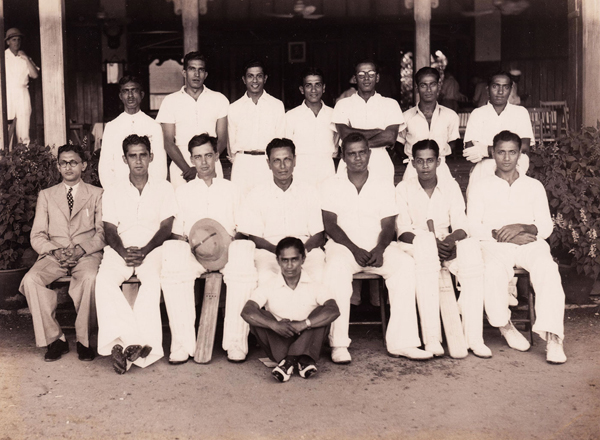
The story of De Saram and Satha: batting geniuses who went to jail
source:-TheCricketMonthly
Two of Sri Lanka’s greatest batsmen had memorable lives, but they have been nearly forgotten today
Ask any sports fan what it takes for a player to reach the pinnacle of their game and you’ll get the same tired answers. Talent. Temperament. Determination. But sporting greatness also relies on factors more arcane. Like luck. Or opportunity. Being in the right place at the right time. Just imagine if Pelé had been born in Bombay or if Gavaskar had grown up in Brazil. Where would they be now?
FC de Saram and Mahadevan Sathasivam are the greatest Sri Lankan cricketers of the pre-Test era. They were born three years apart, and in their heyday either would have walked into any international side.
Yet, de Saram played only 40 first-class games and Sathasivam a measly 11. Both captained their nation and their club rivalry captivated Colombo. They are quite possibly the best batsmen you’ve never heard of.
But that’s not all that binds them. Both de Saram and Sathasivam were left to rot in Colombo’s Welikada Prison. Wrong place at the wrong time? You don’t know the half of it.
FC de Saram – Derrick to all who knew him – was born into sporting royalty. His uncle DL was the island’s first cricketing star, one of four brothers to turn out for Ceylon. They excelled in tennis and golf too, breaking the British stranglehold on those games. The family were equally distinguished away from the field: a tribe of Burghers who dominated the legal profession.
So in 1930, Derrick was sent to Oxford to study law. Wisden declared it “strange” that he played only one trial in his first two years, but discrimination was an all too salient feature of life at the universities. There can be little doubt de Saram’s race held him back. He turned to tennis – easily earning a Blue, but he was overlooked for captaincy of the tennis club; meanwhile, Hertfordshire offered him a chance to play in the Minor Counties. De Saram’s returns were remarkable. In five games, he scored 479 runs at an average of 68.42. A young Len Hutton averaged 69.90.
De Saram always had plans for Satha, whether it was gifting a few boundary balls or inviting him to the SSC on the eve of a game for a whisky or seven. These often backfired. Satha would drink all night and still bat beautifully
Oxford could look away no longer. On debut for the university in 1934, he pummelled Gloucestershire’s attack for 176 in three hours. Two and a half weeks later, when Oxford welcomed the Australians, de Saram made 128 of the university’s 216, 96 of which came in boundaries; Clarrie Grimmett was among those brutally punished. De Saram became Ceylon’s first cricket Blue, ending the season with a first-class average of 50.86.
He was invited to tour the West Indies with the MCC that winter, but told the men at Lord’s he’d rather play for his own country. Clearly he didn’t anticipate Sri Lanka was still nearly 50 years from Test status. He returned home and played for The Rest in 1937’s Bombay Pentangular, making 50 and 122 not out against the champions, Muslims. No other batsman scored a century against them that year. De Saram was proving to be a very special player.
But days before his 27th birthday, the world was at war again. When Trincomalee was attacked in 1942, de Saram was in the thick of things, commanding an air defence battery. He should have been entering his cricketing prime, but he didn’t play a first-class game from the start of 1938 until March 1945. By then he was nearing 34. Many would have thought about giving up for good. But not de Saram. He would soldier on for many years to come.
While de Saram was making a name for himself, Mahadevan Sathasivam was still a schoolboy, but one who was entrancing crowds with the beauty of his batting. There aren’t many left who remember watching him play, but those who do say they never saw anything like it. They get a glint in their eye when recalling how he would look to mid-on and caress through the covers, or walk across his stumps and whip the ball through square leg. Often he cut so late the keeper swore the ball was in his hands. And when he was really flowing, he would turn and ask the gloveman to pick the shot.
All this he did while wearing a silk shirt and cravat, cap perched on his head. Women flocked to the grounds when Satha’s name was on the team sheet. He was that rare sportsman who becomes bigger than the game he plays.
Sathasivam established his legend early, but he did not so easily break into the national side. He was overlooked when the MCC visited in 1936, and despite being the most consistent batsman in the first two seasons of the Daily News Trophy, was left out of the squad that toured India in 1940-41.
All signs suggest his exclusion was not based on cricket. Satha had a reputation. While his contemporaries held down jobs, he considered merry-making a full-time role. He credited his fleet footwork to ballroom dancing, and would drink until dawn – catching forty winks in his car before changing into flannels. Once retired, he was asked if there was truth in the claim that de Saram occasionally brought him a gin and tonic at the water break. His response was forthright: “Derrick always. Even Sargo [Jayawickreme] and Sathi [Coomaraswamy] right down the line. They knew that the occasional shot brought out the cavalier within me.”
Some would disagree and say that the drinking was to the detriment of his cricket. He preferred to walk between the wickets and showed little interest in fielding. There are rumours of drunken dropped catches and chases to the boundary left to his team-mates. But Satha was serious about batting. Each morning he would stand in front of the mirror and watch himself go through the motions.
The war offered few opportunities to impress, but in 1944, he followed in de Saram’s footsteps, playing for the Rest in the Bombay Pentangular. He was Hindu and thus ineligible, but this somehow slipped under the radar. In his first-class debut, against a Muslims attack far superior to any bowling he had faced at home, he batted within himself to make 101, building a huge partnership with Vijay Hazare.
When international cricket returned to Colombo in March 1945, Satha, now pushing 30, could no longer be brushed aside. He made 111 against the visiting Indians – handling Lala Amarnath and Vinoo Mankad masterfully to save the game for Ceylon. Then, in February 1947 against Southern India, he played what many claimed to be the greatest innings ever played at Chepauk.
Satha had arrived in Madras without a bat, so he rushed to AG Ram Singh’s sports shop to pick up a “Lindsay Hassett Autograph” bat before the match. On his way to the middle, a fan offered him a bottle of scotch if he scored a hundred. He simply nodded, returning to the pavilion at day’s end with 134 to his name. The scotch was handed over; its donor now offered a week’s trip to Bombay if he could complete his double the next day. “Taken,” Satha replied, as he swaggered into the night, bottle in hand.
Ceylon wicketkeeper Ben Navaratne woke early the next morning and saw his room-mate’s bed empty. When Satha came crashing in, Navaratne shoved him under the shower and got him downstairs in time for breakfast. Satha did the rest, getting to 215 with minimal fuss.
Years later, Ghulam Ahmed, the Indian offspinner, told journalist Rajan Bala: “Satha with wonderful footwork treated every bowler with disdain… I have never seen a better innings in all my life to this day, and it is unlikely I shall.”

Arthur Mailey’s report on Australia’s 1948 match against Ceylon, who were captained by Sathasivam © The Examiner
In March 1948, Colombo’s cricket lovers were given a rare treat. Bradman’s Australians would be stopping for a match. As the senior man, de Saram was the natural choice to lead the side. He had experience in England and a shrewd cricket brain. But another name was thrown into the hat: Mahadevan Sathasivam. Satha was, in all honesty, less suitable captaincy material. Still, when it came down to the clubs to vote, de Saram missed out. He was furious, and after the match, he made himself unavailable for future fixtures.
That de Saram should have been snubbed is revealing. From a distance he emerges as a dislikable figure, and this seems to be what drove the clubs who voted against him. His achievements represented a new zenith for Sri Lankan cricket, yet he was revered rather than loved. Perhaps he was born too late. He would have been adored in the 1910s, but in an age when a “Ceylonese” spirit had started to soar, he characterised the old, fusty English way.
De Saram was light-skinned, with a haughty manner and a loud English accent. No doubt, he was in some ways an elitist. He is rumoured to have said awful things – not least when a young Arjuna Ranatunga arrived at the SSC, de Saram allegedly declared “It speaks English” in mock surprise – but those who knew him paint a drastically different picture. Many insist he was misunderstood, unaware that his barbs could cut deep. His son Dijen describes his humour as “fairly caustic”. De Saram once needlessly declared with his friend CI Gunasekara stranded on 99. But he was equally happy being the butt of the joke.
And while de Saram’s snobbery is oft discussed, other aspects of his character tend to be overlooked. He would regularly pay fees for members who couldn’t afford them. He was always prepared to take youngsters aside and talk; ever willing to offer advice to team-mates and opposition alike. Right up to the year of his death, he continued to coach. Above all, he was a man who truly loved cricket.
There was no lingering bad blood between him and Satha: de Saram returned to the national team as captain in 1949. They enjoyed batting together and at club level had a fierce but friendly rivalry. De Saram particularly relished these encounters. He scored his first century against Tamil Union in 1937; 20 years later, he was still making hundreds against the club.
He always had plans for Satha, whether it was gifting a few boundary balls or inviting him to the SSC on the eve of a game for a whisky or seven. These latter often backfired. Satha would drink all night and still bat beautifully, while many of the fielders were left nursing sore heads.
De Saram stayed positive during his time in jail – learning Sinhala and making brooms. One day when out shopping, his wife picked up a broom. Derrick looked at it closely and said, “I’ve done better”
A Commonwealth team featuring Frank Worrell arrived in Colombo in 1950. The seamers of the side must have licked their lips when they saw the green Oval wicket; as rain lashed down on the uncovered track, Ceylon’s batsmen knew they were in for a particularly rough ride. They were bundled out for 153. It would have been less but for Satha’s majestic 96. Worrell later claimed if he had to pick a World XI, the first name on the team sheet would be Sathasivam’s. At 34, Satha showed no signs of slowing down. Few could have guessed this would be the last great turn he would play for his country.
On October 9, 1951, Sathasivam’s wife, Anandan, was found strangled in the garage of their Colombo home. Police were quick to pin the blame on Satha; by nightfall he was in lock-up.
Perhaps this was natural. When a woman is murdered, suspicion falls on the husband. What’s more, it was public knowledge that by this stage their marriage was not a happy one. Aunties and uncles across Colombo whispered. Surely, Satha was guilty as charged.
So assumed the police. There was another suspect – William, the family’s servant, who was found after a week-long manhunt and at first admitted to the crime. But when he was shoved in front of IGP Aluvihare, he claimed that Satha had forced him to assist in the murder. The forensics specialist who performed the post-mortem discredited William’s version of events, but he was nonetheless granted a full pardon and went on to become the prosecution’s star witness.
But when he got to the stand, William’s testimony was a mess. He confessed to husking coconuts the morning of the murder, but couldn’t explain why coconut fluff was embedded in Mrs Sathasivam’s jaw. Nor could he justify the scratches on his body. And the defence had exculpatory evidence. The driver who picked Satha up that morning claimed he saw Mrs Sathasivam standing in the doorway. The forensics experts, a Professor de Saram and the world-renowned Sydney Smith, agreed the murder must have occurred after Satha left home. But while Professor de Saram had been relied upon completely by the court in previous cases, doctors were now brought in to contradict him.
The jury took 64 minutes to return with a unanimous not-guilty verdict. The police investigation appeared to be biased, but why?
We will never know for sure, but it was possibly because Satha may have amassed powerful enemies across Colombo. Rumours swirled that he accrued gambling debts and stumbled into bedrooms he shouldn’t have.
The 20-month incarceration changed Satha’s life. There would be no more cricket for Ceylon. He accepted a role as an insurance agent – taking his family to Singapore and Malaya. He captained the cricket teams of both those countries, and must be the only sportsman to have led three international sides.
There was a stint in London too: he would nip to the pub with Basil D’Oliveira, and spend summers visiting countless “cricket weeks” – scoring runs and selling insurance with equal success.
If de Saram was born too late, Sathasivam arrived too early. He would have been at home in today’s IPL, but his playboy lifestyle rankled many in conservative Ceylon. He paid a heavy price. It is sad that he should be remembered by many for a crime he did not commit. But for the lucky few who watched him on the field, no lurid gossip can outshine what burns in their mind’s eye: the magical moment he came to the crease. When the bar emptied, seats filled and an entire stadium held its breath.

De Saram wasn’t universally liked, but there never was a question that he loved the game and was available to help those in need © Chandi Chanmugam
While Satha was enduring trials and tribulations, de Saram continued to captain the SSC up to 1960, just shy of his 50th birthday. After stepping down from the role, he wasn’t too proud to perform 12th man duties – carrying drinks at an age when many would rather be drinking in the stands.
But he could not stomach the direction in which his country was heading. When SWRD Bandaranaike romped to power in 1956, the course of Sri Lankan history was rerouted. Sinhala-speaking Buddhists had long resented the glass ceiling the English language represented. Within two months Bandaranaike proposed laws to make Sinhala the country’s sole official language. In a multi-ethnic society like Sri Lanka, this was divisive and dangerous. The roots of conflict had long been embedded, but now they began to violently puncture society’s surface. By 1962, Bandaranaike’s wife, Sirimavo, held the top job. Since coming to power, she continued to develop her late husband’s policy of “Sinhalising” Ceylon.
Aware that their position in society was being eroded, a group of Christian high-ranking military and police officers planned a “bloodless coup”. At the heart of this plot was de Saram. But “Operation Holdfast”, as the conspirators called it, never got off the ground. At the 11th hour one of the gang drafted in Stanley Senanayake, the Buddhist superintendent of police in Colombo. He blew the whistle and several of the group were arrested.
De Saram gave himself up, claiming sole culpability. Still, 11 persons were given long sentences for their part in the plot – although they were freed in 1965, once the opposition assumed power. Like Satha, de Saram stayed positive during his time in jail. He saw confinement as a chance for growth – learning Sinhala and making brooms. To the surprise of many, when released he identified himself as a Buddhist. One day when out shopping, his wife picked up a broom. Derrick looked at it closely and said, “I’ve done better.”
Derrick de Saram and Mahadevan Sathasivam: two very different men whose lives are inextricably linked. Both gave so much to Sri Lanka. Their batting delighted thousands; their characters imbued Ceylon’s cricket scene with colour. Yet neither man’s legacy is without stain. Sadder still, with each passing year fewer remember them. Soon their careers will be reduced to a few patchy accounts. At least their clubs are doing all they can to preserve their names.
The Sathasivam Stand has long been at the heart of the P Sara Oval. An old friend chuckled when he thought of the pleasure it would bring Satha to know the bar was housed within the stand.
And in late 2018 – just in time for the Test against England – the SSC finished work on the FC de Saram Stand. I managed to sneak in during that match and was taken aback by the atmosphere. The clientele was distinctly English: middle class and middle-aged – a home counties crowd, sporting jackets and MCC ties. It felt more like Lord’s than Lanka. I laughed. I couldn’t help but think that Derrick would have liked that too.
Nicholas Brookes is currently working on a book about the history of Sri Lankan cricket
© ESPN Sports Media Ltd.