Understanding the leopard in a variety of habitats-by Kamanthi Wickramasinghe
WWCT’s leopard survey in Gal Oya Complex
The importance of secure Protected Areas and the need for increased protection in buffer areas and unprotected landscapes
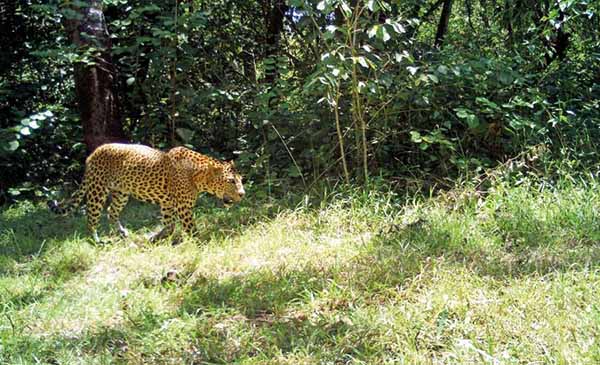
Source:Dailymirror
- Leopards use a wider range of habitats than any other species
- Leopard RAI is low in peripheral areas where human activity is less
- Prey availability in Gal Oya is lower than in other National Parks

Ongoing long-term work by the Wilderness & Wildlife Conservation Trust (WWCT), under the purview of the Department of Wildlife Conservation, is revealing important information about the leopard population in Sri Lanka. Although the overall estimated leopard population in Sri Lanka has remained stable (Kittle & Watson 2019 IUCN Red List) human-induced leopard deaths in specific regions is on the rise.
“Understanding how leopards utilise Protected Areas (PA’s), buffer areas, as well as unprotected edge habitats and mixed landscapes is paramount to ensuring that Sri Lanka continues to have leopards on the island, not just in isolated populations hemmed in within PA’s but across its current distribution. It is vital therefore that buffer areas adjacent to our National Parks and other PA’s be better secured and that other unprotected landscapes where leopards reside be afforded further forms of on-ground protection. This can be achieved in many ways and by multiple partners,” stated Dr. Andrew Kittle and Anjali Watson founding trustees of the WWCT’s Leopard Project.
Immediate need for conservation
According to Dr. Kittle one of the methods in conserving the Sri Lankan leopard is by identifying it as an umbrella species. “Charismatic species such as the panda and tiger have been referred to as ‘flagship’ species. This means that these iconic species garner attention for wider conservation. The leopard is also such a species and furthermore, may also be a keystone species (a species that plays an essential role in the structure, functioning or productivity of a habitat or ecosystem at a defined level). Therefore, its effect on the ecosystem is much more than its numbers. But the leopard as an ‘umbrella’ species for conservation here in Sri Lanka is potentially even more useful as it is the only terrestrial apex predator and is found throughout the island’s habitats. The umbrella concept suggests that targeted protection of a single, wide-ranging species could effectively act to protect a wide range of smaller, more spatially restricted biodiversity that also utilize the same areas – therefore falling under the wide-ranging species ecological “umbrella”. Understanding the leopards range use across the landscape and targeting conservation via this could therefore be an efficient and effective approach that could work for biodiversity conservation”, he said
Out of the 37 wild cat species, leopards use a wider range of habitats than any other species which makes them a very useful umbrella species and previous research by Oxford University shows that they are the most effective such species for the wider conservation of other wild cats.
Previous research by Kittle and Watson has shown that habitat suitability for leopards is higher in better protected landscapes (Kittle et al 2017). “Therefore there is a need to look at better protection being afforded for unprotected mixed landscapes. These patch forests play an important role and are essential for the continuation of leopards on this island”, said Dr. Kittle.
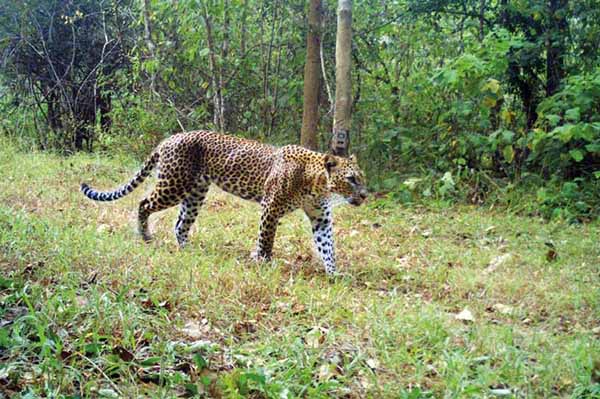
Leopard Survey in the Gal Oya Complex –
Back in 2017, WWCT commenced a dedicated survey within the Gal Oya / Nilgala complex which constitutes the Gal Oya National Park, Namal Oya Sanctuary and Nilgala Sanctuary and other mixed wilderness areas. Although difficult and limited access posed challenges to their efforts, they were able to utilize a standardised remote camera framework study to document leopards and other mammalian species living in the area. The Gal Oya National Park was created to preserve the watershed of the Senanayake Samudraya in the 1950s. “This shows that even during that time there had been an understanding of the importance of water and the watershed forests that allowed for the creation and continuation of such reservoirs. It is a large area with multiple habitats and entry points from different districts and access for patrolling and monitoring is difficult. The duo observe that the different habitat types within the Park make for an interesting comparative study on how wildlife are using these varied areas with varied levels of protection.
“If you take Mullegama, it is an area that’s not accessible to the public. It includes monsoonal forests interspersed with tall forests (similarly to Yala Block 3 and Wilpattu) and is the only place in Sri Lanka that has savannah type grasslands. Another area is Nilgala which is accessible to the public and it also has savannah grasslands but is ringed by small forest villages. It includes lands belonging to the Forest Department and it is essential that this complex be monitored as one, as wildlife does not know man-made borders. Then there is the Namal Oya Reserve which is on the northern edge of Gal Oya NP and in proximity to Mullegama. Here we find that leopards are less frequent, though still present, confirming that although these peripheral lands are of importance it is the deeper better protected forests that give a more secure refuge to the leopard population here” said Dr. Kittle.
In order to conduct this study Watson and Kittle have set dozens of remote cameras to collect images from over 4800 remote camera days across the landscape and have obtained over 200 leopard images. “These were divided between areas and we were able to estimate the Relative Abundance Index (RAI)–the number of times leopards get photo-captured at a particular location over the course of 100 days. By comparing RAI measures between regions we are able to better understand leopard distribution in this landscape. For example we found that leopard RAI was low in peripheral areas which many people use, and was considerably higher in interior areas where human use is lower. In addition, these central areas have more prey available, apart from cattle which use the peripheral areas. This suggests that leopards are avoiding people. We have done similar kinds of studies in other landscapes and there’s a lower relative abundance in Gal Oya when compared to other National Parks (e.g. Yala, Wilpattu and Horton Plains) with RAI values similar to those in unprotected landscapes in the Central Highlands.” said Dr. Kittle.
Dr. Kittle further observed that this could be due to the type of forest. “Prey availability in Gal Oya, as determined from the remote cameras, is lower than the aforementioned National Parks which may be due to the forest type, with fewer open grazing areas for deer herds to congregate. Leopard abundance is strongly related to prey availability so the number of leopards here is correspondingly lower. Poaching in this area could also play a role, but the forest structure is most likely the main influence” he added.
He further said that there were several male leopards detected although only one was detected in more than one section of the NP, being photo-captured in both Mullegama and Namal Oya. “Apart from the leopard, the fishing cat, jungle cat and the rusty spotted cat were also found within this complex. Although no cubs were as yet documented, there was repeated visual evidence that adult females were nursing which clearly indicated cub presence. The study will now focus on the south-eastern side of this complex so as to include all areas as much as possible within the study” Watson said.
By observing activity times of the leopard across their study habitats they have also been able to educate people on avoiding the leopard. “Understanding activity times and how they change across regions helps in human-leopard coexistence. For example, in the unprotected Central Highlands we have observed almost zero activity during day time with a sharp spike in activity just after nightfall. Leopards don’t move around during daytime because there are more people in this landscape. In Gal Oya the pattern is more similar to Wilpattu, with nocturnal activity higher but some daytime activity also observed.” said Watson.
Having varied partners to support this kind of long-term research is essential for conservation here in Sri Lanka. The Gal Oya Survey is being partnered by Olu Tropical waters as they realize the importance of ensuring the continued protection of watershed forests such as the Gal Oya complex. The Gal Oya Lodge provides much needed logistical support for this WWCT project.