When Batting Was Poetry: Remembering David Gower- By Sanjeewa Jayaweera
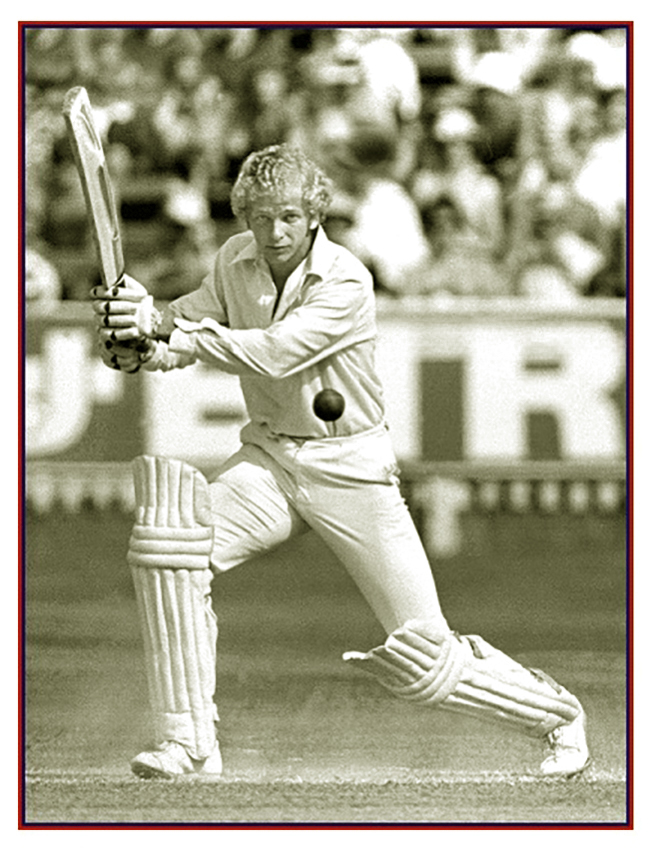
Source:Island
For many Sri Lankans growing up in the late nineteen fifties and early sixties, our cricketing heroes were Englishmen. I am not entirely sure why that was. Perhaps it was a colonial hangover, or perhaps it reflected the way cricket was taught locally, with an emphasis on technical correctness, a high left elbow, and the bat close to the pad. English cricket, with its traditions and orthodoxy, became the benchmark.
I, on the other hand, could not see beyond Sir Garfield Sobers and the West Indian team. Sir Garfield remains my all-time hero, although only by a whisker ahead of Muttiah Muralitharan. For me, Caribbean flair and attacking cricket were infinitely superior to the Englishmen’s conservatism and defensive approach.
That said, England has produced many outstanding cricketers, with David Gower and Ian Botham being my favourites. Players such as Colin Cowdrey, Tom Graveney, Mike Denness, Tony Lewis, Mike Brealey, Alan Knott, Derek Underwood, Tony Greig, and David Gower were great ambassadors for England, particularly when touring the South Asian subcontinent, which posed certain challenges for touring sides until about three decades ago. Their calm and dignified conduct when touring is a contrast to the behaviour of the current lot.
I am no longer an avid cricket viewer, largely because my blood pressure tends to rise when I watch our Sri Lankan players. Therefore, I was pleasantly surprised recently when I was flipping through the TV channels to hear David Gower’s familiar voice commentating. It brought back fond memories of watching him bat during my time in the UK. I used to look forward to the summer for two reasons. To feel the sun on my back and watch David Gower bat!
A debut that announced a star
One of my most vivid cricketing memories is watching, in 1978, a young English batsman pull the very first ball he faced in Test cricket to the boundary. Most debutants play cautiously, trying to avoid the dreaded zero, but Gower nonchalantly swivelled and pulled a short ball from Pakistan’s Liaquat Ali for four. It was immediately apparent that a special talent had arrived.
To place that moment in perspective, Marvan Atapattu—an excellent Sri Lankan batsman—took three Tests and four innings to score his first run, yet later compiled 16 Test centuries.
Gower went on to score 56 in his first innings and captivated spectators with his full repertoire of strokes, particularly his exquisite cover drive. It is often said that a left-hander’s cover drive is one of the most pleasurable sights in cricket, and watching Sobers, Gower, or Brian Lara execute the cover drive made the entrance ticket worthwhile.
A young talent in a time of change
Gower made his Test debut at just 21, rare for an English player of that era. World cricket was in turmoil due to the Kerry Packer revolution, and England had lost senior players such as Tony Greig, Alan Knott, and Derek Underwood. Selectors were searching for young talent, and Gower’s inclusion injected fresh impetus.
Gower scored his first Test century in only his fourth match, just a month after his debut, against New Zealand, and a few months later scored his maiden Ashes century at Perth.
He finished with 18 Test centuries from 117 matches. His finest test innings, in my view, was the magnificent 154 not out at Kingston in 1981 against Holding, Marshall, Croft, and Garner. Batting for nearly eight hours and facing 403 balls, he set aside flair for determination to save the Test.
He and Ian Botham also benefited from playing their initial years under Mike Brealey, an average batsman but an outstanding leader. Rodney Hogg, the Australian fast bowler, famously said Brealey had a ‘degree in people’, and both young stars flourished under his guidance.
Captaincy and criticism and overall record
Few English batsmen delighted and frustrated spectators and analysts as much as Gower. The languid cover drive, so elegant and so pleasurable to the spectators, also resulted in a fair number of dismissals that, at times, gave the impression of carelessness to both spectators and journalists.
Despite his approach, which at times appeared casual, he was appointed as captain of the English team in 1983 and served for three years before being removed in 1986. He was again appointed captain in 1989 for the Ashes series. He led England in 1985 to a famous Ashes series win as well as a series win in India in1984-85.
In the eyes of some, the captaincy might not have been the best suited to his style of play. However, he scored 732 runs whilst captaining the team during the 1985 Ashes series, proving that he was able handle the pressure.
Under Gower, England lost two consecutive series to the great West Indian teams 5-0, which led to the coining of the phrase “Blackwashed”! He was somewhat unlucky that he captained the English team when the West Indies were at the peak, possessing a fearsome array of fast bowlers.
David Gower scored 3,269 test runs against Australia in 42 test matches. He scored nine centuries and 12 fifties, averaging nearly 45 runs per inning. His record against Australia as an English batsman is only second to Sir Jack Hobbs. Scoring runs against Australia has been a yardstick in determining how good a batsman is. Therefore, his record against Australia can easily rebut the critics who said that he was too casual. He scored 8,231 runs in 117 test matches and 3,170 runs in 114 One Day Internationals.
A gentleman of the game free of controversies
Unlike the other great English cricketer at the time, Ian Botham, David was not involved in any controversies during his illustrious career. The only incident that generated negative press was a low-level flight he undertook in a vintage Tiger Moth biplane in Queensland during the 1990-91 Ashes tour of Australia. The team management and the English press, as usual, made a mountain out of a molehill. David retired from international cricket in 1992.
In 1984, during the tour of India, due to the uncertain security situation after the assassination of the then Indian Prime Minister Indira Gandhi, the English team travelled to Sri Lanka for a couple of matches. I was fortunate enough to get David to sign his book “With Time to Spare”. This was soon after he returned to the pavilion after being dismissed. There was no refusal or rudeness when I requested his signature.
He was polite and obliged despite still being in pads. Although I did not know David Gower, his willingness that day to oblige a spectator exemplified the man’s true character. A gentleman who played the game as it should be, and a great ambassador of England and world cricket. He was inducted into the ICC Cricket Hall of Fame in 2009 and appointed an Officer of the Order of the British Empire (OBE) in 1992 for his services to sport.