The mammoth task to rebuild a nation. How Sri Lanka can rise from the debris – By Aubrey Joachim

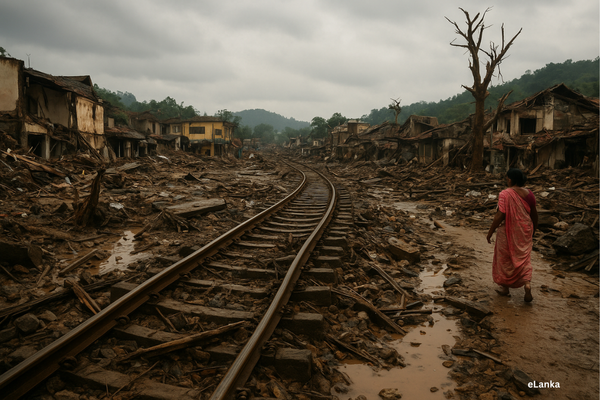
The waters are receding and leaving behind the utter destruction that has been caused across most of Sri Lanka. Altered landscapes, lives shattered, a nation in shock and its infrastructure in ruin. It is thought that cyclone Ditwah and its fury has caused 10 times the damage inflicted by the 2004 Indian Ocean tsunami. Initial estimates by the Disaster Management Centre (DMC) indicates a reconstruction bill of between 6 and 7 Billon USD which is approximately 3 to 5% of GDP. A significant statistic by any measure. In addition, the impact of the loss of productivity and the cost of imports of essential food items resulting from the loss of agricultural crops, meat, poultry etc. must also be taken into account.
While the above aspects as well as the intangible impact on the psyche of the nation is hurting, it has not prevented political bastardry to cease the opportunity of placing blame on the government and its leadership for the event and immediate aftermath. At a time when one would have expected the whole nation – down to every man woman and child – to come together to lift the country out of its predicament, opposition politicians who themselves failed miserably in the past in similar circumstances, pilfered billions of dollars out of the country’s coffers and even monetised past disasters to their own benefit are now seeking to divide the nation. While such accusations are fundamentally flawed, their ‘illusionary’ suggestions in respect of how the disaster should have been managed would have placed Sri Lanka far ahead of any nation on earth that faced a similar calamity even in the most developed world. Those making such claims should be ashamed of themselves and demonstrate their utter incompetence in any leadership role.
However, they have every right to hold the government accountable as to how the recovery and rebuild is managed after the immediate search and rescue phase has ended. President Dissanayake and his government need to carefully plan the next phase which will definitely exceed their current term in office. This they have to do while concurrently focusing on managing the ‘business as usual’ tasks of economic management. In effect their governing and management tasks have been doubled. The country needs its best and brightest at this juncture – irrespective of political affiliation and within the country or further afield. This is a moment which should bring out what Sri Lankans are capable of.
Much has been written and discussed about what should have been done and what should not. This is not the time place or forum for such debate. Of course a sequential, scientific and logical analysis of the disaster and operational actions must be undertaken to learn from and build algorithmic risk management models for the future. It should not be a blame game but an intelligent learning exercise bringing together the experts in the country and even beyond. It should also consider what could have been done better in the past to have mitigated some of the impacts of the event. Such insights should influence the reconstruction.
The focus now has to be on the way forward from here. This needs thoughtful consideration given the inter-related factors. The initial phase following a disaster of such magnitude must be the welfare and well-being of the citizens – not only those directly in the path of the torrents of water that gushed down the mountains but those further downstream in the flood plains far below. The concentration of the volumes of the falling rain, the island’s topography and its overburdened river systems resulted in over 1.4 million persons being directly impacted in all 25 districts of the island. The government’s and the various aid agencies initial focus was to attend to immediate tasks of caring for the human needs. But in so doing much temporary work has to be undertaken. Road access for transport of urgent supplies, and movement of people – essentially the injured, communication lines, electricity supply, water and sanitation facilities and disease prevention are foremost. Of course such emergency ‘patchwork’ cannot be long-term. Permanent fixes should be put in place in the scheme of the wider reconstruction phase.
The emergency services kicked in and with the assistance of teams from neighbouring countries as well as local agencies, businesses and citizen groups, those affected are being rescued and provided assistance to tide over the initial aftermath. Of course there will need to be plans and programs to help rebuild broken lives. This could be years of coordinated work programs.
The next phase will need to address the much bigger issue of the destruction of the country’s infrastructure assets which impact every aspect of the nation. Early assessments have identified significant damage to the road and rail network a mandatory requirement for the country to function. Hundreds of road and rail bridges and hundreds of kilometres of roads are badly damaged. Less than a third of the 1,600 kilometres of rail track are operational. Some sections are badly damaged and will need major repair, replacement or re-routing. In addition, damage to the electricity grid including substations is severe. Similarly, water and waste water facilities will need repair although they have been temporarily brought back online to provide essential service. Hundreds of dams, tanks and irrigation systems are damaged or destroyed. These are essential infrastructure in an agricultural economy. In addition thousands of houses schools, public buildings etc. have also been destroyed or damaged. Only detailed and rigorous assessments will provide a true scale of what needs to be done and the cost of such. It is understood that the government is requesting the World Bank to assist with the work of damage assessment.
Next comes the prioritisation of the rebuild, although most would rank in equal order of importance. Sound economic cost-benefit analyses need to be carried out to optimise cash flows and resource management while identifying correlation to the country’s economic progress. Such a volume of concurrent capital infrastructure rebuild would never have been undertaken in Sri Lanka or for that matter in many other places on earth. It boggles the mind. There could be thousands of individual engineering projects all of which demand resources – construction material, equipment and qualified labour. Even if the massive dollar bill for the rebuild can be sourced through aid funding, borrowing or contributions the biggest challenge is in sourcing the capability to pull off the job in a reasonable timeframe. Hundreds if not thousands of project managers, planners, engineers, technicians, surveyors, trades-persons, equipment operators, quantity surveyors, procurement officers, project accountants contract managers and even data analysts and data entry staff will be required. Such a cohort would never have been assembled in the past. Literally the whole country is a worksite!
While Sri Lanka would have produced many such skilled personnel unfortunately most of them have left her shores and would be gainfully employed across the globe. It is unlikely that they will leave their employment and heed mother Lanka’s call at this point. However, there will be a substantial pool of retired or part-employed skilled Sri Lankan diaspora whose services can be called upon at this hour of need. There would be many expatriate Sri Lankans with experience in managing and working on major huge infrastructure projects in their countries of domicile – Australia, USA, UK, New Zealand, Middle East etc. and who might be willing to give back to the very country that provided them with the free education and the subsequent opportunities in foreign lands. This is certainly a suggestion that President Dissanayake and his team should really consider. While the government is essentially appealing to the Lankan diaspora to contribute financially, it may be a greater value proposition to appeal for their talents, brains and competencies in this hour of need. Such contributions will far exceed the financial value. In fact, some of the work scope could even be performed remotely utilising digital technology in order to save costs. This is the time to think outside the box. Let not the government’s ineptitude be demonstrated by not considering these options. What needs to be done as a matter of urgency is to put out a global appeal for such talent and resources through Sri Lanka’s missions overseas. Of course Lankans themselves must be humble enough to accept such expatriate services while recognising their own shortcomings.
The most important role of the government is to ensure that every dollar is put to good use and not a single instance of graft and corruption is allowed to occur during this massive rebuild of the nation.
Every cloud has a silver lining. Out of every adversity an opportunity arises. So from a positive mindset one could see this as an opportunity to rebuild an even better country than before. It may take a decade or more but the outcome would be for the better. For example, the upcountry railway is a British era legacy over a century old and with large sections of it now in tatters it is an opportunity to modernise this essential piece of infrastructure. Same with the hill country roads that also date back to British times. Advanced technology and construction methods are available. Chinese knowhow will particularly be of value here. Similarly, many dams and tanks could be re-engineered for more effective and disaster proof water capture by lifting dam walls and building spillways which would mitigate downstream risks in case of a future catastrophic rain event while also increasing capacity which would provide further economic benefits. River capacities can be increased and bunds rebuilt to modern standards. Modern day technology and construction methods could be brought into play.
It is often when tragedy strikes that one wonders what could have been done better to have mitigated the destructive aftermath. This is the opportunity to do so with the future in mind. Robust asset planning and asset management systems incorporating maintenance and risk management models must form an integral part of the rebuild.
Sri Lanka has gone through a series of unforeseen and unprecedented events in the recent past – the Easter Sunday bombings, the COVID pandemic, the 2022 collapse of the economy, the aragalaya and the ousting of a President and of course the complete change in political leadership. It would seem like mother nature’s recent unprecedented rainfall was the washing away of all that has been bad for the country. Let this event lead to a new clean Sri Lanka and it will surely emerge much stronger and better as a nation.
The author – former Global President of CIMA is an Australian citizen of Sri Lankan descent and closely follows the happenings in his motherland.