Scientific Exploration Beyond Earth: NASA’s Missions and Innovations – By Bhanuka – eLanka
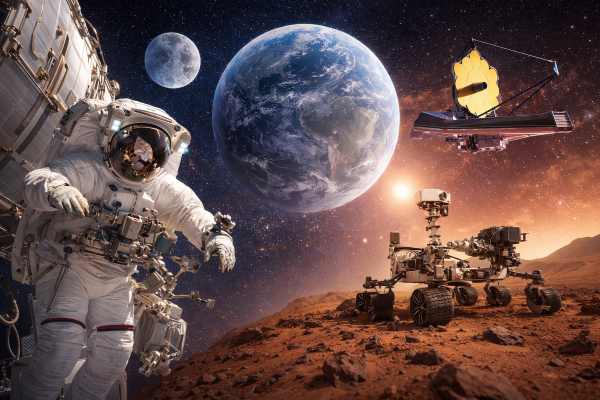
Scientific exploration beyond Earth has become one of the most fascinating and transformative areas of human achievement. At the forefront of this exploration stands NASA, the National Aeronautics and Space Administration, which has played a pivotal role in advancing our understanding of space, technology, and the universe. Through decades of innovation and discovery, NASA has not only expanded the boundaries of science but has also inspired generations to look beyond our planet.
The Vision Behind Space Exploration
The idea of exploring beyond Earth is driven by humanity’s natural curiosity about the universe. NASA’s mission is rooted in answering fundamental scientific questions: How did the universe begin? Is there life beyond Earth? What lies beyond our solar system? By addressing these questions, NASA contributes to a deeper understanding of existence itself.
Since its establishment in 1958, NASA has been committed to peaceful exploration and scientific discovery. Its programs combine cutting-edge research, engineering excellence, and international collaboration to explore space in ways once thought impossible.
NASA’s Landmark Missions
NASA’s journey in space exploration is marked by a series of groundbreaking missions that have shaped modern science.
Apollo Missions – Reaching the Moon
One of NASA’s earliest and most iconic achievements was the Apollo program. In 1969, Apollo 11 successfully landed humans on the Moon, marking a historic milestone. This mission not only demonstrated technological superiority but also provided valuable scientific data about the Moon’s surface and composition.
Mars Exploration – Searching for Life
NASA’s exploration of Mars has been a major focus in recent decades. Rovers such as Curiosity and Perseverance have been sent to study the Martian environment. These missions aim to determine whether life ever existed on Mars and to prepare for future human exploration.
Hubble Space Telescope – Expanding Cosmic Knowledge
Launched in 1990, the Hubble Space Telescope has revolutionized astronomy. It has captured detailed images of distant galaxies, nebulae, and stars, helping scientists understand the expansion of the universe and the nature of dark matter.
James Webb Space Telescope – The Next Generation
The James Webb Space Telescope represents the future of space observation. With advanced infrared technology, it allows scientists to observe the earliest galaxies formed after the Big Bang, providing insights into the origins of the universe.
Technological Innovations by NASA
NASA’s success in space exploration is driven by its commitment to innovation. The agency develops advanced technologies that not only support space missions but also benefit life on Earth.
Some notable innovations include:
- Advanced robotics used in space missions
- Satellite systems for communication and navigation
- Climate monitoring technologies
- Medical advancements derived from space research
These technologies demonstrate how space exploration contributes to everyday life, from GPS navigation to weather forecasting.
Human Spaceflight and the International Space Station
NASA has also made significant progress in human spaceflight. Astronauts have lived and worked aboard the International Space Station (ISS), conducting experiments in a microgravity environment. The ISS serves as a laboratory for scientific research, allowing scientists to study the effects of space on the human body and test new technologies.
Human spaceflight programs have laid the foundation for future missions to the Moon and Mars, bringing humanity closer to becoming a multi-planetary species.
Earth Science and Environmental Monitoring
While NASA is known for space exploration, it also plays a crucial role in studying Earth. Using satellites, NASA monitors climate change, natural disasters, and environmental conditions. This data helps scientists understand global warming, predict weather patterns, and respond to emergencies.
NASA’s Earth science programs highlight the importance of protecting our planet while exploring others.
The Future of Space Exploration
NASA’s vision for the future is ambitious and inspiring. The Artemis program aims to return humans to the Moon and establish a sustainable presence there. This mission will serve as a stepping stone for future exploration of Mars.
In addition, NASA continues to collaborate with private companies such as SpaceX and international space agencies to accelerate advancements in space technology. These partnerships are shaping a new era of exploration where space travel may become more accessible.
Why NASA Matters to Humanity
NASA’s contributions go beyond scientific discovery. It inspires innovation, education, and global collaboration. By pushing the boundaries of what is possible, NASA encourages young minds to pursue careers in science, technology, engineering, and mathematics.
Moreover, NASA’s work fosters a sense of unity among nations, as space exploration is a shared human endeavor that transcends borders.
Conclusion
Scientific exploration beyond Earth represents one of humanity’s greatest achievements, and NASA continues to lead this journey with determination and innovation. From landing on the Moon to exploring distant galaxies, NASA’s missions have transformed our understanding of the universe and our place within it.
As we look to the future, NASA’s ongoing efforts promise even greater discoveries. With each mission, humanity moves one step closer to unlocking the mysteries of the cosmos and expanding the horizons of scientific knowledge.