Colombo Port becoming most efficient in South Asia – By Maya Majueran
Source:ft.lk
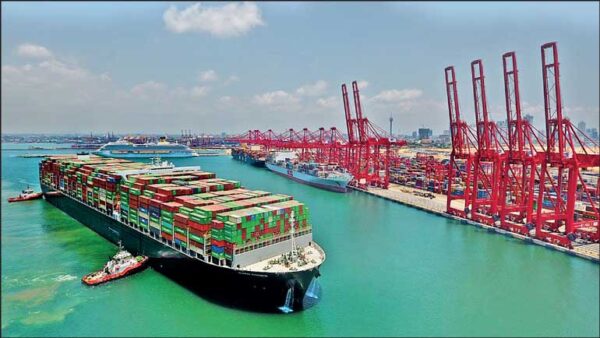
The trend of using larger container vessels has become obvious as shipping companies believe that the voyage cost per twenty-foot equivalent unit (TEU) would be reduced by increasing the capacity of vessels. This may limit the maritime access of mega-ships to all the ports due to draft restrictions and an increase in port facilities and equipment, because of that larger container ships normally call at fewer ports. As ship sizes increase then it makes fewer port calls but larger box exchanges.
 However, mega-ships can only be profitable when fully utilised, without too many port calls. Therefore, ports may lose direct calls for trade lanes where it has limited amounts of cargo unless that port has transshipment cargo.
Sri Lanka’s Colombo port is strategically located on the East-West main sea route as a major transshipment hub in the Indian Ocean. Colombo port, whose market is dominated by transshipment with 80% of throughput coming from transshipment, is the 2nd largest player in the region, with a throughput of more than 7.25 million TEUs in 2021. India, Bangladesh, and East African countries account for approximately 70% of the port’s volume.
As Sri Lanka gets most of its business from India, overreliance on Indian transshipment will harm Sri Lanka if India develops its harbours. Currently, the Indian government, through its Sagarmala initiative, is building six new major ports, including Colachel at the southern tip of Tamilnadu state and Vizhinijam, a short distance north in the state of Kerala, in what appears to be an effort to reduce reliance on Colombo.
Colombo port has strategic geographical advantages where global and navigational contexts were concerned, compared with many other South Asian nations when it comes to connectivity. However, Sri Lanka’s strategic position alone will not support Colombo port to being a shipping hub in the Indian Ocean. Likewise, the sizes of container ships calling at Colombo port are also not determined solely by the capability of the ports to accept ships, but also by the availability of efficient terminals and supporting soft infrastructure.
Therefore, Colombo port needs to improve the productivity and service levels of its port operation to continue to improve its competitiveness. The operational skill, clout, capital and commercial relationships with shippers are paramount important to attracting significant traffic to Colombo port. As container trade around South Asia and the Bay of Bengal is almost exclusively based on the feeding of containers to large container ships at hub ports such as Dubai, Colombo, Port Klang, and Singapore, Colombo port needs to compete endlessly with these ports, if it wanted to develop the transshipment market share beyond the regional boundaries.
In August 2011, Sri Lanka Ports Authority (SLPA) entered a Build-Operate-Transfer (BOT) agreement with China Merchants Port Holdings Company Ltd. (CMPH), a listed flagship company of China Merchants Group for the design, construction, and management of the Colombo South Terminal. Under a 35-year BOT Agreement, the joint venture company Colombo International Container Terminals Ltd. (CICT) constructed Colombo’s third container terminal with a 3 million twenty-foot equivalent units (TEUs) capacity in the Colombo port, under the Colombo South Harbour expansion project. CMPH holds 85% of the partnership whilst the balance of 15% is being held by SLPA.
CICT is the first and only deep-water terminal in South Asia capable of handling the largest vessels afloat. The terminal comprises a total quay length of 1,200 m and a depot land area of 58 hectares, with a water depth of 18 m. The terminal’s deep-water capacity, enables the facility to handle vessels with more than 22,000 TEUs capacity.
Since its inception in 2014, the terminal has incrementally grown the volume it has handled; from 686,639 TEUs in 2014 to 1.56 million TEUs in 2015, 2 million TEUs in 2016, 2.38 million TEUs in 2017, 2.67 million TEUs in 2018, 2.9 million TEUs in 2019 and 2.89 million TEUs in 2020. December 2021 marks the 10th anniversary of CICT in Sri Lanka and celebrated its milestone of reaching 3 million TEUs within a year for the first time. CICT has also continued its winning streak on the global stage by winning the award for the ‘Best Container Terminal in Asia’ in the Under four million TEUs category for a record fifth consecutive year since 2017. CICT is guided mainly by the global standards and procedures of CMPH, which operates more than 50 ports and terminals all over the world.
Furthermore, CICT is the first Greenfield project of China Merchant Port Holdings and has led the way in promoting eco-friendly operations and innovations in service. One of the key projects completed was the conversion of all diesel-operated Rubber Tyre Gantry Cranes (RTGs) to electricity-driven rubber-tired gantry cranes (E-RTGs) which have zero carbon emissions by 2017. This resulted in an overall 45% reduction in carbon dioxide emissions and a 96% reduction in diesel consumption.
CICT has been a significant contributor to the Colombo port’s throughput by attracting vessels that would otherwise have bypassed Colombo because of the absence of a deep-water terminal. Moreover, the ability to access the CMPH global network is also a key factor in gaining and attracting new transshipment volumes to the Colombo port.
Recently, the Port of Colombo has been ranked as the most efficient port in South Asia and the Indian Sub-Continent, third in the Indian Ocean rim and 22nd among 370 ports globally, in the second edition of the Global Container Port Performance Index (CPPI) 2021, ranking developed by the World Bank and S&P Global Market Intelligence and Financial Services.
CICT Chief Executive Officer Jack Huang commented on the CPPI ranking: “As the first and currently only deep-water terminal in South Asia capable of handling the largest container ships in service, we are extremely pleased to have played a major role in achieving this ranking by the Port of Colombo.”
This is evidenced by the fact that Sri Lanka’s partnership with a global maritime player like China is the most practical way to fulfil its plans to boost maritime development and connectivity because China possesses some competencies that would bring advantages in the areas of market power, marketing skills, technological expertise, and access to cheaper sources of finance. CICT is one of the Belt and Road Initiative (BRI) projects that has contributed positively to Sri Lanka’s economy, which has allowed the Colombo port to grow at a rapid pace.