Anuradhapura: The City of Anuradha (Part I) – By Ama H. Vanniarachchy

Source : ceylontoday.lk
“When he was thus left victor in battle, Pandukabhaya went thence to the dwelling-place of his great-uncle Anuradha. The great-uncle handed over his palace to him and built himself a dwelling elsewhere; but he dwelt in his house. When he had inquired of a soothsayer who was versed in the knowledge of (fitting) sites, he founded the capital, even near that village. Since it had served as dwelling to two Anuradhas, it was called Anuradhapura, and also because it was founded under the constellation Anuradha.”
—Mahavamsa, Chapter 10
According to the Pali and Sinhalese chronicles in Sri Lanka, Anuradhapura, the longest-lasting capital city of Sri Lanka was first established as the capital city of Sri Lanka by King Pandukabhaya (474 – 367 BCE) in the 5th/4th century BCE. The chronicles further say that the city was established as a village or a humble human settlement by Prince Anuradha, a minister of King Vijaya, and then later by Prince Anuradha, brother of Queen Bhaddakachchana. Thus, the city was named Anuradhapura, meaning the City of Anuradha.
Accordingly, two Indo – Aryan princes of the same name – Anuradha – are the founders of this marvellous city that withstood the test of time for more than 15 centuries as the centre of a once great civilisation.
Studying the history of the world, it could be possible to believe that no city in the world was the capital city for such a long period, making Anuradhapura perhaps the longest-lasting capital city of the world. Considering the religious, cultural, social, historical, archaeological, and many other values of this city, the Sacred City of Anuradhapura was made a World Heritage City in 1982 by United Nations Educational, Scientific and Cultural Organisation (UNESCO).
Anuradhapura is no doubt the most sacred and beloved city of the Sinhalese. It is the city that bears the legacy of the ancient Sinhalese, which is also considered the hub of Theravada Buddhism and the Sinhala-Buddhist civilisation and culture that was founded at Anuradhapura. It is not just a city but a testimony to the past glory of a nation that stood unshaken through time, strong as a phoenix, coming to life again and again, through fire and ashes.
Anuradhapura is probably the pride of the Sinhalese, a city that showcases the culture, identity, arts and architecture, religion, science and technology, and so on, of the ancestors of Sri Lankans.
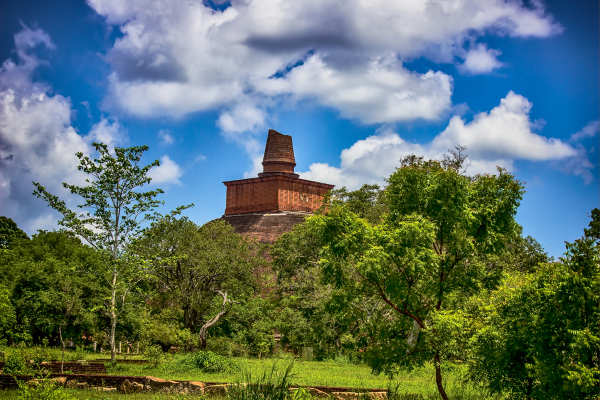
Anuradhapura is home to a large number of ancient Buddhist monasteries including some of the world’s largest brick stupas. Also, the world’s oldest historical tree – the sacred Bodhi tree – is also planted at the historical Mahamegha Gardens in Anuradhapura.
The city’s richness attracts invaders
The glory and marvel of Anuradhapura were so great that it was subjected to the jealousy and envy of many neighbouring kingdoms, especially of the Cholas, who raided the city a few times. South Indian kingdoms such as the Pandyans and Cholas invaded and raided the wealth of the city a couple of times. However, just as a phoenix would come to life through its ashes, Anuradhapura would come back to life, amidst chaos and shine again; thus proving to be a marvel of a city.
The Cholas surrounded the glorious city of Anuradhapura, looted it as much as they could, and set it on fire. The once elegant, graceful city was ablaze. The fire continued for days and days and finally, the magnificent city that stood in pride for more than a thousand years as the capital of the Sinhalese was all covered in black soot, ashes, and smoke.
After the invasion of the Cholas in 993 CE Anuradhapura never returned to its glory days as the capital city of the island. The Cholas looted the city and all its riches, and destroyed sky-hugging buildings including great Buddhist monasteries and stupas. The city’s irrigation and agro lands were abandoned. In no time, the city was abandoned by its inhabitants.
For the next 77 years, we do not have clear records of what happened to the once graceful and magnificent city over the seven long decades. However, we know that the city continued to be used by the Cholas as a fortress and this is why King Vijayabahu attacked the city and took it under his control in 1070 CE. Also, we can assume that the city was not a ghost city as the Cholas kept it as an active city and King Vijayabahu held his coronation ceremony in Anuradhapura.
Although Anuradhapura continued to grow as a major urban centre of the island, it never became the capital city again. Polonnaruwa, which was also known as Pulasthipura or Vijayarajapura, was the capital city of the island after Anuradhapura. After King Vijayabahu the Great saved Lanka from the Cholas and established the Sinhala rule once again in Sri Lanka, he held his coronation ceremony in Anuradhapura, honouring it as the city of his ancestors. Yet, Polonnaruwa continued to be the new capital city of Sri Lanka, until the 13th century.
Probably, the longest-lasting capital city of the world
Calculating the years, we understand that the Rajarata Civilisation continued to flourish and grow until the 13th century CE, since the 5th century BCE. It has only been 800 years since the demise of the Rajarata Civilisation and approximately 1000 years since the fall of Anuradhapura as a capital city. This means that the reigning years of Anuradhapura as the capital of Sri Lanka are longer than the years it has been since its demise. Through this, we understand the significance of Anuradhapura and the Rajarata Civilisation as a whole to Sri Lanka.
The past 800 years have been extremely chaotic for Sri Lanka and a struggling period politically, financially, socially, and culturally due to the South Indian influences and the invasions of the European nations. Out of the 800 years, approximately 500 years Sri Lanka was struggling with the chaos created by the European nations in Sri Lanka. For the past 500 years, Sri Lanka has been struggling with its national and cultural identity, failing to establish who and what Sri Lanka is about.
The writer believes that to understand and answer the question, ‘Who are Sri Lankans and what the national and cultural identity of Sri Lanka is?’ we must return to our roots, which lie deep beneath the ancient capital of Anuradhapura in Rajarata (Land of the Kings).
Why the city was named Anuradhapura?
As we have mentioned above, the city was founded by Prince Anuradha, a minister of King Vijaya (543 – 505 BCE) (Dates may slightly vary). He was an Indo-Aryan prince who arrived in Thambapanni with Vijaya from Sinhapura in Gujarat or Bengal (Vijaya’s homeland is still unknown. It could be somewhere in Gujrat or Bengal).
The Mahavamsa (Chapter 7) says that Prince Anuradha, a minister of Vijaya, formed a village on the banks of Malwatu Oya (Kolom Oya), and named it Anuradhagrama, meaning the ‘Village of Anuradha’.
In Chapter 9, the Mahavamsa says that Prince Anuradha, one of the six brothers of Princess Bhaddakachchana, settled in Anuradhagrama and constructed a tank towards the south of the village and a palace for himself.
Anuradha’s name in the terracotta piece found in excavations
Apart from these two historical characters named Anuradha, there had been a third Anuradha, whose name is mentioned on a terracotta piece discovered at the Anuradhapura citadel or inner city excavations led by the former Director General of Archaeology, late Dr. Siran Deraniyagala.
This remarkable discovery dates back the history of Anuradhapura to a few more centuries beyond the 4th century BCE. This study also revealed that the city was an urban centre centuries before the arrival of Vijaya and his group. The city was inhabited by humans as a town since 900 – 600 BCE where pottery (Black and red ware), domestication of horses, and paddy cultivation were in use and the city was spread across 50 hectares.
Across these findings, scholars speculate that Anuradhapura was already an urban centre when the arrival of the Indo – Aryans occurred, thus making it one of the reasons that Prince Anuradha chose Anuradhapura as his home.
Later, King Pandukabhaya chose this fertile city as his capital, laying the foundations for a civilisation and culture that lasted for almost 2,500 years and is still alive. As the chronicles state, the King established the city under the Anuradha constellation (Anuradha Nakatha) which is considered a powerful and very auspicious sign, thus adding more meaning and value to the city’s name.
In this new article series we start from today; we shall explore the history and archaeology of the Sacred City of Anuradhapura, understanding its uniqueness as we walk among the ruins of a once glorious city that attracted thousands of travellers, merchants, monks, and students during its hay days. Anuradhapura is also home to a rich and complex irrigational system that sustained the nation through many battles and natural disasters.
In this series, we shall explore the many stages of development of Anuradhapura such as;
Citadel excavations (the first historical Anuradha)
Arrival of Vijaya – Anuradha, the Minister (the second Anuradha)
Anuradha, brother of Bhaddakachchana (the third Anuradha)
Pandukabhaya’s urban development plan (Anuradha-grama becomes Anuradhapura)
Mutasiva’s Mahamegha
Devanampiyatissa’s Buddhist city
Kings of Anuradhapura
Many invasions and warfare
Anuradhapura under the Cholas
Anuradhapura under the King Vijayabahu the Great
Anuradhapura under the kings of Polonnaruwa and Dambadeniya
Anuradhapura after the demise of the Rajarata Civilisation up to the 19th century
We will also explore the city’s built environment through the following sub-topics;
Anuradhapura, the city plan
Inner city
Outer city
Religious buildings
Royal palaces and other royal buildings
Other secular buildings such as hospitals, ponds, sanitary buildings, market places, and others
Art and architecture
Science and technology
Irrigation system
Literature
To be continued…
At eLanka, we respect the rights of creators. If we have used an image you own and you’d like it removed, please email us at info@elanka.com.au and we’ll handle it promptly.
Thanks.
eLanka team